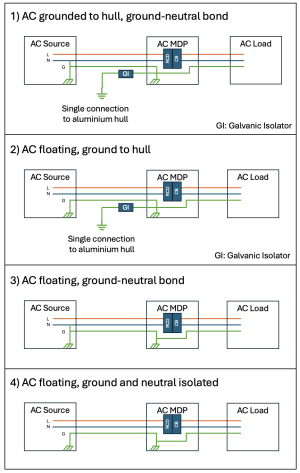
AC & DC ground

Is this still connected in a non-standard way Roger ?

Two possible fault scenarios:

1) A positive DC positive connection is made to the hull, risking greatly accelerated stray current erosion.

2) An AC positive connection is made to a point in the DC negative circuit, making everything in that circuit live.

No 1 is the main reason for the lack of DC connection to the hull

As I am the only one working on the electrics. A connection between AC positive and DC negative is very unlikely as both AC and DC circuits on in separate plastic conduit/ trucking so chafe and short between AC cables and DC cables very unlikely
 
With no connection between the Hull and DC will have no interconnection between the AC and DC. But with a short between the AC and the earth will cause the earth leakage to trip thus shutting of the mains AC supply

As I said the engine and prop shaft have no interconnection between DC at all, the only anodes I have is anodes welded to the steel hull so no DC connection

My propeller and prop shaft are all stainless steel, so no shaft anodes are needed unlike a bronze propeller and stainless steel.

The coupling to the engine is an isolated (rubber) coupling and no metal connection across the coupling

The earth leakage short to hull has been tested several times and also have mains reverse indicator that is checked every time commotion to shore power

“With no connection between the Hull and DC will have no interconnection between the AC and DC. But with a short between the AC and the earth will cause the earth leakage to trip thus shutting of the mains AC supply“

This doesn’t answer my question which was in essence, the same as the second point that PaulRainbow made in his comment. So will take your response to that.
 
No 1 is the main reason for the lack of DC connection to the hull

As I am the only one working on the electrics. A connection between AC positive and DC negative is very unlikely as both AC and DC circuits on in separate plastic conduit/ trucking so chafe and short between AC cables and DC cables very unlikely
So without an intentional low impedance bond between the DC neg bus and hull, should you get a DC insulation fault resulting in 12v or 24v pos connected to the hull, your DC circuit fuse won’t blow and the hull will remain at 12 or 24v pos until you somehow otherwise discover the fault!

Agree with your risk assessment that a fault between AC and DC maybe unlikely, but obviously not impossible! There are places where both systems come closely together - battery charger, inverter. Also need to consider direct contact, whether accidental or not.

Are you using a galvanic isolator or a residual current device for your earth leakage protection? (You mentioned a GI in an earlier response) Not too familiar with a GI being used to prevent electric shock from direct contact - does that provide the required tripping characteristics as an RCD would?
 
I have both an RCD that will shut off mains if there is a short between the hull and the mains line of neutral

The GI is to prevent and Galvanic leakage current eroding my hull anodes

The trip point of the RCS is such that the trip point is set to the requires for the reverse phase leakage

s you say the only possible is a leakage between the ac and DC positive, but this was very careful installed to prevent this happening
 
So without an intentional low impedance bond between the DC neg bus and hull, should you get a DC insulation fault resulting in 12v or 24v pos connected to the hull, your DC circuit fuse won’t blow and the hull will remain at 12 or 24v pos until you somehow otherwise discover the fault!

Agree with your risk assessment that a fault between AC and DC maybe unlikely, but obviously not impossible! There are places where both systems come closely together - battery charger, inverter. Also need to consider direct contact, whether accidental or not.
Those are why the connection is usually made. As you say, several appliances onboard with AC and DC inside. But according to Roger you don't even need to Earth the inverter case, or any other cases with dedicated Earth connections.
Are you using a galvanic isolator or a residual current device for your earth leakage protection? (You mentioned a GI in an earlier response) Not too familiar with a GI being used to prevent electric shock from direct contact - does that provide the required tripping characteristics as an RCD would?
A GI offers no electric shock protection at all. I'm pretty sure Roger has an RCD or equivalent.

When he spoke of his GI in another thread, a while back, it was incorrectly installed though, not sure if he changed it, hence my question in post #19
 
I have both an RCD that will shut off mains if there is a short between the hull and the mains line of neutral

The GI is to prevent and Galvanic leakage current eroding my hull anodes

The trip point of the RCS is such that the trip point is set to the requires for the reverse phase leakage

s you say the only possible is a leakage between the ac and DC positive, but this was very careful installed to prevent this happening
How did you isolated the internal components of all of your appliances that have AC and DC parts inside ? Things like chargers, inverters, generator, fridge etc ?

What do you perceive the problem with connecting DC negative to the hull would be ?
 
Top