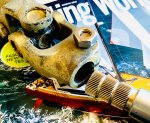
A question for precision machinists

Is it my imagination or is the hole not aligned with the centreline ? That may mean you have to drop down the bolt size and that will induce eccentric movement and slop, or go for a larger hole (as JM suggests) but this time exactly on the centreline, and then a larger 'bolt'

I don't like the idea of threaded bolt passing through the shoulders. Solid bar with threads on each end. Almost an interference fit so it needs to be drifted gently in with grease.
 
I don't fancy drilling at 90°, that removes quite a lot of metal from the shaft, reducing it's shear strength.
Go down a size in bolt, drilling if needed, then perhaps assemble with some thickened epoxy to stop movement.
Got a similar prob on a sloppy tiller bolt through the SS cheeks and the rudder stock. Since it is imperial, going up to the next metric size and making sure the plain shank goes all the way through.
 
I'm doubting that it's strong enough.
A single M8 bolt in shear at a fairly small shaft radius, what's the max torque that tiller will exert in a breeze and waves?

I wouldn't suggest reducing the bolt diameter without doing some design work.
 
The strength question is a good one.
How long is the tiller, 4' at least.
Can you snap an 8mm bolt with a 4' lever? Almost certainly.

Another question to keep Zoidberg awake at night:
Is there a bearing where the shaft goes up through the aft deck?
What will be resisting the loads when a heavy person is thrown across the tiller by a wave, and lands full upon it?

Can we narrow down what boat it is? I have definitely seen one, the design is unusual with the tiller poking through an aperture into the cockpit. Maybe it was the 1973 Boat Show: 'New for this year, the Yacht with a Slot!'
 
Last edited:
I'm doubting that it's strong enough.
A single M8 bolt in shear at a fairly small shaft radius, what's the max torque that tiller will exert in a breeze and waves?

I wouldn't suggest reducing the bolt diameter without doing some design work.
Double shear, but a good point at that diameter.
 
The bodge it and scarper solution is a stainless seloc pin. Available up to 8mm nominal diam. No metal removal will be required. If its tight get a bigger hammer. They are probably harder than a stainless threaded bolt to shear.
 
Not what you are asking, but replace that horrid threaded bolt with a shoulder bolt or a bespoke component. The threads will otherwise chew up the hole and will destroy the part in time, or the slop will wear away the bolt and it will fail. A key way as mentioned above would be a big improvement also.

Even better still something like this with a splined shaft as used on many vehicles (and Lewmar):

341D6499-4CEA-44F9-8AEE-A74CF914BD71.jpeg
 
The existing configuration with a through bolt is not a good practice as it results in very localised loading of the mating parts. It wouldn’t take much effort via the mechanical advantage of the tiller length to shear the bolt. In my experience too, machining two mating components independently to ensure that diametric holes align to an acceptable degree is attempting the impossible.
My suggestion for a solution is to first coat the interfaces of the two mating components with Loctite 603.Then assemble them in your desired orientation and leave overnight to cure. This will effectively lock the items together ensuring that they can be safely line machined.
The Loctite 603 is designed for such applications and would probably do the job on its own. However, additional mechanical joining would certainly be advisable. In this respect I would suggest drilling three or four circumferentially equi-spaced holes (7.1mm dia) radially through both the sleeve and shaft, EXCEPT, only pentrate the shaft by, say 5mm. Then using a bottom tap thread the holes 8mm. Finish by either screwing in lengths of 8mm stainless studding or, preferably using high tensile grub screws, again with some Loctite 603.
The foregoing would imho ensure more than adequate torsional strength by effectively distributing the shear forces and have little impact on the integrity of the existing shaft.
Hope this might be of some help.
Mike
 
Looking at the loads taken by socket set universals, I might have saved a bundle by using a 3/4 inch one and put a gaiter over the joint with some grease in to avoid corrosion.
 
I would ask exactly why the holes do not line up. is a question of radial mis alignment or is it longitudinal mis alignment? It may be that the male part is not entering the female part fully & altering the holes is not the solution
possibly filing the end of the male part if that is bottoming in the hole or filing the face of the female part if the shoulder is stopping the male part going right in. The slightly elongated hole in the male part suggests that some allowance has been made for this, but perhaps not enough.
In any event a tapered pin is nota good idea because at some time it will need to be removed & could work loose in the interim
If the OP bought it to me I would suggest
A machine screw is not the best option as the threads will allow wear on the faces of the thread peaks.I would bore the holes as an assembled component. Locktight to hold whilst working is a good idea. Alternatively superglue--It can be released with heat
I would turn a solid rod with threaded end & nuts each end. Both secured with locktight or nylock. If I had to enlarge the hole I would turn the rod from a larger section to give a tolerance fit to the holes allowing minimal play during use. Then the threads - fine metric- cut using a lathe, as it would be a hard metal
 
If I were starting from scratch I will admit that there are several contributions to this thread which are better than mine. However, I’ve tried to be pragmatic and that is why I made my suggestion. Firstly, the Loctite 603 was designed at its outset for this kind of challenge. Whilst it sets in the absence of air and it’s easy to wipe off any surplus after assembly, it always retains a degree of elasticity and resilience, unlike epoxies. Secondly the drilling and tapping of three or four holes around the assembly’s periphery does not demand access to precision machine tooling such as a jig-borer Or even a lathe. indeed, it could be accomplished in a pillar drill as their positioning is not hyper-critical. Just need to provide some alignment marks should there be a reason to disassemble the unit in the future.
Mike
 
I'm more than a little grateful for the guidance above. There's no intention of USING the machine screws illustrated, which are positioned for convenience. The idea was to source some more suitable shoulder bolts in a high-grade steel, but it may be that 'sellock pins' plus Loctite 603 will prove much better. Let me see what I can clarify....

Here's a pic of the problem - a Cutlass 27, the reason why I'm doing this....

51109690506_6cfdfd3e3c_z.jpg


Here's the intended arrangement.....

51110469970_ae90a09afe_z.jpg


The top of the existing rudder post is a square taper surmounted by a ~40 x 15mm threaded section. The next pic is of the component which fits onto that and which was held down by a nut/washer. The new lower s/s circular extension-piece is drilled/tapped to screw down onto the 15mm threaded male section and be held within the cheeks-pieces by the lower-most 8mm threaded bolt/sellock pin. This pic also shows the general arrangement, BUT the lower circular s/s extension has now been made longer, to screw down onto the threaded stud AND to raise the tiller-connection to the required height.

51107294799_9811a37159_z.jpg


The tiller connection fastened to the lowest visible bolt, but will now fasten in a similar way to the top of this extension, above the rear deck/hatch. Should the extension assembly fail, then the tiller could quite swiftly be remounted in the original fashion, projecting through the original 'sad clowns face' slot....

51110473005_d72ede9774_z.jpg


An upper spherical bearing - by IGUS - will be fitted which can accommodate 10-12 degrees of movement. I am assured it will cope readily with the environment and loads. This will be mounted on a shaped section of 45mm 'Cutty Sark' teak which will, of course, be securely mounted to the rear deck.

51109598028_cb99dd4164_z.jpg


There is insufficient room to bring most tools to bear, and it is necessary to locate and add each component in turn
 
Nice boat and nice pictures Zoidberg. I can’t quite make out though whether you have made two separate cheek plates to transfer the torque from your new shaft to the existing head of the rudder shaft. If you have, and they are connected solely by two bolts, one through the existing head and the other through the new shaft there is a possibility that torsion could result in the plates trying to rotate around the bolts. Does that make sense?
Mike
 
As proposed it will work but I advise against doing so, the increased cantilever load on the rudder post risks causing fatigue cracking and failure, particularly at the root of the threaded section but also by the taper section where there will be stress raisers. Mounting the universal joint directly on, or as close as possible to, the rudder post would significantly reduce the cantilever load.
 
Nice boat and nice pictures Zoidberg. I can’t quite make out though whether you have made two separate cheek plates to transfer the torque from your new shaft to the existing head of the rudder shaft. If you have, and they are connected solely by two bolts, one through the existing head and the other through the new shaft there is a possibility that torsion could result in the plates trying to rotate around the bolts. Does that make sense?
Mike
If you look at photo 4 in post 33, it gives a better view of the fitting, which has a back plate to join the two sides.

I am a little concerned that there is a pivot behind the bracket fixed to the rudder shaft and another just above with the single bolt on the shaft that carries the universal joint. Better to have two bolts to make the shaft rigid with the bracket, Even better to eliminate the hinging action on the lower bolt, or as suggested, a guide bearing just above the universal, picking up on the two bolts in the transom. I get the possibility of refitting the tiller lower down if needed, but do you need the hinge bolt behind the square shaft mounting?
 
Zoidberg is using a Sea Feather wind vane. I will venture to guess that the reason for this mod is wanting rid of the tiller's intrusion into his cockpit space while the SF is steering; and just for general lebensraum.
How about using the original design's slot, but with a joint in the tiller? A stub tiller with a plug-in extension for hand steering, there would be a lot less engineering...and he could keep the original as as a back-up, and to repel pirates.

Or is the exposed tiller vital to attach the SF steering lines? Perhaps instead, they could be led through holes in the transom, with rubber concertina bellows? That could be neat and minimalist.
 
Last edited:
Top