
A mid-hul cut in front of the keel!?

VandKoala

Active Member
Joined
10 Jul 2023
Messages
60
Visit site
So I have been sanding the bottom paint and noticed a crack in the gel coat, dead-center of the bottom of the hull, in front of the keel. Inspecting a bit closer I saw it repeating further and further. Sanding the gelcoat away showed there is a long, about 0.5cm deep "cut" that goes from the keel to the very bow of the boat, including where it starts to go up on the nose of the boat. It has been filled with something, that has cracked in some places and thus cracked gel coat.
Removing some old through-hulls indicates that the hull thickness is at least about 1.5-2cm, probably more at the bottom. Have you ever seen something similar? Should I be worried about the structural strength of the boat?

My current thought is to clean it all up and remove the filler. Fill the groove 474868248_3837581756553507_4903839851726460769_n.jpg473693419_991049669578722_6492550820060591977_n.jpgwith thickened and fiber-reinforced epoxy474773467_1190650809287691_6996842704070593502_n.jpg473519041_1885395142284057_6410909977508174189_n.jpg, and add a couple of layers of fiberglass on top (while chemical bonding is still "on"). Then after fairing/sanding seal it with a two-component primer and bottom paint it.
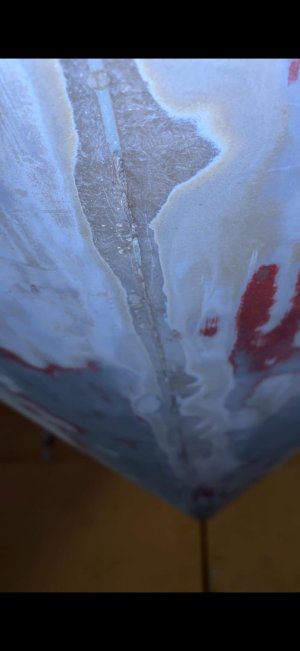
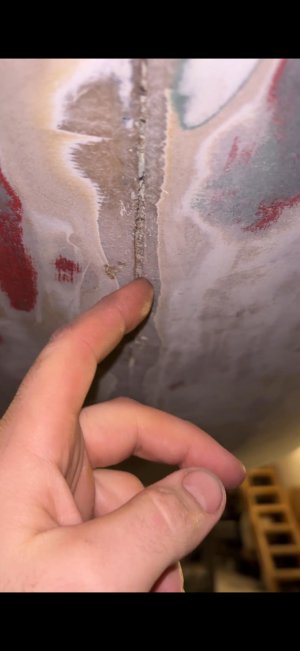
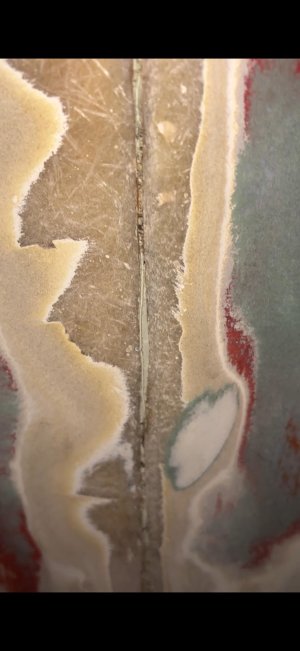
 
Your boat was moulded in two halves which was common on encapsulated keel boats of a certain age. I remember my dad and his friends discussing the pros and cons ... apparently on the more dodgy ones it was possible for the two halves to part company in a hard grounding/collision but I have no evidence of this happening as they pre-date the internet. I wouldn't worry, if they haven't parted company yet then they are unlikely to fail now.

Edit: beaten to it by @vyv_cox
 
Last edited:
It looks to me that the hull has been moulded in two lateral halves which were then bonded together. Are there internal flanges?
There are no internal flanges, nothing that could indicate such bonding on the inside. Furthermore, there are both longitudinal (is this a word?) and lateral massive stringers glassed in all over the hull. Can these be made after the hull is joined? Because the central stringer runs straight down the middle of the boat.
 
There are no internal flanges, nothing that could indicate such bonding on the inside. Furthermore, there are both longitudinal (is this a word?) and lateral massive stringers glassed in all over the hull. Can these be made after the hull is joined? Because the central stringer runs straight down the middle of the boat.
Which is probably covering the internal evidence of the join.
 
I just found this on another forum, talking about HR Monsun 31 of a similar age:
"Here's a follow up in case anyone is following along at home. I emailed HR and got a reply from the CEO, Magnus Rassy, himself. He gave me details on how the hulls are constructed (see link). They are made from 2 halves that are then joined together and laminated from the inside and covered by gelcoat putty from the outside. On my boat some of this putty had crumbled and cracked away and was allowing water into the direct contact with the fiberglass. While this doesn't appear to be a structural issue it could certainly lead to osmotic blistering."

Boats have been built not far from each other in Sweden, and It makes me believe it was a "common practice" back in 74-80ies

Edit: And as I can see even much later than that: How a hull is built
 
The Monsun hull has a trace of tumblehome aft, making it impossible to get out of a mould in one piece. Hence built in two halves, then stuck togerther. As others have said, all the strength in on the inside.
 
OK, thanks everyone, I feel much better about it. I have fixed much bigger holes in the hulls and it held fine, I think I will manage to fix the groove and seal it fine. I can now sleep calmly without dreaming about my boat splitting in half :D
 
Top