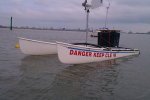
A-level project, boat pump.

How high does the water have to come before it senses it and starts pumping? Does it start floating before it starts pumping? I ask as either the whole unit or the blade carrier will have to rotate to point into wind. If its not floating it won't move. You will probably need a wind vane to make it point the right way. How high is it? You may find if it is inside a dinghy it will be blanketed by the side of the dinghy from the wind and if not the flow could be quite turbulent unless the fan is above the gunwhale. You will need to anchor it somehow so it can still move but won't drift into the sides or the thwart. The blades are a bit exposed and could get damaged quite easily when not in use or being stored.

How about a clamp and small 5W solar panel linked to a combined battery, pump, and sensor. The solar panel is clamped to the seat or side of the boat, with a telephone handset type coiled power cable going to to the unit sitting on the bottom of the dinghy for pumping. Wouldn't need to float but just be waterproof. Less prone to damage and likely to get more useful power out of it so be more effective. if the solar panle is laid fairly flat then no directional issues either.
 
For A level purposes it doesn't really matter all that much whether it works perfectly or not. The really important work now is to compare what your final product is and how it performs with your initial specification. To get the maximum mark for this final summary and evaluation work you have to objectively evaluate it against every single specification point in your initial design work, eg
1. The spec says it needs to pump 1 litre/min. In practice it only delivers 0.8 litres/min. The reason for this is that the inlet hose is too small in diameter. I can improve this flow rate by using a larger diameter inlet hose.
2. The spec says it should operate reliably when unattended. In practice the wind generator blades sometimes catch on the side of the dinghy and stop the pump (or stop the battery charging, or whatever). I can improve the design by tethering the float or by making a wire guard for the generator blades.
Etc etc.
It would be very nice to produce a perfect working product for an A level D and T project, but what is being examined is your ability to think through a design problem and come up with a workable solution, and to produce an objective critique of every aspect of your finished product. In many ways it pays to have a non-perfect product, as you then have much more potential for gaining marks in the evaluation section, provided you do a really thorough objective evaluation along with proposals for improvements.
 
OOOh, harsh audience! It is just a school project.
If it were me I would make it a fixed unit instead of a floating unit and put a swivel on the turbine so as it swings into the wind. The problem with floating things is they tend to float into places they're not meant to be or get stuck under a thwart etc. I would fit a float switch rather than a water sensor as in the UK it would run continuously due to rain which would burn it out. I think that your idea for solving the problem is a good one though and it is the ability to think of a solution that they will be looking for a school level.
 
OOOh, harsh audience! It is just a school project.
+1
Dont be disheartened by all the smart "donkey" comments and criticisms. Well done you for having a go and creating something!

If it were me I would make it a fixed unit instead of a floating unit and put a swivel on the turbine so as it swings into the wind. The problem with floating things is they tend to float into places they're not meant to be or get stuck under a thwart etc. I would fit a float switch rather than a water sensor as in the UK it would run continuously due to rain which would burn it out. I think that your idea for solving the problem is a good one though and it is the ability to think of a solution that they will be looking for a school level.

There are at least some constructive criticisms here.

Good luck with the marking and make sure your project presentation ticks all the boxes in the schedule, not just the ones you enjoyed doing. :D
 
Last edited:
OOOh, harsh audience! It is just a school project.
......

I think people want to offer criticism so the OP has the chance to counter what we might see as obvious problems, rather than hearing the issues from an examiner?
Personally I would suggest having some measured results and comparing them against an analysis of the problem, e.g. amount of water a dinghy will catch in an average March rainfall or something, how much wind it takes to keep the battery charged etc.
I'd suggest mounting the turbine on a stick above head height perhaps, or being able to show the spinning blades are safe for a child's fingers or whatever.
The concept seems sound, there is a need.
In the dark months, it might be more cost effective than solar panels and a Rule pump, which is what we do during the keelboat season.
 
Top