A knife to hand at all times?

When I was a stupid stupid 16 year old I got my hand stuck in the drivebelt of a hollow tine machine on the 3rd hole of Worthing golf club. No knife , had to pull the bloody thing back to the yard where the belt was cut and the bloody hand released. 3 months off on full pay as the guards were missing. Two lessons learnt that day and I still carry a knife.
 
Knives are tools in my h. o.

My boat has them dotted around.

On a new (to me boat) I started engine and cast off from busy mooring field only to find I had not unlashed the tiller.

I had used fiddly paracord. A nearby knife saved me ramming the boats all around.

An examiner once asked me to show him my knife. He grilled me about many things in fact; a stressful examination.
Top tip.

SOP before letting lines go.

1. Check engine is actually connected to a propeller and drives boat.
2. Check full rudder movement port & starboard.

I’ve had both fail the test at one time or another. For 1. At one time the drive plate between engine & gearbox drive shaft had failed. Another time the bell housing to engine bolts came loose/sheared and the duty engineer hadn’t noticed when he did engine checks. (It wasn’t me!) .
 
Used shackle key a lot on board and the knife and lock-spike at home for splicing more often than on the boat.

I forgot about the lock spike, yes that's also useful. Although I ripped my finger nail out with it once, my god did that hurt!
 
I always had a German Army knife - like the Swiss, but green - on a lanyard. Even working in an office, it came in handy at least once a week and, more than once, saved a call-out for a printer or photocopier repair.

On board, I carry a multi-tool. It gets used often. It would live on my belt all the time if the stupid knife legislation allowed it. A 2" blade is illegal because it locks? FFS, it locks because that makes it safer to use. I get it if I'm waving it under someone's nose, but the old offensive weapons legislation covered that.
 
I don't carry a knive but I have shackle tools, knife and spike and scissors next to the companionway, a set of tools next to the engine and a box of splicing tools down below. And the galley.

I am not a fan of multitools as they often give a sub optimal tool plus some offer the risk of the knife blade folding onto fingers.

Quality (and sharpness) of the blade really matters - a poor blade will struggle with thick rope.
 
Top tip.

SOP before letting lines go.

1. Check engine is actually connected to a propeller and drives boat.
2. Check full rudder movement port & starboard.

I’ve had both fail the test at one time or another. For 1. At one time the drive plate between engine & gearbox drive shaft had failed. Another time the bell housing to engine bolts came loose/sheared and the duty engineer hadn’t noticed when he did engine checks. (It wasn’t me!) .
So in those scenarios you'd use a knife...? Only thing I can think of would be to attack the duty engineer.
 
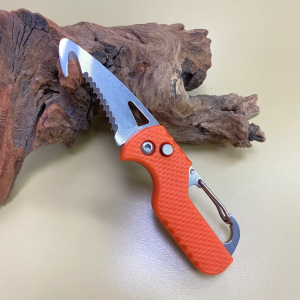
I have one of these:

Mac Race Rescue Knife

It's a cheap-looking, plasticky thing that doesn't even seem very sharp, but it goes through rope far better than any other knife on board.

I once bought a long serrated bread knife to use for cutting lines off the propellor, but when the day came it proved useless, whereas the little yellow knife made short work of it.
 
I have been aware of the “always carry a knife” advice for as long as I remember. For a while I always had a ‘boat knife’ near the companionway but I think it got lost between boats. I have two or three boat knives including a Swiss Army knife, and we have a kitchen knife with a serrated edge for emergency rope-cutting, though I have never had to do this in fifty years. I can see the virtue of carrying a knife for pros and full-time sailors but felt it was one thing too much for me, however desirable.
 
A surprising number of people, maybe not surprising?, appear to use a knife frequently to open parcels - mail order is alive and very much kicking.

Jonathan
Parcels are generally delivered to a house - bring parcel in, put on kitchen table and get scissors from drawer if necessary to unwrap. Takes extra 2 seconds - compared to carrying lump of metal around all day and every day. And can choose best implement for job, not just a jack of all trades.
 
I have been aware of the “always carry a knife” advice for as long as I remember. For a while I always had a ‘boat knife’ near the companionway but I think it got lost between boats. I have two or three boat knives including a Swiss Army knife, and we have a kitchen knife with a serrated edge for emergency rope-cutting, though I have never had to do this in fifty years. I can see the virtue of carrying a knife for pros and full-time sailors but felt it was one thing too much for me, however desirable.
Other than trapeze dinghy sailors, for rules and inversion trap risk, I would be very surprised if pro sailors regularly carried a knife.
Extra bulk and weight. And if something needs doing they would use the right specific tool for the task, not bodge with a pocket knife.

And mention of shackle key made me think - as never use one and don’t carry one. Only shackle used daily is on the main halyard and is a Winchard with a lever on the handle to make easy.
Only other shackles on board are done once a season or less - and most with cable tie through to ensure not working loose.

Rather than carry stuff around all day, better to carry the right tools on board and know exactly where to find them.
 
Over the years I have used one design of pocket knife due to its quaility of steel. I used to buy them from a shop in Ostend for about 40 euros each. Being a joinery manufacturer I used a knife a lot when looking at old joinery. I also used it for marking out etc. I have about 6 old ones now worn out.
It always amused me that the instructions that came with them said "Not to be used as a weapon"
The manufacturer is Smith & Wesson
 
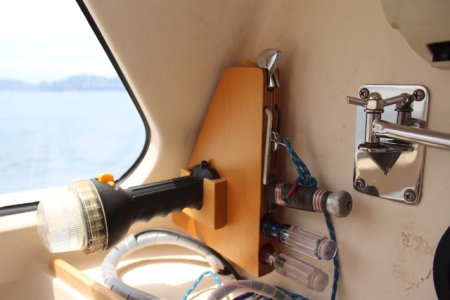
I made a simply tool block, along the lines of a kitchen knife block, from scrap ply. You simply rebate out the slots or recesses on one piece of ply and glue to another.

It holds a sheath knife, a folding knife (with shackle key), a small adjustable spanner, a flat and star screw driver 3 commonly used Alan keys and a floating strobe + torch.

It is located inside the bulkhead behind which is the helm (with chart plotter screen and compass, log, wind etc). Its on the stairs down to the starboard hull and galley. There is a hatch to the right of the block (off the image) and you can reach through the hatch to the block.

Its obvious......

Its also a compromise - its a long way from the bow (or top of the mast) if you need any of the collection - immediately - so you do need to think and plan (and I have a collection of folding knives (and head torches) that are provided for temporary crew (and my wife and I have our own folding knives (with shackle keys) etc.


If I were making again I'd at least add a mole wrench

If you need a big shifter - it would be most unusual and it and the bolt croppers are on the aft berth in a bag (roughly under the helm seat)

Jonathan
IMG_5374.jpeg
 
I tend to keep a small, folding knife with a shackle key on it in my pocket when sailing. It's come in handy often enough to continue the habit. It's one of those serrated ones, optimised for cutting rope, and it's possible to visualise situations in which it could be a life-saver, but none of them have happened so far ...
 
He is a plonker.

He did not have enough warps and wanted to cut a long length to a shorter length (sacrilege!) not the way I skipper a boat but there you go.
So the moral of the story is always carry a knife in case you happen to be sailing with a plonker and decide to be complicit in his plan to ruin a rope?

Correct ropes should be cut from reels in most cases.

On rare occasions you might want to recycle an unneeded long rope into shorter ones. But you need a lot more than a knife for that -- you need waxed thread, sail needles, sailmaker's palm, etc. I personally prefer microserrated shears (so-called "dyneema shears") to knives for actually cutting ropes unless they are more than 25mm thick. In addition, for warps, you want a loop spliced in one end.
 
PS The examiner asking to see your knife was out of order. Although ‘seamanship’ is assessed in the YM scheme, nowhere in the syllabus does it specify carrying a knife.
I always treat with a pinch of salt any claim that an examiner (or any other auditor, assessor etc) required something. Often, it means a question was asked and a satisfactory answer was provided, but there is no way to know what the alternative was (or even what triggered the question). Its the sort of thing that gets passed into legend though.

In my experience having a knife to hand means you are likely to try using THAT knife for every job - which might be more dangerous than going to get the right tool.
Thinking about it, I don’t know where else on board except galley (not exactly tool knives) any knife could have been found. Don’t know where skipper keeps tool box; I should know and will find out for future reference.
I have two different "welcome aboard" briefings. One for passengers and one for people I expect to help sail the boat. Battery isolators, bilge pumps, emergency steering, tools, bolt cutters, spare parts, kedge anchor all on that list.
 
Lots of interesting stories.

  • I've never used a knife to cut a jammed rope. In fact, I can only think of a very few jams, all overrides that happened immediately after some manner of re-rigging. More inconvenience than emergency, and there are better ways of relieving an override than cutting an expensive line. I think maybe a halyard jam also, but the place it might have been cut to some advantage was well out of the reach, Better to work it loose.
  • I've used a knife to cut a fishing rope off a prop or rudder, but having it in my pocket would not help. You're going swimming, so there is time and planning. I'm probably changing pants, for starters
  • I've used a knife to cut thread and whipping twine (common), cable ties (common), lashing line (hot knife is more common), and many small tasks, but the common "thread" is that I was probably using other tools and it was not an emergency.
I raced dinghies (beach cats) for years, and I plain don't believe the inversion thing. I think you chances of calmly working the line loose are much better than cutting the right line. You need to remain calm. I suspect surfing, kayaking, and snorkeling, and being very relaxed in and underwater helps. I had a sheet around a foot once or twice and didn't really think it was a "thing." Mostly, if you are smart, you get clear of the boat before it goes over. Don't cling, and if it does go over with you in it, go down and away to get clear, before coming up. Same with a kayak.
 
Other than trapeze dinghy sailors, for rules and inversion trap risk, I would be very surprised if pro sailors regularly carried a knife.
Extra bulk and weight. And if something needs doing they would use the right specific tool for the task, not bodge with a pocket knife.

And mention of shackle key made me think - as never use one and don’t carry one. Only shackle used daily is on the main halyard and is a Winchard with a lever on the handle to make easy.
Only other shackles on board are done once a season or less - and most with cable tie through to ensure not working loose.

Rather than carry stuff around all day, better to carry the right tools on board and know exactly where to find them.

100% agree with your logic, but a minor quibble about Pro sailors. The reason I carry a knife now (and some line and a spare shackle) is that I got roped into dinghy instructing at my dinghy club (due to lack of volunteers not due to talent or desire to instruct). A large range of kids dinghies with a variable maintenance attitude means that my knife/line/shackle do get used and I'd be surprised if pro instructors don't also carry some basics to do ad hoc jury rigs.

So if we count paid dinghy instructors as pros then I strongly suspect those pro sailors *do* carry multitools/knives and I bet the wrong tool for the job is frequently used. Mangled screwheads on someone else's boat is a small trade off for keeping a paid lesson going. (I have no direct experience of this.)
L
In my experience having a knife to hand means you are likely to try using THAT knife for every job - which might be more dangerous than going to get the right tool.

Which reminds me of a tale from my youth. I was in the boat park, a fellow teenager approached an adult to ask if he could borrow a knife. The grown up went to his car and returned with a knife. My mate proceded to torque up a Philips screw with the tip of it wrecking both the screw head and the knife blade.

He returned it to the grown up with apologies.

I overheard the guy half laughing half exasperated saying "If you needed a screwdriver why didn't you ask to borrow a screwdriver?".

(Genuinely not me, but both are FB friends and both still sailing a lot of years later..)
 
I raced dinghies (beach cats) for years, and I plain don't believe the inversion thing. I think you chances of calmly working the line loose are much better than cutting the right line.

I've been tangled up underneath a turtled Fireball and that's exactly how it was for me. I made a conscious effort not to panic. That's the bit I remember most. Everything had gone quiet, and I genuinely willed myself to stay calm. I felt down to my foot and just dragged all the line I could feel downwards over my foot. (Or maybe it was upwards, I'm not sure what my orientation was.)

I've never thought about it until now but there is no way I could have guessed what to cut and getting a knife out would have used up time.
 
Top