
A couple of rigging questions

Ameatbike42

New Member
Joined
24 Feb 2025
Messages
3
Visit site
Hello YBW forum

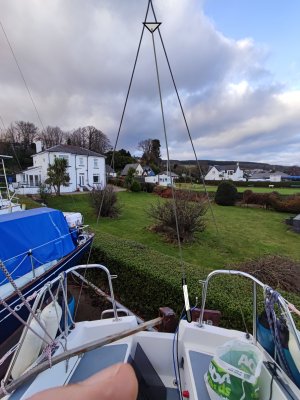
I am doing some work on the rigging of my Jaguar 25 and have a couple of questions I would like answered. I am looking to add a backstay adjuster set up like this:
173747623093222.jpg

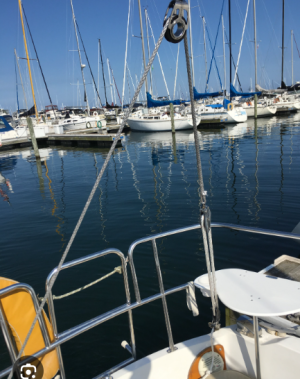
I have however also seen them set up like this:
Screenshot 2025-02-24 033422.png

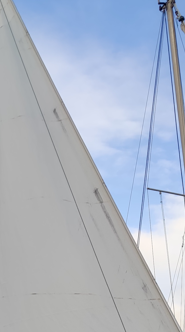
This would arguably be a better solution. My question is, what is stopping the boat being dismasted in the very likely event the rope gets knocked out of the cleat with a stong wind from behind? Is there enough strength in lowers and/or bend in the mast to prevent it collapsing? I am wanting to add the backstay adjuster to help control forestay sagg. Related to that I have noticed these dark streaks apperaing on the luff of the genoa where it is obvious there is some wear between the furler foil sections and I wondered what the cause might be.
Screenshot 2025-02-24 034215.png

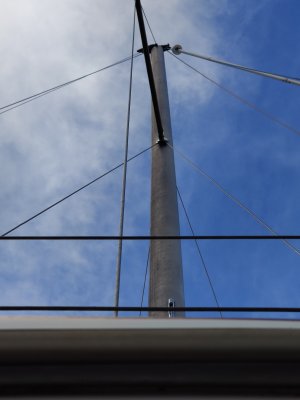
The mast also seems to judder quite badly at times when not sailing. Product of incorrect rig tension? I had also wondered if the effects of vortex shedding are possilbly worsened by having internally routed halyards..
 
It's very very unlikely that wind will "knock" the backstay adjuster out of a cleat if the line is properly OXOXOXed in the cleat. If you are really worried, then a bigger cleat for yet more turns, or a quick lashing with some industrial adhesive tape.

If the backstay fails and the wind is aft, then it's likely the mast will collapse twds the bow (deck stepped mast ?)

The juddering is most probably the result of uneven rig tension and a mast which is not straight. Look up the luff groove to see what's happening, then borrow a Loos rig tension gauge and learn to use the main halyard to set the mast straight, or with a bend, or a lean aft, as the class recommends.

The black stains look as if abrasion is taking place within the foil from the forestay, or someone has oiled the inside of the foil.

If you are still worried about vortex shedding, then wrap the main halyard round and round and round the mast when not sailing.
 
It's very very unlikely that wind will "knock" the backstay adjuster out of a cleat if the line is properly OXOXOXed in the cleat. If you are really worried, then a bigger cleat for yet more turns, or a quick lashing with some industrial adhesive tape.
I wouldn't be at all worried about the wind knocking the rope out, more so a rogue hand or foot. From what you're saying, I gather the integrity of the backstay and thusly the whole rig is dependant on the stopper knot? Seems like a system I couldn't have 100% faith in personally but I see a lot of people using it without issue.

The mast level fore/aft and is sraight laterally although I would say perhaps there is more bend than Is ideal in a cruising masthead of this era? I'll give the halyard a trick a go and see if that helps.


IMG_20250125_153244.jpg

The dark stains are indeed undoubtably from the foil sections abraiding against eachother, the question is why. I installed the furler myself last winter and followed the manual down to a tee. I can assure you no oil was used.
 
AM I right in thinking that the Jaguar 25 has a masthead rig? If so, I don't think a backstay tensioner will offer much, if any, advantage over a properly tensioned fixed backstay.

On ours, I'd get the tension in the capshrouds right, then tighten the babystay to give a small amount of pre-bend in the mast - not too much! Then get the mast straight looking up the mainsail slot using the lower shrouds. You should be able to do something similar using the forward lowers to give the pre-bend.
 
Hello YBW forum

I am doing some work on the rigging of my Jaguar 25 and have a couple of questions I would like answered. I am looking to add a backstay adjuster set up like this:
View attachment 189986

I have however also seen them set up like this:

View attachment 189987

This would arguably be a better solution. My question is, what is stopping the boat being dismasted in the very likely event the rope gets knocked out of the cleat with a stong wind from behind? Is there enough strength in lowers and/or bend in the mast to prevent it collapsing? I am wanting to add the backstay adjuster to help control forestay sagg. Related to that I have noticed these dark streaks apperaing on the luff of the genoa where it is obvious there is some wear between the furler foil sections and I wondered what the cause might be.

View attachment 189988

The mast also seems to judder quite badly at times when not sailing. Product of incorrect rig tension? I had also wondered if the effects of vortex shedding are possilbly worsened by having internally routed halyards..
If you are concerned about accidental release, and to be fair on some rigs that is a valid concern, then simply add a strop at "max ease" so that when eased past that point the strop takes the load. Where that goes to depends on the layout of your proposed system.
 
You might find this useful Setting up your masthead standing rigging

Pumping of the mast in fresh winds is a consequence of masthead rig with plenty of compression from shroud tension and no babystay, or in the case of some Sadlers including the 34, of very acute angle between babystay and mast. Wrapping a halyard around the mast can help, or if it is a serious problem haul a looped line half way up the mast and run it tight to the forward cleats or windlass.

I agree with other posters that adjustable backstay tension on a masthead rig will do little for you. Although the design you show is fine on a bendy fractional rig you will never achieve sufficient tension with masthead. With a big bottle screw or similar it takes some effort to keep forestay sag to a minimum in a blow.
 
Concerning the backstay adjuster: In my experience being able to counter forestay sag when going to windward in a blow by tensioning the backstay is indeed useful on a masthead sloop. On my 9 m sailboat I have an adjuster similar to the setup in photo #1 and it works well.
For a few years I changed to a setup similar to photo #2, but eventually felt that the former system was more safe, so altered back again. I think the second type of setup is more common on boats with fractional rigs with swept spreaders, on which the support of the backstay is less important.
 
On my little 21ft with fractional rig I have had the back stay part while under spinnaker. Not a huge problem obviously the shrouds are aft of mast in line so mast was held by them but also the mast is held back by the main sail itself. I have the latter type with tackle on one side of a bridle. Bendy mast means more shortening of back stay is in order.
Now on a mast head rig as said back stay tension adjustment is much less critical and will not require much shortening in a blow. The first system of squeezing the back stay legs together gets more power (tension) easier, so is more common on mast head rig boats.
On the other hand as said back stay tension adjustment is not so critical on mast head rig. (from light airs to a blow) Just tighten it up pernaently might be a good option. ol'will
 
The first system of squeezing the back stay legs together gets more power (tension) easier, so is more common on mast head rig boats.
That's what I have on my 22' masthead rigged tub, 2x purchase on a simple jam cleat - it hasn't ever accidentally released. Works well for controlling genoa shape up/downwind. Lower shrouds are pretty solid, so the bend is constrained in where it can go - pretty much doing the job of a baby stay on a larger rig (I think).
 
In my experience being able to counter forestay sag when going to windward in a blow by tensioning the backstay is indeed useful on a masthead sloop
I have heard a quite few people say that it is a useful addition, even to a masthead. It doesn't take much for the effects of sagg to become noticable and it can be quite pronounced once the wind picks up.
The first system of squeezing the back stay legs together gets more power (tension) easier, so is more common on mast head rig boats.
Yes I like that system as it means there is still a backup if any component of the tensioner where to fail and I can't imagine there being any issue in getting sufficient tension into the system with a 4:1 tackle on a boat of this size.

I can understand the idea of simply setting the forestay/backstay tension higher at all times but if you were to set the forestay tension to the same maximum level you could achieve with the tensioner there would be a higher constant strain on the hull and the mast step. Additionally from what I understand, having some sagg in the forestay is actually beneficial in light airs (Centre of the luff saggs towards the clew and deepens the sail possibly?)

I have the bits for It already so I guess I'll whack it on and If I don't like it then it's easily removed.

Grub screws on the fishplates that join the sections loose or missing is one cause.
Hmm I was sure I did them up tight when I installed them but I'll have a look and tighten them up when I get the mast down.
 
Top