A couple of exhaust quiestions

GHA

Well-Known Member
Joined
26 Jun 2013
Messages
12,552
Location
Hopefully somewhere warm
Visit site
1. Any reason not to mount a plastic water trap on a ply shelf restrained with webbing?

2. With a new exhaust getting installed, the top of the anti syphon loop needs to go somewhere, tempting to fit a small telltale in the hull rather than figure out a way to get it back into the main pipe. Any thoughts?

TIA
 
1. Any reason not to mount a plastic water trap on a ply shelf restrained with webbing?

2. With a new exhaust getting installed, the top of the anti syphon loop needs to go somewhere, tempting to fit a small telltale in the hull rather than figure out a way to get it back into the main pipe. Any thoughts?

TIA
Water trap must be the lowest pint in the exhaust system so that all the water drains into it when the engine is stopped. No problem with the ply shelf provided you are not raising it.

Either you misunderstand about the anti-syphon loop or I misunderstand you.

Talking about the anti-syphon loop in the cooling water circuit? Usually, but not always, immediately before injection into the exhaust

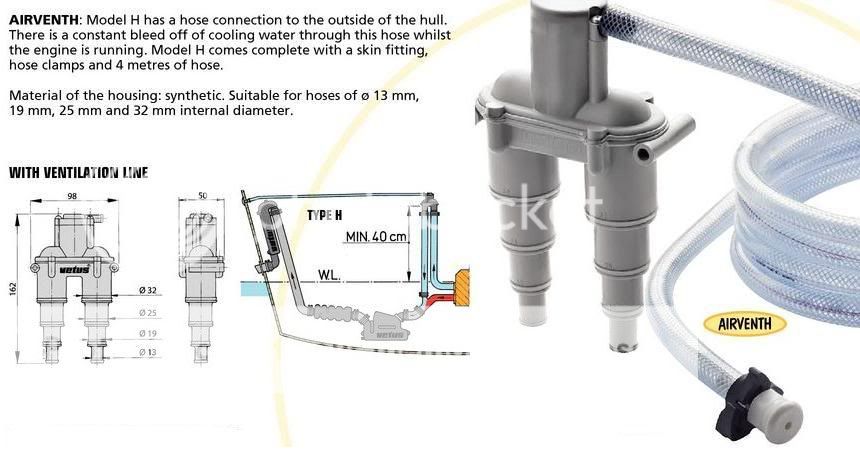
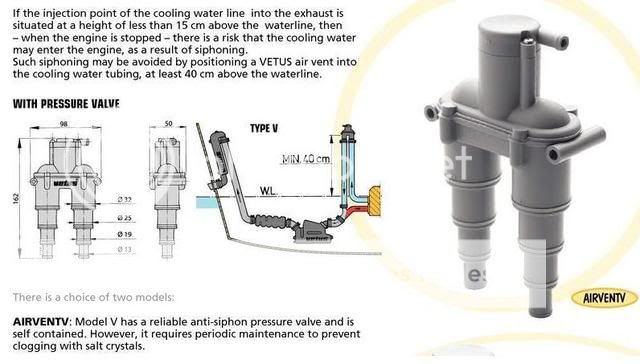
Pipe rises in a loop to the anti-syphon valve and then back down to the injection point. The anti-syphon device either has a small valve in the top of it which opens when the engine is stopped to admit air. or has a small diameter discharge to a cockpit drain or overboard ... a bit like an outboard telltale

VetusV.jpg


VetusH.jpg
 
. or has a small diameter discharge to a cockpit drain or overboard ... a bit like an outboard telltale
The system being removed had the pipe from the top of the anti syphon connecting back into the main exhaust pipe just before the seacock, as a bigger diameter hose is going in it would be easier to have it discharge through the hull rather than make up a new y split.

Any suggestions for a hull fitting? , would be nice to point the flow downwards.

Ta
 
The whole idea of the valve or bleed from the anti-syphom loop is to admit air to break any syphon, so plumbing it back into the exhaust, which could be flooded by a following sea, is a dangerous practice. As we don't know what boat and engine combination you have, it is difficult to offer more than generalities. If you have a suitable surface with a downward slope, but above the waterline, a simple plastic skin fitting will do the job. If not, then it can be brought through into the cockpit and fed directly into the cockpit drain. Either way, the visible flow confirms that the cooling flow is OK, and the syphon is broken when the engine stops. If it must go straight out sideways, then remember to stop the engine before the harbourmaster's launch comes alongside!

Rob.
 
The system being removed had the pipe from the top of the anti syphon connecting back into the main exhaust pipe just before the seacock, as a bigger diameter hose is going in it would be easier to have it discharge through the hull rather than make up a new y split.

Any suggestions for a hull fitting? , would be nice to point the flow downwards.

Ta

There are 2 different types of valve. One has a valve and is inserted in the raw water hose anywhere downstream of the pump, so it can be before the water enters the heat exchanger or, as in many engines in the hose that comes out of the heat exchanger (or head if seawater cooled) and the injection point into the exhaust. This type does not need an overboard bleed, although sometimes they dribble so it is common to have a pipe to a bottle to catch any dribbles. The second is a permanently open vent as shown in the diagram in Vic's drawing. That can be vented either into the cockpit or overboard so there is always a visible sign of water flow. Both types achieve the same objective of breaking the syphon when you stop the engine and choice usually depends on which is more convenient in a particular installation.
 
The whole idea of the valve or bleed from the anti-syphom loop is to admit air to break any syphon, so plumbing it back into the exhaust, which could be flooded by a following sea, is a dangerous practice. As we don't know what boat and engine combination you have, it is difficult to offer more than generalities. If you have a suitable surface with a downward slope, but above the waterline, a simple plastic skin fitting will do the job. If not, then it can be brought through into the cockpit and fed directly into the cockpit drain. Either way, the visible flow confirms that the cooling flow is OK, and the syphon is broken when the engine stops. If it must go straight out sideways, then remember to stop the engine before the harbourmaster's launch comes alongside!

Rob.
It did see a bit of an odd arrangement when it came to light stripping out the old exhaust pipe, and still does thinking about it. But no matter, all that is needed now is a downward facing skin fitting , which don't seem to be very widespread so might end up with a grate or flap or something.
It's a high lift exhaust pipe (Beta 35) well above the waterline so doesn't really need an anti syphon but just as easy to keep it as to remove. Won't do any harm.
 
I suspect you are confusing two different things, and missing the points made above.
Could you explain? Both Vetus and the beta installation guide state that if the injection point is above the heeled waterline by 15cm (vetus) or 30cm 30cm (beta) then an anti syphon loop is unnecessary. What am I missing?
And irrelevant anyway as it's staying in but always good to learn
 
Could you explain? Both Vetus and the beta installation guide state that if the injection point is above the heeled waterline by 15cm (vetus) or 30cm 30cm (beta) then an anti syphon loop is unnecessary. What am I missing?
And irrelevant anyway as it's staying in but always good to learn

Sorry. My error. I thought you were confusing the need to avoid syphoning/washing up the exhaust outlet with the (usual) need to avoid syphoning via the water inlet (and was in too much of a rush to properly explain at the time). I bow to Vetus' & Beta's knowledge on the matter.
 
Top