Beneteau381
Well-Known Member
But does any one know if the spool of insulated rewind wire has the wire taken off the spool like a sewing machine does, ie pulls it off the top or does it have to be wound off?
Ta
Stu
Ta
Stu


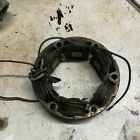
my thoughts as well, given that a load of us are interested in old bikes I wondered whether anybody had done this. Just bought this with a view to rewiring it.Surely it depends how the wire was wound onto the spool by the manufacturer.
With sewing machine threads on a cop you take it off vertically. If the thread is on a bobbin you would take it off tangentially.

Normally when rewinding the wire is pulled off over the end of the bobbin so that the smooth end cheek does not snag or tension the wire .my thoughts as well, given that a load of us are interested in old bikes I wondered whether anybody had done this. Just bought this with a view to rewiring it. View attachment 127824
The last pic i did that a few years ago
View attachment 127825


Likewise!Back in the 60s I used to take my Tiger Cub apart frequently, but not down to the alternator windings?
Am going to test the windings first but I suspect that the 60 year old varnish is gone. The biggest prob I beleive is the coil supports, they are just varnished cardboard. So "fishpaper" is now being researched. Also looking at "walkerite" and such stuff. Got to be heat and oil proof as must the varnish. First job is to document the winding connections, then ohm them. Then strip one coil for number of turns etc.I would say that the bobbin of wire when manufactured would be wound on by rotating the bobbin. So it should be unwound the same way. To pull off the end of the bobbin would put a twist in the wire for each turn. Apparently that does not matter with thread and it may not matter with enamel coated wire but if possible I would unroll by turning the bobbin. Also easier to control the wire off the bobbin avoidiing a huge tangle if too much comes off the end. I assume you are going to rewind the coil on the alternator. Is it really in such bad condition? Good luck with the rewind. ol'will

Just as a follow on, from experience with all sorts of motors etc, a.c. & dc. unless it is done professionally you won't have a lot of success. Very difficult to get everything tight!View attachment 127826
my thoughts as well, given that a load of us are interested in old bikes I wondered whether anybody had done this. Just bought this with a view to rewiring it. View attachment 127824
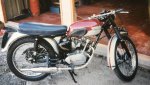
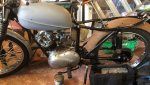
The first pic, I did that one a few years ago, the primered one is the current one
View attachment 127825
Just as a follow on, from experience with all sorts of motors etc, a.c. & dc. unless it is done professionally you won't have a lot of success. Very difficult to get everything tight!

What he needs is a good old "Bridge Megger" to check that each coil has the same resistance i.e. balanced. Multimeters will not read low enough. Also with a machine of that age I would be wary that the permanent magnet rotor hasn't lost some of its oomph! If he thinks that the existing coils are OK I would suggest baking in a very low oven for an hour or so to drive out any dampness. He could then immerse the whole thing in a suitable varnish and repeat the baking process. Even if he did the rewind I would recommend the varnishing and baking. Down side is that good insulating varnish is expensive!!Check for continuity of the coil. But another failure mode which is hard to spot is shorted turns. This failure mode will give poor output. If you do not rewind and coil seems OK then finally check for useful output. The professionals will have what is called a growler. a coil with pole pieces fed with 50 hertz AC. If you lay a suspect coil and pole pieces across into the magnetic circuit. A good coil will just sit there. If it has shorted turns it all acts like a shorted transformer and the whole arrangement vibrates and growls. Most often used for motor armatures where you test individual coils by rotating in the field. ol'will
I bought a bike with Hagon elastic band forks welded to a bantam cub frame, the engine bottom end you see in the project bike along with the horribly mutilated, now fixed back wheel, etc. The head and barrel, oh dear me! The barrel was an alloy square with a trident liner and piston. Made it 230cc. It was a horrible bodge but it worked allegedly. It ran on methanol, allegedly! The frame, front forks and wheel were bought off Ebay. I laced a 19" rim on. Rims and spokes are horribly expensive! Its coming together slowly. The alternator on the engine is working, it gives a flick on a digi voltmeter as I kick it over. It ohms tests ok. I degreased it, then ovened it as you say, then red transformer winding paint when still hot. We shall see. The alternator we are talking about was on ebay for £12. It is pretty grotty but the big issue is two broken wires off one of the wires out. Easy fix. The old card support for the coils is bad but repairable. Each coil is reading 00.3 on the 200 ohm scale, so I think are good. Comments on that reading welcome. The ones on the bike, are reading 00.8 and 1 but they are wired in series for each wire out.Looking at the second Cub, the one with the primer tank, it seems to be a competition bike - look at the rear sprocket size compared to the standard one.
Good project.
Your previous bike looks great and in perfect original condition.View attachment 127826
my thoughts as well, given that a load of us are interested in old bikes I wondered whether anybody had done this. Just bought this with a view to rewiring it. View attachment 127824
The first pic, I did that one a few years ago, the primered one is the current one
View attachment 127825
The one with the red tank was a Sports cub, very desirable. It came from the factory like that. They fitted 19" front and 18" back wheels, along with stronger meatier front forks off the T21 350 cc. The cowls were never fitted as std to this model. I regret the sellingof this afew years agoYour previous bike looks great and in perfect original condition.
I think everyone removed the cowls that covered the area between the carb and the rear shocks.

Did you deduct the resistance of the meter leads from the coil readings?I bought a bike with Hagon elastic band forks welded to a bantam cub frame, the engine bottom end you see in the project bike along with the horribly mutilated, now fixed back wheel, etc. The head and barrel, oh dear me! The barrel was an alloy square with a trident liner and piston. Made it 230cc. It was a horrible bodge but it worked allegedly. It ran on methanol, allegedly! The frame, front forks and wheel were bought off Ebay. I laced a 19" rim on. Rims and spokes are horribly expensive! Its coming together slowly. The alternator on the engine is working, it gives a flick on a digi voltmeter as I kick it over. It ohms tests ok. I degreased it, then ovened it as you say, then red transformer winding paint when still hot. We shall see. The alternator we are talking about was on ebay for £12. It is pretty grotty but the big issue is two broken wires off one of the wires out. Easy fix. The old card support for the coils is bad but repairable. Each coil is reading 00.3 on the 200 ohm scale, so I think are good. Comments on that reading welcome. The ones on the bike, are reading 00.8 and 1 but they are wired in series for each wire out.
The spare alternator, an interesting project to get it working. So insulating 1mm card ordered, cotton tape, shellac etc. A good clean degrease and baking. Then repairs to the coil formers. Anneal the broken copper wire ends, re solder, shrink wrap, cotton tape then shellac all and gently cook again. As I said to the wife, I enjoy stuff like this, it hones skills usefull in my yottie repairs as well