A bit of mathematics, or lateral thinking ...

In a manufacturing environment where the next 200,000 units would be affected by the outcome it would be wise to work this out mathematically. On a single boat with a single engine just fit the bugger.

The reason for doing this is to fit an new adjuster a bit like a bottle-screw, for which I need a bit more space. I don't want to make it, then find it doesn't fit. Just getting a sanity check to confirm my reasoning, thanks for replies.
 
The reason for doing this is to fit an new adjuster a bit like a bottle-screw, for which I need a bit more space. I don't want to make it, then find it doesn't fit. Just getting a sanity check to confirm my reasoning, thanks for replies.
On UTube there's just such an answer - trouble it assumes you can get to the engine from all sides. In real life not a likely scenario.
 
Using the geometry provided and CAD I believe that the point A will move 26mm along the slot and that the point P will move 15mm to the right.The alternator assembly will rotate c. 12 degrees to give a line perimeter that increases from 975 to 1000.The relationship to an actual grooved pulley and a belt with thickness is another matter.
 
Last edited:
The reason for doing this is to fit an new adjuster a bit like a bottle-screw, for which I need a bit more space. I don't want to make it, then find it doesn't fit. Just getting a sanity check to confirm my reasoning, thanks for replies.

I'm not quite sure what advantage you are looking for. One socket on an extension is all you need to adjust the alternator with the industry-standard mechanism. A bottle screw adjuster needs two spanners to lock in position.

adjstrsm.jpg
 
Using the geometry provided and CAD I believe that the point A will move 26mm along the slot and that the point P will move 15mm to the right.The alternator assembly will rotate c. 12 degrees to give a line perimeter that increases from 975 to 1000.The relationship to an actual grooved pulley and a belt with thickness is another matter.

I suspect Nigel is not talking about a bottlescrew but rather an adjustable bolt with a lock-nut.
My alternator has 3 bolts which have to be undone to adjust - 2 x17mm and one x 13mm. then you tension with a 700mm screwdriver, kept in position as you tighten the bolts...
 
I think you quoted the wrong post.

However there are these types of adjuster (I have on in the garage somewhere) although he did say "a bit like a bottle screw"

hemi_6_adjustable_alternator_bracket.jpg
 
Pivot point P to alternator is fixed length. Increasing the length of belt by 25mm will result in more of the 25mm being taken by the top section of the belt as the alternator swings to the right to take up the slack. It is all to do with angles but at a guess I would think more than ½" but less than ¾" to the right. (Pully cannot rise vertically as much as it can move to the right. as for the other bit - insufficient information - as LS said JFDI.
+1.
But belts vary in thickness, and wear, so don't lose all the adjustment range!
 
Pivot point P to alternator is fixed length. Increasing the length of belt by 25mm will result in more of the 25mm being taken by the top section of the belt as the alternator swings to the right to take up the slack. It is all to do with angles but at a guess I would think more than ½" but less than ¾" to the right. (Pully cannot rise vertically as much as it can move to the right.

WRONG ! Since the distance between the other two pullies doesn't change then half the extra length will be either side of the alternator pully wherever it's new position is.
 

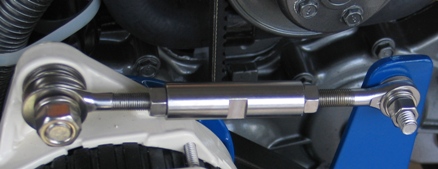
This is exactly what I plan to make, as I can't find one short enough to fit, and even my design needs a bit of extra space. I'm using a bit of hex bar and a pair of 8mm Go-Kart track-rod ends (eBay item number: 270991212465), they have a ball joint so it can be adjusted without slackening them. The existing fixing bolts are about 6mm, and have both stripped.

miCHmKCdYq8hhEDlGt6H2uA.jpg
 
Last edited:
This is exactly what I plan to make, as I can't find one short enough to fit, and even my design needs a bit of extra space. I'm using a bit of hex studding and a pair of 8mm go-cart track-rod ends (eBay item number: 270991212465), they have a ball joint so it can be adjusted without slackening them. The existing fixing bolts are about 6mm, and have both stripped.

miCHmKCdYq8hhEDlGt6H2uA.jpg

I've come to this thread late but one of your trackrod ends will need to have a L/H thread.
 
I believe that Nigel wants to add an arrangement that a) locks the desired tension setting in place and b) allows fine adjustment.The standard arrangement has a habit of creeping even as you tighten it,relying as it does on the large screwdriver as a lever to hold the unit in the desired position and requiring not one but two spanners to tighten the bolt in the slot.And the spanner at the back and the hand that holds it is likely to be impeded when held at 90° to the nut.Basically one is short of the necessary hand to use the lever.I haven't found a neat wedge that will lie in the slot to obviate the screwdriver but I have considered adding a second locking bolt ,for which there is room, in an attempt to stop creep during use.I suppose one could add an elliptical plate washer on the second bolt to provide the temporary leverage but once done I can see that Nigel is going to cut out a lot of fiddling time and more to the point keep the tension exactly where he wants it.The weight of an alternator is such that the long bolt thro the body at the main pivot barely contributes to holding the required position,even if the head at the back is held firmly against the tightening.
 
Top