5v around the boat?

GHA

Well-Known Member
Joined
26 Jun 2013
Messages
12,552
Location
Hopefully somewhere warm
Visit site
Been hovering around the upper end of the list for a while now - fitting a few 5v usb fans (still HOT here!) & sockets for phone/tablet/kindle charging. The obvious route seems to be just tee off a nearby lighting circuit locally,current is next to nothing. Having a biggish single buck converter at the panel then running in new wires for 5v just seems a lot of pointless work.

But....... you never know, always worth a quick ask :) - How do you lot do it?


(what will take longer is going through the stash of 12v-5v converters to measure which ones keep the voltage up under load & don't spit out too much RF noise)
 
All the wiring around the boat is 12v, with individual 12v-USB adaptors next to each bunk and above the tray in the saloon where phones etc tend to get dumped. These are all on a "12v and domestics" circuit that also powers 12v lighter sockets in the same places and the stereo.

Be aware that if you just wire a bare USB socket to 5v, most phones won't charge very fast. They need a particular resistance across the data lines to tell them that it's ok to draw more than the original standard 0.5 amps.

Pete
 
A decent USB adaptor will supply a couple of amps per socket so, allowing for some loss in bringing the volts down from 12 and a bit of fudge factor, that's a potential couple of amps. A lighting circuit designed for a few filament bulbs that's now driving LEDs will still be supplying less than it was designed for with an adaptor working flat out and all the lights on.

As for fans, why not use 12v? It would be more efficient, though admittedly less convenient than being able to plug in to a USB one.
 
Been hovering around the upper end of the list for a while now - fitting a few 5v usb fans (still HOT here!) & sockets for phone/tablet/kindle charging. The obvious route seems to be just tee off a nearby lighting circuit locally,current is next to nothing. Having a biggish single buck converter at the panel then running in new wires for 5v just seems a lot of pointless work.

But....... you never know, always worth a quick ask :) - How do you lot do it?


(what will take longer is going through the stash of 12v-5v converters to measure which ones keep the voltage up under load & don't spit out too much RF noise)

i'd be reluctant to tool up for the USB A standard with USB C on the rise. All my devices are USB C and I have 12v to USB C PD chargers. It is an order of magnitude more efficient in charging. Unfortunately you can't simply plumb it in around the boat because the charger negotiates the charging regime, including voltage, with the charged device. You can charge a USB C device from USB A but only at USB A speed. There is no way it'll do your laptop for example. Sadly, being more intelligent, the USB C chargers are noticeably more expensive. N.B. It matters which charger you get - it needs to be PD (power delivery). In my experience even some chargers that claim to be PD don't go all the way to the Max specified in the standard - 5 amps at 20 volts.
 
As for fans, why not use 12v? It would be more efficient, though admittedly less convenient than being able to plug in to a USB one.
Local DIY store has some for about €6, close to completely silent and only about 200mA @5v , perfect next to the bunk so will be nice to dot a few around and still keep the coframo.
 
Another quick thought - in you choose to disregard my warning there are still good reasons for not creating a 5v circuit around your boat. The lower the voltage the higher the current needed create the same power. That means thicker cables or more power loss along thin cables.
 
Another quick thought - in you choose to disregard my warning there are still good reasons for not creating a 5v circuit around your boat. The lower the voltage the higher the current needed create the same power. That means thicker cables or more power loss along thin cables.

5v ring round the boat had already been pretty much disregarded, that being one of the reasons. Or not quite power being dissipated, but decent cables being needed to stop too much voltage drop - one good reason not the skimp on usb cables if you want faster charging, your 5.1v at the charger can easily be 4.75 at the phone.
 
I ordered one of these:
buck.jpg


and then made a few voltage dividers like this, positioned near the USB sockets:
divider.jpg


This charges up Iphones, Ipads and other mobiles fine.
No RF noise.

However, I do not claim this route to be any better, easier or cheaper than installing a few 12V USB outlets. But it can be done and I learned something doing it.
 
Last edited:
Another quick thought - in you choose to disregard my warning there are still good reasons for not creating a 5v circuit around your boat. The lower the voltage the higher the current needed create the same power. That means thicker cables or more power loss along thin cables.

I agree with that. And the higher the current drawn by the device, the greater the voltage drop in the wiring.
 
My boat devices lag well behind the bleeding edge of USB :)

Anyway, really doesn't matter much if they charge a bit slow, not like there's a hurry..

OK, up to you, but at some point you will get a phone or a tablet that expects USB C and be annoyed at how slow it charges, or a laptop that you want to use on the boat. I can now plug my laptop into any socket and have no need of a dedicated charger. It is to all intents impossible to charge a computer from USB A. I'd advise you to put several of those horrible cigarette lighter sockets in and accept that you plug in chargers - they are cheap and can be tiny. This means that:
a) you don't get the power loss of a 5 volt circuit
b) you can buy a USB C PD charger when the time comes and plug it in
c) if you invite me on to your boat as a visitor I can bring a PD charger for my toys
 
OK, up to you, but at some point you will get a phone or a tablet that expects USB C and be annoyed at how slow it charges, or a laptop that you want to use on the boat. I can now plug my laptop into any socket and have no need of a dedicated charger. It is to all intents impossible to charge a computer from USB A. I'd advise you to put several of those horrible cigarette lighter sockets in and accept that you plug in chargers - they are cheap and can be tiny. This means that:
a) you don't get the power loss of a 5 volt circuit
b) you can buy a USB C PD charger when the time comes and plug it in
c) if you invite me on to your boat as a visitor I can bring a PD charger for my toys

Seems pointless to source and fit 12v USB C just to run a cheap fan and maybe trickle charge a mobile overnight after falling asleep to Audible...

If the comes a need then one will get fitted somewhere, otherwise no point at the moment for what's required. But your boat, do what you feel is best. Ciggy sockets are long gone, XLR where any power is needed like DC converter for the laptop.

If you did happen to be onboard desperately wanting faster charging for the toys you'd probably be told to chill out and enjoy the real world :cool: ;)
 
Seems pointless to source and fit 12v USB C just to run a cheap fan and maybe trickle charge a mobile overnight after falling asleep to Audible...

If the comes a need then one will get fitted somewhere, otherwise no point at the moment for what's required. But your boat, do what you feel is best. Ciggy sockets are long gone, XLR where any power is needed like DC converter for the laptop.

If you did happen to be onboard desperately wanting faster charging for the toys you'd probably be told to chill out and enjoy the real world :cool: ;)
There is no lack of chill on my boat. Might even be able to run a fridge off my USB sockets. Most phones now come with USB C and it's even Apple compatible. The ability to take 100W out of your USB sockets is bound to win out. And no, I don't believe it is going to go out of date any faster than USB A (which hasn't yet after 20-25 years). Since I can't afford a real nav system, my IT setup does my navigation. Never really let me down and it's all very relaxing. Luckily I don't have to remember to charge my phone that often cos I can put enough charge for a couple of days into it in an hour.

However, if you are unconvinced by the technical arguments, USB C has a final winning feature. It doesn't matter which way up you put the plug in!

Oh, and ps... one thing we agree on: ciggy sockets are an abomination. I have my own idiosyncratic robust solution. Can we not have a sensible marine standard for 12v plugs? And I want 25 amps out of it - enough to inflate the dinghy.
 
The ability to take 100W out of your USB sockets is bound to win out.

:eek::eek:

Well, was never going to be type c anyway but that's killed any idea stone dead. couple hundred mA off something nearby is one thing but pulling 8A isn't going to happen without some much more serious thought, maybe even pen to paper!

Anyway, here's some boat porn for you in the meantime, cor, look at the terminals on that!!! :)

teaser_klein.jpg
 
A standard USB outlet, something like this

s-l1600.jpg
will charge a USBC gadget via a suitable cable, albeit more slowly than a dedicated smart charger and it's the standard for generic USB outlets. Seems to me that the USBC kerfuffle is a red herring. It'll also run a fan, but I still think 12 fans would be a better bet
 
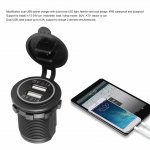
I'd fit a dedicated charging/power circuit, with some good quality USB sockets of this style https://www.asap-supplies.com/double-usb-cigarette-lighter-socket-715661

Don't fit cheap and nasty ones, i've had those output 12v. A USB voltage checker is a good buy, loads on Ebay for pence https://www.ebay.co.uk/sch/i.html?_from=R40&_sacat=0&_nkw=usb+voltage+tester&_sop=15

You can charge USB C devices from those sockets, albeit slower. Most modern USB C phones can be charged wirelessly, the wireless charger has a USB A cable to power it and does the smart charging itself, so no need for a USB C socket. It may be a bit lower with some USB A sockets, due to current limitations, but it's simple enough to make a USB A socket with higher current output by digging the insides out of a cheap Ebay socket and wiring it to a DC-DC converter. Of course, you can buy higher output USB A sockets, but they cost more and this is PBO :)

As for talk of not being able to charge a laptop from USB A, can you charge any laptops from USB at all ? Tablets, sure, but laptops ? With a dedicated charging/power circuit you can add in anything you want (make sure the cable is big enough, i'd use 2.5mm, should run anything you throw at it). If you need to charge a laptop you could fit a dedicated 12v socket and plug in a car charger, or hardwire the car charger to a switch. I do this to run a 19.5v Dell laptop, no problems and it charges fast.

If you have a tablet that needs a smart charger, such as some of the newer iPads or Samsung tablets, these can still be charged from the same circuit by fitting a dedicated socket, powered by a travel charger.

If all you have now is Olde Worlde tech, a circuit of standard USB A sockets, with power sockets of your choice, will suffice. It will be simple to add in different sockets as required in the future.
 
A standard USB outlet, something like this
As per the first post, there's a stash of 12v - 5v converters onboard already, what will take much longer is digging out the half finished adjustable constant current load/amp/voltage logger to see how they fare. Then try to figure ouy some objective way to measure the noise they kick out. Messing around with a multi meter I suspect one of the cheap ebay offerings actually does much better than those dual pre built ones.

Try sleeping under a noisy 12v fan then a nearly silent 5v one running on low ;)
 
Curiouser and curiouser.......

So samsung, so they say, want to see 1.2v between D+/D- and ground to charge fast - bit there's something going on in the cable as well it seems, on my galaxy tab s2 anyway..
So with a cheapo 12v - USB ebay little board, 5.1v between power and gnd, 2.7v between D+/D- & gnd. Normal cable same the other end, samsung cable it somehow knows this and sets both D+/D- to 0v to gnd...
Also needs a samsung cable to fast charge from the wall wart even though a different cable will test continuity exactly the same & pin voltages exactly the same..

Not that it matters that much, no rush to charge but far too interesting to leave unfiddled with get on with some jobs instead :)
 
Top