40-50 foot sport cruisers with surface drives?

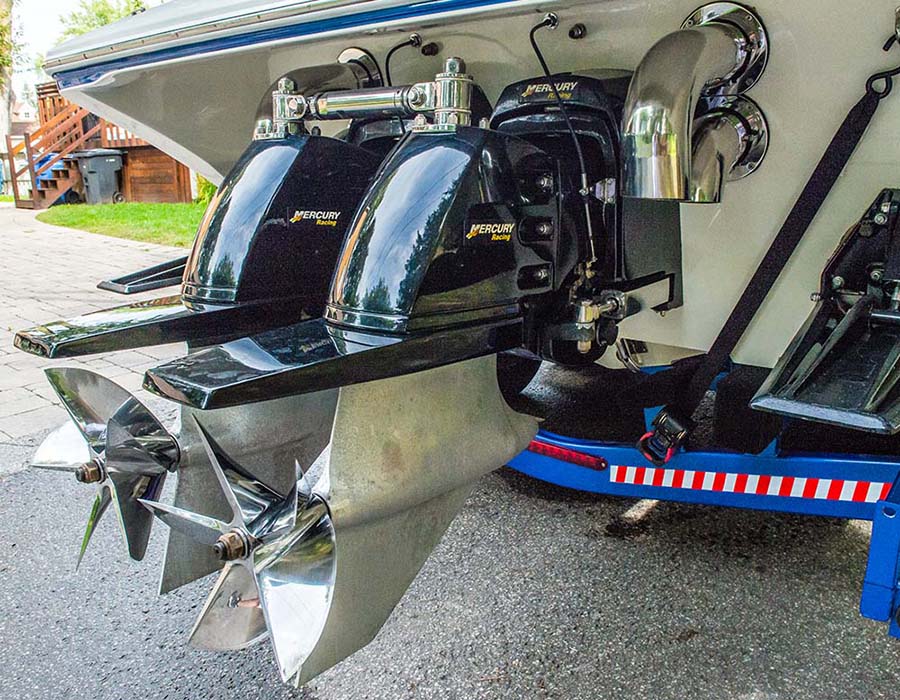
The pipes I’ve shown go to fresh air, air is pulled through the pipes, there is no exhaust or air scoop.
Ah , the low pressure on the upwards side draws air in .
But he can vary the depth anyhow and control that , but every cm lower means more thrust I guess .
I am not super convinced but hey ho .
Looks a low cost mod so nothing to loose .
 
The pipes I’ve shown go to fresh air, air is pulled through the pipes, there is no exhaust or air scoop.
I guessed so, but frankly I'm a bit skeptical about their effectiveness.
Sure, if someone who adopted them say that they work, who am I to argue?
But if we should never comment based on armchair engineering only, we could as well shut this place down, I reckon! :D
Besides, I guess that your neighbour might be a bit biased, and would hardly tell anyone that his modification achieved no improvements...
Not that I'm sure this is the case, mind. But these are the reasons why I'm a bit skeptic.

To start with, I don't buy the higher top speed, because that doesn't make sense.
Or better said, if the vent tube does produce a top speed improvement, there's probably something else wrong.
For instance, if the boat needs the drives to be kept a bit lowered also at top speed, then yes, theoretically some additional ventilation could make the surface props work a bit better.
But that would be a patch of a patch, so to speak.
A well balanced surface drives boat should reach top speed trimmed at neutral position, with the upper half of the prop completely out of the water.
Hence getting all the ventilation it needs, with no need for other tricks.

Regardless, the true purpose of these things is to facilitate going over the hump to plane, which in turn also means higher acceleration.
And in this respect, aside from the somewhat sophisticated previous solution from Buzzi, there are some alternatives.
The one in your pic reminds me of what I've seen on some surface outdrive powered boats, like the following:
12eiGKmc_o.jpg

But in all Arneson boats I can think of, the swim platform is pretty long and covers the whole transmission sticking out of the stern.
And even if the bathing platform isn't visible in your previous pics, I doubt that your neighbour made two holes in it, to grab unobstructed air, as it happens in the above #6 outdrives powered boat.
So, if the upper part of the tube ends under the swim platform, obviously it can only work at a fraction of its theoretical capacity, also because the speed at which its contribute can be relevant is still pretty low - in between displacement an planing.
OK, maybe better than nothing, and it could facilitate an earlier prop cavitation, compared to no ventilation at all.
THIS is something I can believe, but frankly, I'm not sure I'd bother trying such modification, in a Pershing 52.
In fact, I'd be very surprised if you should get a really meaningful improvement.

Just as a side thought, which popped to my mind while thinking of outdrives, here is another solution which I came across in the US.
And which I find very elegant, because it kills two birds with one stone:
Firstly, silencing the exhaust at displacement speed, when the exhaust tips are submerged.
And secondly, throwing quite a bit of air at the prop also at lowish speed, when it needs it most.
But I've never seen something similar on any Arneson powered boat.
Not sure why, but pretty sure it wouldn't be an easy modification, even if it were feasible...
N2daA0Mh_o.jpg
 
What problem are you trying to solve Chris ?
Pershing did a bigger engine option MAN Model: D2840 LE403 10V – 2 x 1050hp ., for the P52 .
If there is ever a next boat hunt down the biggest engine Hp variant , that would be my advice after 15 years of Med sports boating .I did .
 
What problem are you trying to solve Chris ?
Pershing did a bigger engine option MAN Model: D2840 LE403 10V – 2 x 1050hp ., for the P52 .
If there is ever a next boat hunt down the biggest engine Hp variant , that would be my advice after 15 years of Med sports boating .I did .
I’m not trying to solve any problem, I’m more than happy with the way my boat performs as it is, I was chatting to the mechanics that look after the magnum and they explained the benefits of the air tubes, just wondered if anybody else had come across this but I suppose there aren’t enough boats fitted with surface drives on the forum or even out there in the wild.

Years ago I used to mess about with cars but that was fairly easy, when it comes to boats, you need a lift out and consider standing costs.........can you imagine the cost of lifting out a few times to adjust things, I would prefer to spend my money on booze and good food !
 
The air tubes start to make a bit sense at 50 plus knots if I remember well.
Do you possibly mean that they make sense on boats CAPABLE of 50+ kts, rather than when going at that speed?
As a rule of thumb, it's true that the faster the boat, the more useful they are, but NOT because they do anything at high speed, where they are irrelevant.
They are only there to help the transition from displacement to planing.
THAT is the condition where some fast boats with surface transmission can struggle, because the engines are spinning at a low(ish) rpm, where their torque and power can be barely sufficient to go over the hump.
And in that condition, cavitation, which is harmful for non-surface props, can actually be useful, because it allows surface props to spin faster and the engines to go up in rpm, eventually getting on the plane with less effort.
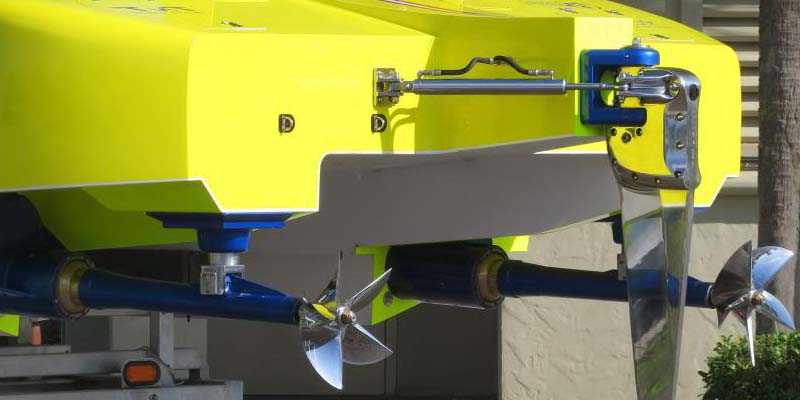
For a further proof that ventilation is useless at high speed, just see below for the business end of a 200+ mph turbine catamaran, with no vent of any kind.
bBnliKdh_o.jpg
 
I am always interested to read about surface drives on here. People have very firm opinions that are often based on the experience of someone they know rather than first hand, or that apply to only a particular model or brand of boat, yet their opinion becomes generic.
I’m just as guilty. I have heard that Arnesons (from people who have had them) are great provided you maintain them each year (a bit like an outdrive leg then ?). The bigger boats that I see with them, Pershing, Mangusta etc etc seem to go like the clappers - so that’s good too. Manoeuvrability is an often discussed criticism but ive never seen anyone have any issues, although I did hear about someone who had a 40ft boat with them who did say they were hard to operate, and he remembers turning Bonifacio into a white water frenzy whilst trying to spin her in a strong breeze. But I’ve never actually had a boat with Arnesons nor even driven one - so what do I really know ?

First hand experience is different. I have 3 x Trimax drives on my 2002 (rebuilt in 2017/18) Sunseeker super hawk 50. These are fixed surface drives with rudders on the 2 outer drives. She is fast (47 knots flat out), and relatively economical (4-5 litres per mile at 35 to 40knots or so). She is easy to drive...... you justlower the flaps, push the throttles and go. She has a 2 speed gearbox but to be honest she accelerates perfectly well from 2nd gear - I am not sure I get the point of the 1st gear - and then you raise the flaps to build the speed....... all pretty normal. The drives do have air intakes (as per Portos post of the Otam with 4 x Trimax drives) where the spinning propellers draw air from holes in the vertical plane of the aft end of the bathing platform and if one of those is blocked then it does make a huge difference. Manoeuvring isn’t any harder than any very long, very thin pointy boat - the bow does have a liability to catch the wind and the bow thruster (limited in size by the rake of the pointy bit) is not powerful enough to counter it as well as I would like, but she spins and can be walked sideways like any shaft driven boat. Best of all the drives require NO MAINTENANCE just like a shaft drive, but they do need to be clean......which is a PITA And I do spend a lot of swimming time scrubbing them (another good reason to have 2 rather than 3!). They are also quite vulnerable to anything in the water as the outer ones are far from the centre and also very near the surface and therefore there is not much forgiveness for a lazy line (don’t ask me how I know !) not quite sunk to the bottom.
In general I would recommend that people be no more frightened of a boat with surface drives than one with outdrives and that if the boat is specifically designed for them they will likely be very good. These days bow and stern thrusters take the stress out of manoeuvring if that’s what worries you. It is probably also true that one of the significant advantage of surface drives is to give out drive performance (or better) in instances where more diesel HP is required than can actually be channelled through an out drive. IPS has moved that along a little but at a significant cost.
 
One additional thought. Someone referred to a poor turning circle with fixed surface drives. My Superhawk turns harder than my passengers can or will tolerate......... no issue at all with turning circle which is probably the tightest of any boat I’ve ever had.
 
I have already said ^^^ in the SoF anything over or near 30 knots is too “ stressful “ inho .
Unless you go far out , a long way out .

Anyhow turns out the skipper was stoned on cannabis , bit like cars and alcohol+ speed there is an inevitability of an accident.
So bad decision making / judgements all round not the drive mechanism in this case .

I would be livid if crew where taking drugs on the boat while we were ashore dining .
If I had regular crew permanently on board I would think about weekly drug testing by a third party taking samples .
 
Top