3YM30 starter doesn't engage

Thanks for the info.

I recognize that part, it's on the top rear center of the engine. Perhaps a good test would be to jump the relay there. Are the two
large terminals supposed to be jumped momentarily to engage the starter?

It looks like there are two smaller terminals above them, do you know what attaches there?

I switched on the ingnition and with a small bit of electrical wire, I 'connected' the thin white wire to the thicker positive wire.
Sprang to life immediately.
 
Thanks for the info.

I recognize that part, it's on the top rear center of the engine. Perhaps a good test would be to jump the relay there. Are the two
large terminals supposed to be jumped momentarily to engage the starter?

It looks like there are two smaller terminals above them, do you know what attaches there?
This is the Yanmar part: Genuine YANMAR Marine Starter Motor Relay JH / YM series - 120270-77511 / 128990-77550

It doesn't seem that this is your problem although I did clean the connections on my identical 3YM30 magnetic relays a couple of years ago as they were looking a bit crusty.

The small terminals are used for the 12V low-current connections which I would guess come from the ignition/starter switch?

A question, which I have never sought to investigate, is why this relay is not incorporated into the solenoid attached to the starter motor? It's possible that this relay is being used to provide a negative ground to the crankcase for starting purposes but if anyone has the definitive answer to this question, I would also be interested.

EDIT .... thinking about this, I don't believe that the YM series have a switched earth. I therefore suspect that Yanmar have incorporated two relays into the starter system. The one under discussion takes the thin cables from the ignition switch and activates a thicker cable which goes to the starter-motor solenoid which then activates the high current connection to the starter motor itself.

This inevitably brings a second failure point into the YM system but Yanmar presumably believe that this is preferable to either running thicker cables all the way to the ignition switch or risking too much of a voltage loss by running thinner cables all the way to the starter motor solenoid. I can understand this approach in installations where the engine/s is/are far away from the control panel.

Richard
 
Last edited:
A question, which I have never sought to investigate, is why this relay is not incorporated into the solenoid attached to the starter motor? It's possible that this relay is being used to provide a negative ground to the crankcase for starting purposes but if anyone has the definitive answer to this question, I would also be interested.
EDIT .... thinking about this, I don't believe that the YM series have a switched earth. I therefore suspect that Yanmar have incorporated two relays into the starter system. The one under discussion takes the thin cables from the ignition switch and activates a thicker cable which goes to the starter-motor solenoid which then activates the high current connection to the starter motor itself.
This inevitably brings a second failure point into the YM system but Yanmar presumably believe that this is preferable to either running thicker cables all the way to the ignition switch or risking too much of a voltage loss by running thinner cables all the way to the starter motor solenoid. I can understand this approach in installations where the engine/s is/are far away from the control panel.

Richard
This is correct... Not only Yanmar ... Youll find a similar arrangement on VP engines........and probably others that I dont know about

The starter solenoid contains two windings , a high current pull in winding and a lower current hold in winding. The pull in winding grounds via the motor windings and is bypassed by the main contacts when closed The solenoid current is initially quite high .. I have measured 40 amps . Hence the local heavy duty relay switching the current to the starter solenoid.
There is nothing externally to indicate the double winding of the solenoid. but there is a diagram and an explanation in the YM series workshop manual.
 
Last edited:
I switched on the ingnition and with a small bit of electrical wire, I 'connected' the thin white wire to the thicker positive wire.
Sprang to life immediately.
You had already done something similar using a remote starter to prove that the starter motor and its solenoid were OK.
What you have now done proves that the starter relay is also OK.
Failure of the relay would not explain the warning lights going out and the buzzer stopping so it is no surprise to discover thatit is OK

Check the electical connections on the red wires arouns the strter solenoid and the relay looking in particular for a bad connection to the wire labelled 3R in the wiring diagram in your ownwers manual

If nothing wrong is found in this area its back to checking the 3 pin connectors in the wiring to the panel, monitoring the power input to the panel during starting attempts and checking the key switch
 
Last edited:
You had already done something similar using a remote starter to prove that the starter motor and its solenoid were OK.
What you have now done proves that the starter relay is also OK.
Failure of the relay would not explain the warning lights going out and the buzzer stopping so it is no surprise to discover thatit is OK

Check the electical connections on the red wires arouns the strter solenoid and the relay

I think you have me confused with OP.
 
This is correct... Not only Yanmar ... Youll find a similar arrangement on VP engines........and probably others that I dont know about
That's interesting. It's the first time I have ever read on here that some marine engines have a relay/solenoid for the solenoid/relay. It's such essential information that I'm amazed that, to my knowledge, it has ever been explained before. :unsure:

I wouldn't regard myself as a starter expert, especially wrt the electrics although only a couple of weeks ago I changed the complete bendix on my car inertia starter motor for a new bendix. It's the first time in 50 years that I've ever attempted that. Thankfully, I was successful and now she engages beautifully. :)

Richard
 
Check the electical connections on the red wires arouns the strter solenoid and the relay looking in particular for a bad connection to the wire labelled 3R in the wiring diagram in your ownwers manual

If nothing wrong is found in this area its back to checking the 3 pin connectors in the wiring to the panel, monitoring the power input to the panel during starting attempts and checking the key switch

Just printed the manual schematic you've referenced and I'll try jumping 30 & 17 of the start switch.

Please correct me if I'm wrong, but the schematic shows when the starter battery switch is ON, the + goes to the Starter terminal B, and 3R is the power source to the panel? If this is the case, wouldn't 3R have to be working for the warning lights to come on as expected as the key is turned to "ON"?

They key switch could be so broken that not only is is it failing to jump 17 and 30, but 30 is loses its connection to AC as the key is turned to START.
 
Just printed the manual schematic you've referenced and I'll try jumping 30 & 17 of the start switch.
Good

Please correct me if I'm wrong, but the schematic shows when the starter battery switch is ON, the + goes to the Starter terminal B, and 3R is the power source to the panel? If this is the case, wouldn't 3R have to be working for the warning lights to come on as expected as the key is turned to "ON"?
Yes but a bad connection, good enough, to power the warning lights but not close the relay, might cause the symptoms you describe .......... Its not my primary suspicion though

A voltmeter clipped between 30 and the black wire on the back of the tacho ( the only negative in the panel) while you attempt to start would confirm or eliminate the possibility of a bad connection

They key switch could be so broken that not only is is it failing to jump 17 and 30, but 30 is loses its connection to AC as the key is turned to START.

Something along those lines is my number one theory

Earlier in the thread it was suggested that the starter relay (24) ( pictured in #36) could be the cause of your troubles. I am still trying to work out what fault with it would cause the symptoms you describe.
It would be interesting if Koeketiene could tell us exactly what was wrong with this. . An open circuit coil would not cause the warming lights to go out, nor would failed or burnt contacts. An internal short maybe?

Jumping B to the W/Y connection would test the relay
 
Earlier in the thread it was suggested that the starter relay (24) ( pictured in #36) could be the cause of your troubles. I am still trying to work out what fault with it would cause the symptoms you describe.
It would be interesting if Koeketiene could tell us exactly what was wrong with this. . An open circuit coil would not cause the warming lights to go out, nor would failed or burnt contacts. An internal short maybe?

Jumping B to the W/Y connection would test the relay

I have no idea.

When I had this issue (similar symptoms as OP), I was stuck in Cherbourg (trying to bring my boat home) and my only interest was to get going as fast as possible.
Disassembling a relay goes beyond my limited technical abilities.
The issue was addressed by WhatsApp-ing 'my' mechanic to investigate where exactly the fault lay.
The cause of my troubles was traced pretty quickly to the relay I posted in #36.
This is apparently a known Yanmar issue. I have been told that there was a factory recall for these parts some years ago. A newer model relay is now available.

A local mechanic in Cherbourg then jury-rigged a 12V 40A automotive alternative to get me home.
He also confirmed that these Yanmar relays are a 'known issue'.
 
Jumped 30 & 17 of the start switch. Noticed a spark when first connected, nothing else happened. Also tried it with the key set to ON, and the alarm stayed on uninterrupted, but nothing else happened. (The original problem was that the alarm and all lights went dark when the key was turned to START.

A voltmeter clipped between 30 and the black wire on the back of the tacho ( the only negative in the panel) while you attempt to start would confirm or eliminate the possibility of a bad connection

Voltmeter from 30 to a convenient ground showed good battery voltage while the key was at OFF or ON, and a drop in voltage of about 1Volt when either the key was turned to START, or 30 & 17 were jumped.

Moving on to the starter relay (24 in diagram, pictured in post #36) confirmed good battery voltage on the thick Red wire with black to engine bolt ground.
Tried to jump the tiny control wires of the relay but nothing happened, I was running out of time and couldn't fiddle much. As a quick test, I jumped the thick Red wire on the relay to the thick White wire, and Nothing! This should have engaged to starter.

The problem started a couple weeks ago away from home port. As I recall my first attempt with the manual engine starter did not work, I heard an electric motor turn but the part which shifts didn't engage. A mechanic had a try while I was at the helm and it started right away, his explanation was that the small white wire had to be captured. I'm not sure if the problem observed right now is the original problem, or if the remote engine starter hookup was done in a manner which disconnected something.
 
Tried to jump the tiny control wires of the relay but nothing happened, I was running out of time and couldn't fiddle much. As a quick test, I jumped the thick Red wire on the relay to the thick White wire, and Nothing! This should have engaged to starter.

The problem started a couple weeks ago away from home port. As I recall my first attempt with the manual engine starter did not work, I heard an electric motor turn but the part which shifts didn't engage. A mechanic had a try while I was at the helm and it started right away, his explanation was that the small white wire had to be captured. I'm not sure if the problem observed right now is the original problem, or if the remote engine starter hookup was done in a manner which disconnected something.

Doesn't this all point to the relay I first suggested earlier in the thread?
 
Jumped 30 & 17 of the start switch. Noticed a spark when first connected, nothing else happened. Also tried it with the key set to ON, and the alarm stayed on uninterrupted, but nothing else happened. (The original problem was that the alarm and all lights went dark when the key was turned to START.


Voltmeter from 30 to a convenient ground showed good battery voltage while the key was at OFF or ON, and a drop in voltage of about 1Volt when either the key was turned to START, or 30 & 17 were jumped.

Moving on to the starter relay (24 in diagram, pictured in post #36) confirmed good battery voltage on the thick Red wire with black to engine bolt ground.
Tried to jump the tiny control wires of the relay but nothing happened, I was running out of time and couldn't fiddle much. As a quick test, I jumped the thick Red wire on the relay to the thick White wire, and Nothing! This should have engaged to starter.

The problem started a couple weeks ago away from home port. As I recall my first attempt with the manual engine starter did not work, I heard an electric motor turn but the part which shifts didn't engage. A mechanic had a try while I was at the helm and it started right away, his explanation was that the small white wire had to be captured. I'm not sure if the problem observed right now is the original problem, or if the remote engine starter hookup was done in a manner which disconnected something.
Very puzzling

Jumping the thick red to the white wire between the relay and the solenoid should have operated the starter motor. Even of the motor brushes are knackered or the mechanical parts jammed it should have operated the solenoid, which would have been obvious, and because the solenoid takes quite a significant current there would have been an obvious flash as you broke the connection.
Puzzling because what you did with the remote starter in #29 ( I take it that is just a switch ( button ) on a couple of leads ???) suggested that the relay, the starter solenoid and the starter motor were OK.
It now appears that the solenoid is defective or you have a bad connection somewhere around there

But maybe I am misunderstanding what you are doing
 
Last edited:
Very puzzling

Jumping the thick red to the white wire between the relay and the solenoid should have operated the starter motor. Even of the motor brushes are knackered or the mechanical parts jammed it should have operated the solenoid, which would have been obvious, and because the solenoid takes quite a significant current there would have been an obvious flash as you broke the connection.
Puzzling because what you did with the remote starter in #29 ( I take it that is just a switch ( button ) on a couple of leads ???) suggested that the relay, the starter solenoid and the starter motor were OK.
It now appears that the solenoid is defective or you have a bad connection somewhere around there

But maybe I am misunderstanding what you are doing

Yes, it still starts with the remote, and it's just an automotive type switch with two alligator clips. So the starter is working OK.

Maybe a wire was disconnected or broken between the relay and the starter/solenoid? It might be a few days before I get to the boat, and there has been some sailing because the remote is working fine.

Power is at the Red on the relay. The motor starts find when the remote switch at the starter/solenoid is used. Jumping behind the relay doesn't work. So the white wire from the Relay to the starter / solenoid must have failed?

Is there a site that has close up photos of the starter wiring?
 
Yes, it still starts with the remote, and it's just an automotive type switch with two alligator clips. So the starter is working OK.

Maybe a wire was disconnected or broken between the relay and the starter/solenoid? It might be a few days before I get to the boat, and there has been some sailing because the remote is working fine.

Power is at the Red on the relay. The motor starts find when the remote switch at the starter/solenoid is used. Jumping behind the relay doesn't work. So the white wire from the Relay to the starter / solenoid must have failed?

Is there a site that has close up photos of the starter wiring?
Has the relay coil got a ground lead to the engine & hence the battery neg?
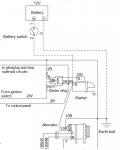
This is an enlargement of the starter motor and relay section of the wiring diagram

Yanmar 3YM30 starter wiring.jpg
 
OK, The starter relay is used because the ignition switch will not like carrying the current needed for the solenoid to engage.
When wire 2W goes on, the coil in the relay should engage and connect the heavy cable from the battery to the solenoid which will then pull in the pinion and contacts inside the motor will connect and spin up the starter motor.
If wire 2b is not grounded to the negative the relay will not pull in.

Directly connecting the heavy wire from the battery to 2W wire on the solenoid will run the starter if it and the solenoid are in order.

When the ignition is in the start position you should have battery voltage between 2W and 2B if not one or both wires are open.

Does this make it any easier?
 
It seems the problem is an intermittent fault in the starter relay (24 in diagram, pictured in post #36).

Following up on post #55, that test was flawed because the manual starter switch was installed by removing the small white wire attached to the solenoid on top of the starter. Thus when the relay was jumped, nothing happened. Removing the remote starter switch and re-attaching the small white wire resulted in the engine starting as normal from the panel.

So as Koeketiene pointed out, these Yanmar relays are said to have problems. I'm going to buy, but of the two numbers
 
it seems that part number 128990-77550 is the more recent one. Hopefully they've fixed whatever issue it had. Plus, I'm still puzzled why the
panel would have gone black. Unless activating the relay cause a short somehow.
 
Top