3.5hp OB with no reverse for a Corribee?

Mark-1

Well-Known Member
Joined
22 Sep 2008
Messages
5,545
Visit site
I'm thinking of getting a lower power long shaft OB with no reverse gear for simplicity and to save some weight.

Something like this: Mariner 3.5 HP 4-Stroke Long Shaft Outboard Motor F3.5ML

I only use reverse leaving the marina berth, I think I can manage without, and am prepared to risk it. (The gear lever on the existing OB is such a reach it's easier to turn the engine around anyway.)

Will power be a problem, to people think? Is there anything else I need to consider?

Anyone know, off hand, if the 50cm recommended transom height will happily match the transoms height on my 5hp 2str mariner? (I'll measure it later!)
 
I had the loan of a Mariner 3.5 from a mate of mine after my 6Hp was nicked off the back of the boat .. mine's a Hurley 20 and it shifted it along very nicely.. I would have gone with it full time but the lack of a reverse gear put me off, because the engine sits in a scoop so reversing the engine was not an option..
 
I'm thinking of getting a lower power long shaft OB with no reverse gear for simplicity and to save some weight.
Something like this: Mariner 3.5 HP 4-Stroke Long Shaft Outboard Motor F3.5ML
I only use reverse leaving the marina berth, I think I can manage without, and am prepared to risk it. (The gear lever on the existing OB is such a reach it's easier to turn the engine around anyway.)
Will power be a problem, to people think? Is there anything else I need to consider?
Anyone know, off hand, if the 50cm recommended transom height will happily match the transoms height on my 5hp 2str mariner? (I'll measure it later!)
50cm (or 20") transom height requires a long shaft engine

A standard/short shaft engine will be for a 38cm (15") transom height
 
Last edited:
I have a Corribee and had a non reverse outboard for a few years. In all honesty it was possibly easier that the Yamaha motor I have now that has reverse. I wouldn't go less than 3.5hp though. You definitely need a long shaft motor - the stern comes a surprising amount out of the water in a swell. Two strokes are great as they are very light for their power, but a modern 4 stroke is significantly more economical. The Yamaha uses about 1.1l per hour, the Mariner 4hp 2 stroke I used to have used about 4l/hr

There is a good Corribee Facebook group Facebook Groups
 
I've a 2.3hp Honda on my Folkboat, which is absolutely fine and pushes along in flat water at about 4kts. There's no reverse gear, but it's got 360° for the reverse in marinas, which is perfect.
I've crossed the Pentland Firth with it, and not had a problem because if there's wind, I can sail....!
I've extended the long shaft by 1 element (for want of a better word).
The long shaft version is the short shaft with 'an' element added. I added it to avoid cavitation. The mod is really simple 2 bolts and extending the shaft at a local engineer.
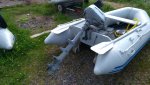
Pic of motor on tender.
IMG_20170619_162259 (1).jpg
 
Unless you're having problems with your existing one I honestly wouldn't bother for the sake of saving a few of kg...

Yeah, it has death rattle. I think it would take more effort and resource to investigate the rattle than it would take to buy a new one. There's no way I'd swap a working 2str engine.
 
I have a Corribee and had a non reverse outboard for a few years. In all honesty it was possibly easier that the Yamaha motor I have now that has reverse. I wouldn't go less than 3.5hp though. You definitely need a long shaft motor - the stern comes a surprising amount out of the water in a swell. Two strokes are great as they are very light for their power, but a modern 4 stroke is significantly more economical. The Yamaha uses about 1.1l per hour, the Mariner 4hp 2 stroke I used to have used about 4l/hr

There is a good Corribee Facebook group Facebook Groups

Thanks for a first class post.

Shortly after I posted this I realized that if I need reverse any time other than leaving my berth I habitually turn the engine round, which totally answers my own question. The gear lever is an awkward reach, turning the engine is a doddle.
 
I've a 2.3hp Honda on my Folkboat, which is absolutely fine and pushes along in flat water at about 4kts. There's no reverse gear, but it's got 360° for the reverse in marinas, which is perfect.
I've crossed the Pentland Firth with it, and not had a problem because if there's wind, I can sail....!
I've extended the long shaft by 1 element (for want of a better word).
The long shaft version is the short shaft with 'an' element added. I added it to avoid cavitation. The mod is really simple 2 bolts and extending the shaft at a local engineer.
Pic of motor on tender.
View attachment 105295
That's neat.. Is the shaft one piece or extended by splined joints? Last time I looked the bits to swop cost enough to look for another s/h engine.

Friend uses a Mercury 3.5 4T, same as the Mariner, after a Tohatsu 3.5 2T. In a well so can't turn much, but lack of reverse not a prob.

Same with my project. I have two 3.5 2Ts. Both old, but working OK. But, there might be a 4hp Merc 2T with little use and reverse available. Tempting...
 
Last edited:
That's neat.. Is the shaft one piece or extended by splined joints? Last time I looked the bits to swop cost enough to look for another s/h engine.

Friend uses a Mercury 3.5 4T, same as the Mariner, after a Tohatsu 3.5 2T. In a well so can't turn much, but lack of reverse not a prob.

Same with my project. I have two 3.5 2Ts. Both old, but working OK. But, there might be a 4hp Merc 2T with little use and reverse available. Tempting...
As I recall, the whole lot cost about £100. The bits I bought were only £50 I'm sure, and the engineering company simply welded a 'pup' piece extension in the middle of the shaft.
The whole lot bolted together in a couple of minutes, and has been trouble free for over a 100 hrs. :)
 
I've a 2.3hp Honda on my Folkboat, which is absolutely fine and pushes along in flat water at about 4kts. There's no reverse gear, but it's got 360° for the reverse in marinas, which is perfect.
I've crossed the Pentland Firth with it, and not had a problem because if there's wind, I can sail....!
I've extended the long shaft by 1 element (for want of a better word).
The long shaft version is the short shaft with 'an' element added. I added it to avoid cavitation. The mod is really simple 2 bolts and extending the shaft at a local engineer.
Pic of motor on tender.
View attachment 105295

@jamie N , I'm *really* tempted by the Honda. It's light, and air cooled, so no impeller to change.

I've heard they're noisy, is that a problem? (I've got a 5hp 2stroke which is already pretty noisy.)

Corribee is half the weight of a folkboat, but as a bildge keeler probably harder to push through the water....

Is there a valve for an external fuel tank?

Automatic clutch is a positive advantage to me, but presumably means it won't chug along in tickover do you find that a problem?

I guess you literally thrash it at full throttle and it doesn't complain?

I frequently take the kids out in a flat calm so I do expect it to be running for extended periods, so I can't compromise *that* much on power/noise....

Any idea if there's a high thrust prop option? Any idea if it's worth having one!?

Decisions....
 
An extension on the gear selector is a lot easier than turning the engine. The twist grip is away from you. I have had all combinations on sub 20' yachts and woudln't choose to do without reverse.
 
Some good advice above. One of the problems of small outboards is they are usually propped for small, very light tenders that are accelerated easily. With a relatively heavy (in comparison) yacht you well may find your engine never reaches the speed to give its full power because the load is too great for the pitch of the propellor.

Slightly larger outboards are more likely to be available with a 'high thrust' version (as opposed to high speed) for yachts or heavier boats, so fitted with a shallower pitched propellor (or with such propellors available as an option or manufacturer's spare) which will allow it to reach full engine revs (and hence power).

Setting that issue aside, a surprisingly small engine will drive a yacht along nicely at a decent speed in calm conditions. It is when you start facing wind and waves that the absence of spare horses will show itself and your speed will plummet.

Which is not to say you shouldn't get a small outboard. Expectations of required hp were significantly lower when the Corribee was new, and people seemed to manage OK then. I have an old PBO publication (probably based on PBO's original test of the Corribee) which refers to them using a 4hp to 8hp outboard. Based on my own experience of 16', 17' and 22' yachts with outboards, I'd have thought about 5hp to 6hp would be the best compromise for a Corribee.

The other thing to consider is charging. It will depend on your use of the boat, but when I had outboard propped boats, and used them for touring, the pathetic charging available from them was a major drawback. Things may have changed since then it that regard, and the availability of solar panels has also made a big difference.
 
I tried my short-shaft 3.5 Tohatsu in an Achilles 24's engine well. According to Achilles owners, long shaft is essential, but I'd seen how far the boat's own long-shaft protruded through the well...and I wasn't surprised when my 3.5 sent a river of wash away behind the boat, with no water rebounding up the well. I've no doubt it was powerful enough for the 1,200kg displacement in fair weather.

On the Redcrest, I was surprised that 3.5hp didn't push us faster...are aged round-tail inflatables the hardest shape to drive along?

I wondered about the propeller - I don't know if the Tohatsu 3.5 two-stroke was offered with a choice of props. I'll fit it to the Osprey, which at under 150kg on the water, seems reasonable - but whether a non-standard prop will suit that hull better, I don't know.
 
Prob depends on where you sail, off a mooring reverse is less important than in a marina berth. Way back, we sailed a 27ft off a mooring with a Seagull Silver Century L/S. Used it on the dinghy too. It had a clutch, which made a big difference. Wouldn't have fancied it the other day in the marina, when the allocated berth in a narrow row turned out to be occupied and a multi point turn in a cross wind was needed.

Dan, if you try your o/b on a rigid small dinghy and judge the revs and speed, then on the Osprey, if the revs are lower, then maybe a finer pitch prop would help. I sometimes wonder if the ally props on o/bs can be repitched, but maybe the ally is to fragile compared to bronze.
 
Thanks all. I've pretty much decided the Tohatsu 3.5 will work fine for me. Hopefully there will be a high thrust prop option, if not I'll lump it.

My main question now is can I get away with the 2.3 Honda, which saves weight, gives me a centrifugal clutch and isn't cursed with water cooling.... At the expense of noise and even less power. :(
 
At 17kg, that seems pleasingly lightweight for a four-stroke. ?

It seems insanely heavy to me. My 5hp Mariner 2str with reverse weighs 21kg and find that hard on my back. (Leaning over the back of the boat to fit it etc...) I'd expect 20 years newer, and no gears to be way lighter. (Well I didn't *expect* that because two strokes got banned, but you know what I mean.)

My dad's 2hp Yamaha was easily manageable by me on my own at 8 years old. Fitting to the boat, lifting into the boot the lot. X decades of progress should have made outboards about the same weight as helium.
 
[17kg] seems insanely heavy to me. My 5hp Mariner 2str with reverse weighs 21kg and find that hard on my back. I'd expect 20 years newer, and no gears to be way lighter.

We seem to have had (at least some) very similar engine experience. I too have had recent use of a Mariner 5hp two stroke. Its former owner had believed it to be a four stroke (fortunately he didn't own it long enough to refuel the pre-mixed remote tank) and I could well believe it was 28kg or even more, as 5hp four strokes typically are.

The fact that the Mariner 5hp two stroke is 21kg and (it seems to me) built like a tank, contrasts very noticeably with the short-shaft Tohatsu 3.5 two-stroke, which at 13kg has a toy-like feel.

I've read some horrendous weights for new four-strokes...like the Honda 4hp short shaft - 27kg! So, if anyone is building a 17kg 3.5hp four stroke, let's not be ungrateful - it could be far, far worse.
 
Last edited:
Top