24v to 12v series to parallel switching.

ncritchley

Well-Known Member
Joined
14 Sep 2012
Messages
82
Visit site
Hi there,
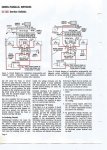
I've got a Watermota Sea Panther diesel, one that by design requires a great whack of 24 volts through a 12v starter motor to get going. I've been meaning for a few years to fit a 12v/24v series/ parallel switch to the charging circuit, so that once the engine's running everything switches from series to parallel for domestic, navigation, charging electrics etc. This all works beautifully, except that if I follow the manufacturer's diagram, only one battery is charged, once the 12v parallel circuit has switched in. I've attached the relevant diagram here, it's the diagram on the right.
Could anyone advise me what's wrong here? It's obviusly not ideal if one of my batteries has to be charged separately. Or do I just wire it in somehow as an extra on the alternator's charging output circuit?
Very grateful for any advice.
Thanks,
NeilDelco-Remy-page-0.jpg
 

Attachments

Are you saying it does not work or that you cannot see how it should wok.

I can see how it should work
 
Hi there,
I've got a Watermota Sea Panther diesel, one that by design requires a great whack of 24 volts through a 12v starter motor to get going. I've been meaning for a few years to fit a 12v/24v series/ parallel switch to the charging circuit, so that once the engine's running everything switches from series to parallel for domestic, navigation, charging electrics etc. This all works beautifully, except that if I follow the manufacturer's diagram, only one battery is charged, once the 12v parallel circuit has switched in. I've attached the relevant diagram here, it's the diagram on the right.
Could anyone advise me what's wrong here? It's obviusly not ideal if one of my batteries has to be charged separately. Or do I just wire it in somehow as an extra on the alternator's charging output circuit?
Very grateful for any advice.
Thanks,
Neil

"once the 12v parallel circuit has switched in" The key word there is "parallel". If the batteries are in parallel, they both get charged, unless the switch is faulty.
 
Hi there,
I've got a Watermota Sea Panther diesel, one that by design requires a great whack of 24 volts through a 12v starter motor to get going. I've been meaning for a few years to fit a 12v/24v series/ parallel switch to the charging circuit, so that once the engine's running everything switches from series to parallel for domestic, navigation, charging electrics etc. This all works beautifully, except that if I follow the manufacturer's diagram, only one battery is charged, once the 12v parallel circuit has switched in. I've attached the relevant diagram here, it's the diagram on the right.
Could anyone advise me what's wrong here? It's obviusly not ideal if one of my batteries has to be charged separately. Or do I just wire it in somehow as an extra on the alternator's charging output circuit?
Very grateful for any advice.
Thanks,
NeilView attachment 104418

Albright make, or did, a parallel / series change-over relay, changes two 12 volt batteries in parallel to 24 volt in series, we also used it for starting rally cars.

Brian
 
Are you saying it does not work or that you cannot see how it should wok.

I can see how it should work

Hi there, thanks for your comment. It could be that I'm misunderstanding the whole thing. With reference to the picture I supplied, the RH of the two circuit diagrams, with the switch in parallel mode, i.e. default mode, with ignition switch circuit open, and a 14.6V charging current supplied as indicated, I get the following results:
1. If I put a voltmeter from negative terminal battery "A" to positive terminal battery "B" I get a reading of 14.66V.
2. If I connect the voltmeter from negative terminal battery "A" to positive terminal battery "A" I get 14.66V.
3. If I connect the voltmeter from negative terminal battery "B" to positive terminal battery "B" I get 12.6 V, the same reading as when that battery is fully disconnected.

I appreciate your time and trouble!
 
"once the 12v parallel circuit has switched in" The key word there is "parallel". If the batteries are in parallel, they both get charged, unless the switch is faulty.
You're right of course, I'm hoping it isn't a dud. the fault is most likely in my understanding of electrics. I gave a few more details of what's happening in my reply to Vic.
 
Eh what a diabolical circuit that is. No sorry just can not get my head around the current paths. Inevitably on cranking you must have 4 contacts making to get current to starter motor. Not good for the high current. If with engine running you check the voltage across each battery and they are the same you have parallel charge if not then you don't have paralleling. This could be from bad contacts assuming it all worked well once.
I wonder if the engine would not crank reasonably well on 12v in a normal circuit? I would try it.
If not I think I would go for simplicity of a 24v system. ie get a 24 v alternator and fit a 24v solenoid for the starter. All hard wired for reliability.
You can then fit a 24 to 12v converter for 12v devices. Or you could fit an additional battery to serve as a service battery charged by a 24 to 12v converter best fed by a Voltage Sensing Relay.
 
Often wondered if modern really high CCA 12v batteries might overcome the old school thinking behind the equally old school behind the requirements in those days to have a 24v feed to a 12v starter for firing a high compression diesel like this. I’d be tempted to try, if I was you.
 
Hi there, thanks for your comment. It could be that I'm misunderstanding the whole thing. With reference to the picture I supplied, the RH of the two circuit diagrams, with the switch in parallel mode, i.e. default mode, with ignition switch circuit open, and a 14.6V charging current supplied as indicated, I get the following results:
1. If I put a voltmeter from negative terminal battery "A" to positive terminal battery "B" I get a reading of 14.66V.
2. If I connect the voltmeter from negative terminal battery "A" to positive terminal battery "A" I get 14.66V.
3. If I connect the voltmeter from negative terminal battery "B" to positive terminal battery "B" I get 12.6 V, the same reading as when that battery is fully disconnected.

I appreciate your time and trouble!

Your voltage readings tell us what we need to know

Using your numbers

2. Your reading tells us that the battery A is receiving charge

1. Your reading here tells us that the positive terminal of battery B is connected to the positive supply from the generator

3. Your reading here is the one which is wrong ... It tells us that the negative terminal of battery B has not been connected to the negative ground.

The negative of battery B should be grounded via terminal 2, the right hand pair of auxiliary contacts, terminal 5 and the shunt for ammeter 2 ( if fitted)

Check the external circuit from 5 to ground. If that's good I'd deduce that the trouble lies within the solenoid switch assembly almost certainly with the auxiliary contacts between 2 and 5.
 
Eh what a diabolical circuit that is. No sorry just can not get my head around the current paths. Inevitably on cranking you must have 4 contacts making to get current to starter motor. Not good for the high current. If with engine running you check the voltage across each battery and they are the same you have parallel charge if not then you don't have paralleling. This could be from bad contacts assuming it all worked well once.
I wonder if the engine would not crank reasonably well on 12v in a normal circuit? I would try it.
If not I think I would go for simplicity of a 24v system. ie get a 24 v alternator and fit a 24v solenoid for the starter. All hard wired for reliability.
You can then fit a 24 to 12v converter for 12v devices. Or you could fit an additional battery to serve as a service battery charged by a 24 to 12v converter best fed by a Voltage Sensing Relay.
Often wondered if modern really high CCA 12v batteries might overcome the old school thinking behind the equally old school behind the requirements in those days to have a 24v feed to a 12v starter for firing a high compression diesel like this. I’d be tempted to try, if I was you.

I struggled at first to understand how it worked

FWIW I believe that later versions of the engine had an all 12 volt system with some sort of preheating . A thermostarter probably ???
 
Last edited:
Your voltage readings tell us what we need to know

Using your numbers

2. Your reading tells us that the battery A is receiving charge

1. Your reading here tells us that the positive terminal of battery B is connected to the positive supply from the generator

3. Your reading here is the one which is wrong ... It tells us that the negative terminal of battery B has not been connected to the negative ground.

The negative of battery B should be grounded via terminal 2, the right hand pair of auxiliary contacts, terminal 5 and the shunt for ammeter 2 ( if fitted)

Check the external circuit from 5 to ground. If that's good I'd deduce that the trouble lies within the solenoid switch assembly almost certainly with the auxiliary contacts between 2 and 5.

Wow, I'm so grateful for the trouble you, and the other responders here have gone to. I'll try out your suggestion straight away and report back. Once again, this forum shows what a fantastic community this is!
 
Thanks again to everyone. I'm just wondering if anyone knows what the role of terminal 5 is? I've figured out that 6 and 7 are for the starter switch circuit. But 5? The diagram's not at all clear to me on this.
 
Thanks again to everyone. I'm just wondering if anyone knows what the role of terminal 5 is? I've figured out that 6 and 7 are for the starter switch circuit. But 5? The diagram's not at all clear to me on this.
5 is a negative, or ground connection, The diagram shows the connection to ground ( admittedly the ground symbol is drawn sideways) via ammeter 2.

When the switch is in the 12 volt charging position the two pairs of auxiliary contacts are closed and the negative terminal of battery B is grounded( to the negative via terminal 2 , the right hand pair of auxiliary contacts and terminal 5
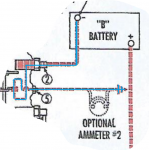
The diagram below shows the path in blue

When the switch is in the start position the auxiliary contacts are open, disconnecting the battery from the negative ground but the upper pair of main contacts connect it in series with battery A.

If the auxiliary contacts are bad that may be the cause of your problem but check the circuit from terminal 5 to ground because a break in that could also be the cause

I guess the solenoid switch is a sealed non-serviceable unit. If so and testing shows the RH pair of auxiliary contacts to be faulty it would be possible to bypass them using a relay. with normally closed contacts.
I am not 100% happy with the idea but provided a fuse is included it should be safe.

1607307115171.png
 
Last edited:
You're right of course, I'm hoping it isn't a dud. the fault is most likely in my understanding of electrics. I gave a few more details of what's happening in my reply to Vic.

That's a very poor schematic, but Vic has correctly identified the way it works and i think he's pinpointed the fault too.

Check for continuity between terminal 5 and the negative of battery A. If no continuity, the switch has a bad contact between terminals 2 and 5 (you could double check by testing for continuity between terminals 2 and 5). You could connect a suitably rated, normally closed, relay between terminals 2 and 5, connect the relay coil to negative and terminal 7. There must be a fuse between the relay and either, terminal 2 or 5, rated for the same current as the relay.
 
Last edited:
Hard to see how they can justify that Roger but that's Vetus for you. Wouldn't be difficult to make something up for the OPs purpose, but probably not much of a market.

Yes you are right there

When I was designing my current boat I selected a 12Vdc bow thruster. Yes this ment bigger cables but as I was building it was easy to fit big bus bars.

I picked up an above deck andersen winch motor that is 24dc so I will need to look at how to drive it but that some time ahead. One reason I looked at the post.

As Vic pointed out its rated at 100 A continuous so it would not drive my Vetus bow thruster 600 Amp max but it could drive a 24Vdc starter motor as a starter motor is only intermittent operation
 
Top