
240v circuitry - mains tester

prv

Well-Known Member
Joined
29 Nov 2009
Messages
37,358
Location
Southampton
Visit site
Recent threads about disintegrating shore power leads and the like have got me thinking. I'd like to have a "socket tester" type circuit, the kind with three neon lamps, incorporated in the panel. I know I could just buy a plug-in tester for a few quid, but I'm a perfectionist and I want the panels to match :)

I've found this circuit: http://www.marcspages.co.uk/pq/4511.htm
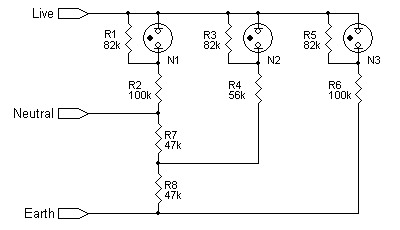
4511a.gif


...these neons: http://www.ebay.co.uk/itm/515205RED...al_Components_Supplies_ET&hash=item53f69b6a48 .

..and these resistors: http://www.ebay.co.uk/itm/82K-Ohm-C...al_Components_Supplies_ET&hash=item20b8f84065 (and others like them for the other values in the circuit).

I'm quite happy with my ability to assemble the circuit properly on a sliver of veroboard, and the whole lot will be mounted inside an adaptable box with just the panel-mount neons protruding through the front. But I've never really done anything like this with 240v before, so I thought I'd run it by the wisdom of the forum for any obvious howlers. In particular, do I need special resistors rather than the standard 0.5w ones above? Will the "integral resistor" in the neons mess up the functioning of the circuit? Will the whole lot end up drawing masses of power and heating up if it's left on the whole time I'm plugged in?

Cheers,

Pete
 
Last edited:
The circuit should be quite safe from heating. The large ressitance in each leg mean very little current can flow. I think .5 watt resistors will be OK however if you have concerns then ahlve the resistor value and fit 2 in series. That will double the voltage rating of the resistor. The voltage rating being the max voltage the resistor can take from lead to lead (disregarding actual current flow) before you get arcing between the 2 leads. Higher wattage ressitor being physically bigger will also tend to have a higher voltage rating. The voltage rating not being a thing we are often concerned with.
I am not sure what the cvircuit is supposed to tell you. The neon first from the left will show power applied. The neon on the right will show normally with power via the earth lead. If it does not light then earth lead may be live (dangerous). The middle neon Would I think normally light via both neutral and earth ie via 47ks in parallel. Not sure what wil;l happen if neutral and actie are swapped. good luck olewill
 
I am not sure what the cvircuit is supposed to tell you. The neon first from the left will show power applied. The neon on the right will show normally with power via the earth lead. If it does not light then earth lead may be live (dangerous). The middle neon Would I think normally light via both neutral and earth ie via 47ks in parallel.

Sounds like you've laboriously worked out that a good supply is all three neons on :)

As you say, right one out means the earth is either missing or at the same potential as the live - either is not good.

The other combinations are shown below the circuit, on the linked page. A live / neutral swap, for example, causes the left neon only to come on, with the other two off.

Pete
 
I have commented on this on the other thread (373731), but to repeat: I would advise not having a permanent connection between live and earth, even via a resistance of about 50kΩ. You could get round this with a DPST momentary switch.

The circuit requires neons without an internal resistor BTW.
 
Last edited:
Recent threads about disintegrating shore power leads and the like have got me thinking. I'd like to have a "socket tester" type circuit, the kind with three neon lamps, incorporated in the panel. I know I could just buy a plug-in tester for a few quid, but I'm a perfectionist and I want the panels to match :)

I've found this circuit: ..............................................
I'm quite happy with my ability to assemble the circuit properly on a sliver of veroboard, and the whole lot will be mounted inside an adaptable box with just the panel-mount neons protruding through the front. But I've never really done anything like this with 240v before, so I thought I'd run it by the wisdom of the forum for any obvious howlers. In particular, do I need special resistors rather than the standard 0.5w ones above? Will the "integral resistor" in the neons mess up the functioning of the circuit? Will the whole lot end up drawing masses of power and heating up if it's left on the whole time I'm plugged in?

Cheers,

Pete

0.6W resistors from Maplin are rated for 250 volts. The ones in your link are rated for 700 volts. No problems, therefore, with either as far as voltage ratings are concerned.

I assumed the circuit is designed for neons without series reistors eg http://www.maplin.co.uk/wire-endedneon-type-1952 but noticing these require a 270K series resistor for 230 volt operation I am now not so sure.


I don't know what Nigelmercier's objections are but my concern would be that the current flowing to earth would "turn on" a galvanic isolator . I'd suggest therefore that any permanent indicator fitted should be connected to the shorepower earth on the input of any galvanic isolator.
 
Exactly that, or indeed cause electrolytic corrosion.

There was a discussion some time ago where VicS proposed /posted 2 different ways of connecting a GI to allow for the protection against electrolytic corrosion but to still have a direct earth connection to the incoming power lead earth wire.

Vic may still have the diagrams as I cannot find the Vic's post.

As I have a steel hulled boat GI and electrolytic corrosion is very important to me. All I can say is still have the original anodes fitted to my hull from when I launched my boat 4 years ago where most of the boats around me are having anodes replaced at least every year.

I have pics some ware. The anodes on my set that have eroded the most and on my prop shaft which I planed to change last August at my annual inspection but found that would last at least another year.
 
There was a discussion some time ago where VicS proposed /posted 2 different ways of connecting a GI to allow for the protection against electrolytic corrosion but to still have a direct earth connection to the incoming power lead earth wire.

Vic may still have the diagrams as I cannot find the Vic's post.

They went with the question "is the circuit in Fig2 acceptable?"

Galvanicisolator.jpg~original
 
Thats it Vic and IMHO I think it is OK as it blocks DC from passing through any anodes to ground thus setting in impressed electrolytic corrosion yet not blocking and leakage current from passing to the supply ground which would potentially have a lower impedance path. but if that leakage path became high impedance any leakage current could still pass to earth through the GI. The current I measured passing down the supply earth leg was only about 2 mA so had no real effect on my RCD

I did have mine wired as Fig 1 but changed to no Fig 2 and I have found no difference in anode wastage. I didn't have much anyway.

Nigel any comment?
 
I would just disassemble something like a Socket-and-See, and build the innards into the boat panel.

I did think of that, but I suspect the mechanics of it might actually prove more complicated than making my own circuit and popping three panel-mount neons into holes in the panel.

Pete
 
I think the LED one would tend to trip the RCD unless there is a high impedance drive circuit driving the LED's.

Neon old fashioned but IMHO better in this application.
 
I don't know what Nigelmercier's objections are but my concern would be that the current flowing to earth would "turn on" a galvanic isolator .

Exactly that, or indeed cause electrolytic corrosion.

I don't have a galvanic isolator, or indeed any hull anodes.

The only metal in contact with the water is the seacocks and rudder stock, which aren't connected to anything, and the sail drive which has a prop anode but is electrically isolated from anything inside the boat.

I haven't touched the existing shore power setup, but to the best of my knowledge it has no connections to any other system on board. The earth connection is back to shore via the cable. This is as installed in Sweden; the immersion heater and battery charger are plugged into two-pin euro sockets, but the "user" sockets have been replaced with UK style (or possibly built that way since they knew the boat had a UK buyer).

The only reason I want to meddle with it is that the consumer unit is in a vulnerable position in the cockpit locker. Otherwise it's entirely satisfactory.

Pete
 
I assume your boat is GRP if it is your set up in OK IMHO.

When you have mains connected and for some reason the supply line earth becomes faulty and one of your mains powered devices also becomes faulty with a mains to metal case fault. is it possible to touch the metal case accidently. If not IMHO you dint need to earth any metal bits below the water line as your boat is in effect like a double insulated appliance.

My boat being steel IMHO must have hull earthing yours does not.

The neons fitted as discussed would be useful to verify incoming earth and line/neutral reversal.
 
sail drive which has a prop anode but is electrically isolated from anything inside the boat ... I haven't touched the existing shore power setup, but to the best of my knowledge ...

To the best of my knowledge, my engine was isolated from the ground. It wasn't. Cost £3000.

The reason I suggested the LED version is that LEDs are easier to mount, and the circuitry is likely to have much higher value resistors. The resistors in a neon are not meant to drop the voltage, just limit the current once the neon has struck.

It has just occurred to me that perhaps people are under the impression that a neon is open circuit. This is a common misunderstanding, the fact is that they are open circuit until they strike, but then exhibit negative resistance! In other words, a short circuit on steroids.
 
I don't have a galvanic isolator, or indeed any hull anodes.

The only metal in contact with the water is the seacocks and rudder stock, which aren't connected to anything, and the sail drive which has a prop anode but is electrically isolated from anything inside the boat.

I haven't touched the existing shore power setup, but to the best of my knowledge it has no connections to any other system on board. The earth connection is back to shore via the cable. This is as installed in Sweden; the immersion heater and battery charger are plugged into two-pin euro sockets, but the "user" sockets have been replaced with UK style (or possibly built that way since they knew the boat had a UK buyer).

The only reason I want to meddle with it is that the consumer unit is in a vulnerable position in the cockpit locker. Otherwise it's entirely satisfactory.

Pete

Apart from having a shaft drive, our set up is the same as yours. Less than a year after buying the boat, with new anodes on shaft and prop fitted, we lost a blade due to a tree branch wedging briefly under the after hull. We had to beat down the Hamoaze and get into our berth in a locked marina under sail. The prop had turned to copper, as had the P bracket, and the anodes were long gone. Since fitting a GI the anode life has extended to 18 months + despite shore power being on 24/7.

Fitting a GI is much cheaper than the possible consequences of not doing so on a marina based AWB.
 
Apart from having a shaft drive, our set up is the same as yours.

So how was the shaft isolated from the engine?

My saildrive has a dirty great plastic gasket, plastic sleeves round the bolts, and little plastic tabs under the bolt heads.

Since I have no intention of wiring my engine up to the mains, I'm not sure what this has to do with me anyway.

Pete
 
Top