2 cracked exhaust elbows - MTU

seems to me you all have points, maybe a combo of heating cycles and a bit of seasoning with back splash of seawater...

Marc, what's the distance (as in HEIGHT ABOVE!) from WL at rest and the point that the flex thing joins the big black dry exhaust bit?
It seems to me to be something like 20cm
and furthermore, mixing point must be even less.

Not sure LS would be happy with such a setup (considering his suggestions on a rusted turbo I had- ended up building new SS elbows going all the way up to 3cm from the salon floor to get enough head and keep water out)

V.

I have had a quick look and the cooling water joins the exhaust approx 700mm above WL, although there is an earlier split to allow water out of the above water exhausts.

The bottom of the black exhaust is about 900mm above WL between the turbos. The top is maybe 40mm below the ceiling.
 
I have had a quick look and the cooling water joins the exhaust approx 700mm above WL, although there is an earlier split to allow water out of the above water exhausts.

The bottom of the black exhaust is about 900mm above WL between the turbos. The top is maybe 40mm below the ceiling.

Ok, so I'm talking balls, photo perspective distorting distances a lot...

no way water going up hill 900mm!

V.
 
Ok, so I'm talking balls, photo perspective distorting distances a lot...
no way water going up hill 900mm!
Funny you should say that V, 'cause I tend to agree more with your initial impression than with the actual numbers posted by markc.
Far from pretending to know your boat better than yourself of course, but are you sure to have considered the right dimensions, M?
By heart, I would say that 900mm is the height of your whole e/r, if measured from the engine mounts to the ceiling!

For further reference, have a look at the pics below.
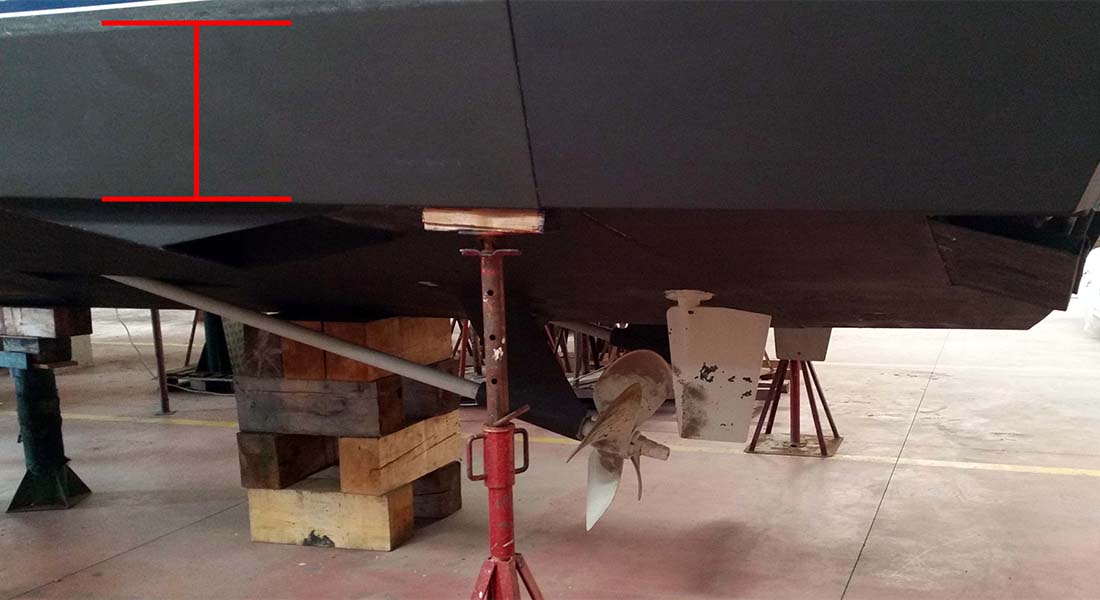
The first shows the exterior of a F165, and I drew some red lines to show the distance between the bottom of the u/w exhaust and the w/l.
I don't have any accurate reference in the pic for telling how much that dimension is, but I just checked my boat (whose size is very similar to yours, and with just 1 degree more of deadrise), and it's in the 30cm ballpark.
I don't think we are much wrong by assuming that yours is the same.
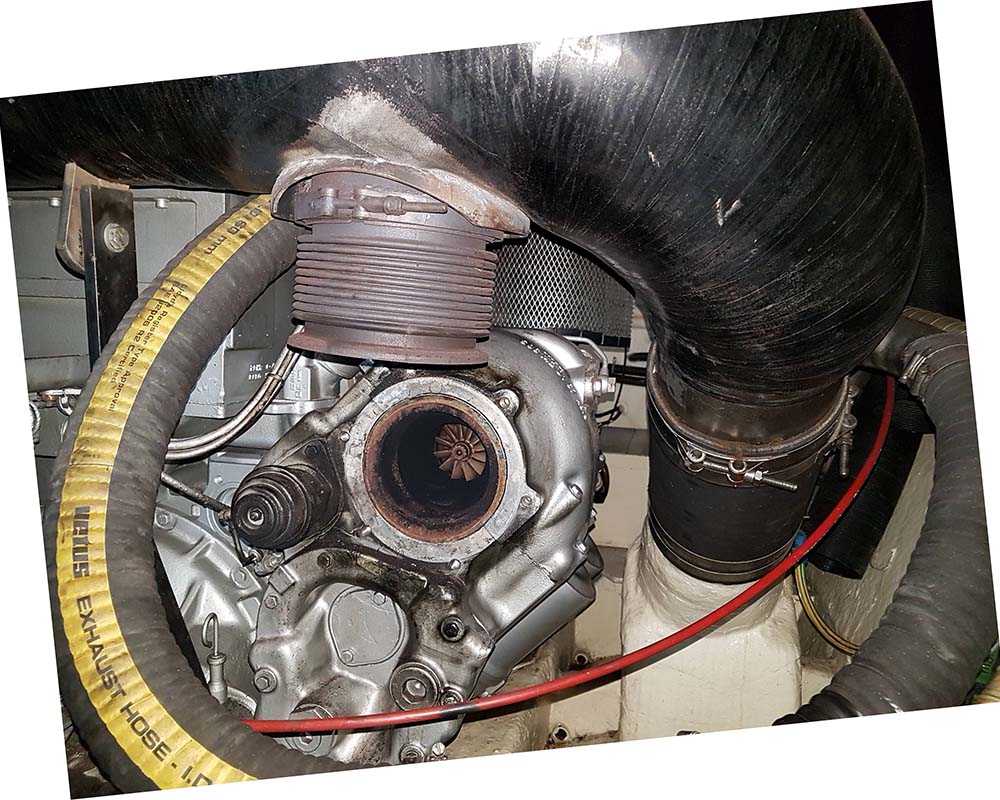
In the second pic, I tried to "straighten" one of your pics which shows the GRP box of the u/w exhaust, right in the same position of the previous pic, but inside the e/r.
Again, I don't have any accurate reference, but if you go 30cm up from the bottom of that box, by and large you should reach at least the lower part of the rubber exhaust section, downstream of the raw water re-injection pipe.
And if my estimate is correct, there's no way that such pipe is another 70cm higher.
Somewhere between 20 and 30 is more likely imho, and I wouldn't be surprised if it were actually even a tad less than 20.
Consistently, the bottom part of the exhaust in its higher point is bound to be much lower than 90cm above the w/l - maybe a half, if that.
Still more than enough to restrict water from going uphill, of course - in a static environment.
But a boat ain't static, and a rolling movement can create a sort of "pumping" effect, with seawater getting progressively "sucked" backward into the exhaust.
That's exactly what did happen with the early 175s, as I was told by a chap who was actually involved in the wrecked engine replacement… :ambivalence:

qYPhwGxd_o.jpg

QxdVdcW0_o.jpg
 
I'm just passing by and was sufficiently interested to read your post Mark and it seems to me as a casual observer that the main difference between the inner and outer elbows is that the outer (and cracked) ones are in reality 'injection' elbows that you are using 'dry', whereas the inner elbows are simple single wall plain pipe bends. If that is so then I would think that using the injection elbow in a condition that it was not designed for is the root of your problem. That is to say some kind of differential expansion within the elbow combined with different materials between the inner pipe and the outer sleeve may have lead to its failure! If my assumption is right and you have no real need to use a jacketed elbow then why nor replace with un jacketed elbows just like the inner exhaust lines? maybe I have observed in correctly in which case just ignore all the above!
 
I'm just passing by and was sufficiently interested to read your post Mark and it seems to me as a casual observer that the main difference between the inner and outer elbows is that the outer (and cracked) ones are in reality 'injection' elbows that you are using 'dry', whereas the inner elbows are simple single wall plain pipe bends. If that is so then I would think that using the injection elbow in a condition that it was not designed for is the root of your problem. That is to say some kind of differential expansion within the elbow combined with different materials between the inner pipe and the outer sleeve may have lead to its failure! If my assumption is right and you have no real need to use a jacketed elbow then why nor replace with un jacketed elbows just like the inner exhaust lines? maybe I have observed in correctly in which case just ignore all the above!

I may be able to throw some light onto this, they were a standard component designed originally as a single application component and then became a common use component and fitted to many non marine applications. Ones I saw were one piece cast items and the inner pipe was cast as was the outer pipe and they were cast as one piece units and the hole was to release gases and heat during casting and they machined it and tapped it and fitted blanking bungs.
 
Problem is in the 430 it’s the same dimension rear subframes / chassis etc as the 360 .
They fitted a wider 4.3 V8 .Yup the Masser derived V8 is wider physically, than the original screaming F1 derived V8 .
Point is this the exhaust manifolds are on the outside of the V had to turn in a tighter space .
Compounded by cat packaging- = huge failures .
Initially Ferrari just replaced with std replacements - ie the same part not acknowledging an issue .
Then aftermarket manufacturers started to make / design / fabricate etc a better set ,removing the primary cats so,s to get the angke of the bends less acute - remember it’s a tight fit between the suspension turrets .
Read more at http://www.ybw.com/forums/showthrea...-exhaust-elbows-MTU/page4#Rlq8HLYfkzv1KLbe.99

Know all about that Portofino as a company I contracted to resolved the problems and I built the prototype for testing on the Mazzer and the rights were sold off to an American company.
 
the hole was to release gases and heat during casting and they machined it and tapped it and fitted blanking bungs.
That doesn't explain the two different versions of the thing, though - not to mention the logic of differentiating their installation between the inner and outer cylinder banks.
Anyway, based on what was debated so far, if the dimensions/curvature of the inner and outer elbows are the same, I think that the suggestion from ean_p to replace the cracked elbows with the "un-welded" version, as fitted to the inner banks, makes good sense.
Btw, it seems to me that if the outer elbows were designed to be used as wet, the re-injection hole would be way too small - just compare it with the actual size of the water hose, right before the final rubber section.
Regardless, if the welded bit serve no purpose in this installation, it doesn't make sense to have it, as the cracks sort of prove.
Otoh, I would get in touch an MTU engineer first, to check if there's any reason for the difference which we are missing, just in case.
 
On many other applications other than marine they used the tapped hole for various things, some even had two in plant applications and the 1 hole variant was designed to release gases during the casting process and could have been left but MTU in their wisdom decided to tap it and put a bung into it, this could cause numerous problems such as pressure build up in the cavity and by not releasing it meant the outer could explode under some circumstances, and the two hole versions often had it connected to a water supply to defrost machines and plant on cold mornings.

No two castings are the same and you can take identical moulds and pour molten metal into 10 of them and all 10 will be different, therefore you can get 10 different stress points, one in each casting and that's the problem with low volume work.
 
I understood your point and I accept it, but mine was different:
Since the dimensions of the two different elbows (bunged and un-bunged, so to speak) look identical judging from the pics, why not use the un-bunged version for both the inner and outer cylinder banks, in this specific installation?
Not a rhetorical question, mind. I don't have any sensible answer!
 
Actually Mapis you do have a sensible answer and you have given it to yourself, simply leave the casting hole and save the cost of machining and tapping a hole and fitting a bung.

Some plant hire companies did just that, they removed the bung and drilled a 1mm hole in it and refitted it as this let it breathe and removed the additional stresses from the pressure build up within the outer casting and they didn't just do it with MTU engines.
 
A quick update to this.

The elbow is confirmed as an MTU part. The cost is £2,880 each and I require 2. (MTU living up to More Than U expected!)

However, with some great advice from forumites on the thread and via PM, I am having these fabricated in stainless steel by a very good local company, to a very high spec (much better than the MTU part I should imagine), and the cost is a more sensible £600 each. I'll post some pictures when I have them in about a month. Thanks again for all the input
 
A quick update to this.

The elbow is confirmed as an MTU part. The cost is £2,880 each and I require 2. (MTU living up to More Than U expected!)

However, with some great advice from forumites on the thread and via PM, I am having these fabricated in stainless steel by a very good local company, to a very high spec (much better than the MTU part I should imagine), and the cost is a more sensible £600 each. I'll post some pictures when I have them in about a month. Thanks again for all the input

well done,

if my man maths is correct you now have over 4K to spend on the boat (otherwise "wasted" on the MTU items...)

:D

V.
 
However, with some great advice from forumites on the thread and via PM, I am having these fabricated in stainless steel by a very good local company, to a very high spec (much better than the MTU part I should imagine), and the cost is a more sensible £600 each. I'll post some pictures when I have them in about a month. Thanks again for all the input

Sounds like a bit of a result there. Hope it works out. I for one would be interested in pics and a report because replacing exhaust elbows is a problem that is going to hit all of us sooner or later
 
Mark, I have traced them back and they were made by a Hyundai subsidiary company and could have been cast in either Taiwan or Singapore; who knows you may have one cast in each country.
 
Its like anything, virtually nothing is made in one country these days and being an engineer I have a distinct advantage in knowing where to look and by not going directly to MTU is certainly a bonus. In most cases the majority of MTU equipment is made elsewhere,
 
Just a quick update as I've just picked up the new elbows from the fabricators. They have been made from 304 stainless as it is slightly better coping with high temperatures, especially as there is no water in this part of the exhaust. The bend is in 6mm thick material, and everything else is matched with the MTU spec (noting that the elbows that cracked were not the correct ones as they had a water jacket). Cost was £465 each plus vat, compared to £2800 each plus vat from MTU.

Here are the results

mOwkSPh.jpg


EfyJj52.jpg


raFOsJc.jpg


CY9zaEB.jpg
 
Top