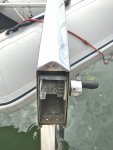
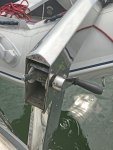
1980s Simpson Davits. Renewing the wire cable. How?

Bump.

No-one done this in the past?

After sleeping on it, my guess is that you have to remove the handle, shaft and ratchet/dog mechanism shown in the photo somehow. Perhaps the central internal Allen bolt holds the shaft for the handle and by unscrewing this the shaft can then be pulled out? Then by removing the two small bolts from underneath the the davit arm(pit) this hopefully allows the wire drum etc, and the rest of the mechanism (which appears to be on an internal steel 'sled') to slide out. Am I on the right lines?
 
Why not give Cooney Marine a call?
I will if I can't figure it out :) - or no-one responds with an answer. My other boat has got Cooney 'Simpson' davits and they're not the same mechanism as these original Simpsons 1980s ones and I have the feeling Cooney might not have the answer being only familiar with their own product.

TBH I just thought someone on here had done it in the past and kaboom the answer would be forthcoming - after all it is the Practical Boat Owner forum - but the forum seems more focussed on software and electronics nowadays.

I'll wait a little longer - no hurry. Thanks for the suggestion.
 
After sleeping on it, my guess is that you have to remove the handle, shaft and ratchet/dog mechanism shown in the photo somehow. Perhaps the central internal Allen bolt holds the shaft for the handle and by unscrewing this the shaft can then be pulled out? Then by removing the two small bolts from underneath the the davit arm(pit) this hopefully allows the wire drum etc, and the rest of the mechanism (which appears to be on an internal steel 'sled') to slide out. Am I on the right lines?

I've never done it but, as an engineer, I reckon you're on the right lines certainly. Be prepared for frustration due to corroded bits!
 
I've never done it but, as an engineer, I reckon you're on the right lines certainly. Be prepared for frustration due to corroded bits!
........ and if doing when still attached to boat and over water .......... expect some small but vital (and no longer obtainable) component you didn't know existed to fall out, bounce twice and then go splash, leaving the davits unusable!
Need to put some catch area around and below.
 
........ and if doing when still attached to boat and over water .......... expect some small but vital (and no longer obtainable) component you didn't know existed to fall out, bounce twice and then go splash, leaving the davits unusable!
Need to put some catch area around and below.

I know, I know.

It scared me enough taking the end plate off! I've decided I'm going to leave the attempted disassembly until I'm on the hard again. I think the current rusting galvanised wire with clamps on the end will last the summer out - hopefully.

Thanks pvb for the input.
 
I know, I know.

It scared me enough taking the end plate off! I've decided I'm going to leave the attempted disassembly until I'm on the hard again. I think the current rusting galvanised wire with clamps on the end will last the summer out - hopefully.

Thanks pvb for the input.
Our davits just has good old fashioned bits of rope - but as backup (not least in case of the stuck on D- rings having a sulk) we have secondary ropes on when at sea. Simply looping the painter over the davit does for the bow, and a pre-sized clip on rope at the heavier stern. Some seem to have secondary straps under.
Using a secondary safety rope and leaving till back ashore sounds a good plan :)
 
I will if I can't figure it out :) - or no-one responds with an answer.

TBH I just thought someone on here had done it in the past and kaboom the answer would be forthcoming - after all it is the Practical Boat Owner forum - but the forum seems more focussed on software and electronics nowadays.

Sorry I cannot help, I'm not long enough in the teeth :)

I agree - if they were electronic davits you'd have the answer by now :)

They look gorgeous davits, SL knew how to manufacture :). Good luck, persevere. The Alan keyed bolts (?) don't look original to me (in my ignorance)

If you enjoy success, post here - it may help someone in the future.

You don't say how the cable failed - when you solve the conundrum might dyneema be a better option.

Again in ignorance - why don't you remove them from the transom and take them home - they will benefit from being worked on in comfort.....

Take care, stay safe

Jonathan
 
My thought is:
Put an eye on the end of the wire.
Hold it in place with the hex head screw.
Feed the wire around the post on the left of the picture via the cutout in the nylon bush.
Then back crossing over the secured wire end then up the stainless box and out to the dinghy.
 
I’ve just replaced the wire in the exact same davits with 4mm Dyneema. I also did it on the same davits on my dads boat. It was a fiddly job but works great now.
I ordered the bare Dyneema from a rigging shop and got my friend to splice a small eye in each end.
I measured the length of the davit and the fall of the rope and added a foot or two. The Dyneema rope needs a small loop spliced on one end and a slightly larger loop on the other end. The wire is secured to the axle of the winch by either a flat or Phillips head bolt. These can be fiddly to get back in so you could replace them with Allen head bolts and use an Allen key without a ball end to refit it. A ball end will make it difficult to fit as it allows too much movement in the bolt. I replaced mine with the Allen head bolt and had to tape the bolt to the screwdriver.
Steps
1. Remove the bolt from the winch axle and tie or tape the wire to the large loop of the Dyneema
2. Secure the small loop near the winch and pull the wire through the sheave.
3. Tape the Allen head bolt to Allen key and put the threaded end through the small Dyneema loop.
4. ensure the correct rotation
5. Screw the Allen Head Bolt into the winch axle.
Done.
I just completed a 600 mile cruise at sea and it all worked perfectly. My dinghy is a 2.9m Talamex Aluminium hull Rib fitted with a Tohatsu 9.8hp 2 stroke. It weighs 90-95kg in total.
 
I have similar davits but the wire is visible on the drum next to the opening (which is always open). I have just changed the wire to dyneema - much nicer in use. Avon 3.5m solid floor inflatable and mariner 10hp.
 
I have similar davits but the wire is visible on the drum next to the opening (which is always open). I have just changed the wire to dyneema - much nicer in use. Avon 3.5m solid floor inflatable and mariner 10hp.
Thanks Dino and Hermit. The problem is the wire is not visible. I had a set of davits like these on my Nic39 (which were replaced by the Cooney 'Simpson' davits a few years back). On my old Nic39 davits I could access the wire and drum and in the distant past did replace the cable (no dyneema in those days!) while on the water - but it was so long ago my memory might be misplaced. The davits shown in this post look the same as my old Nic39 davits outwardly but, as I said I can't get at the wire (& drum) via the faceplate, the ratchet/dog/handle axle is in the way - plus the recessed wire drum appears to have a guard on it & no wire is visible viewing through the faceplate opening. To my eyes it looks like the whole mechanism has to slide out of the davit arm itself once the ratchet/dog/handle axle has been removed.

I'll take another photo tomorrow which hopefully will show the problem more clearly.

I'm 99% sure the old wire I want to replace will last the season (I'll back it up with a strop as per Dunedin's suggestion) and I'll dismantle the mechanism when I'm next out of the water & I'll report back.
 
I'm just attempting to do the same job on an even older set of ED16 davits made by Whittall, although they do look pretty much the same. I think Simpson / Cooney took over Whittall somewhere back in the mists of time and just did some minor updates and changed the stickers. I plan on using 4mm dyneema to replace the cables, with a hard eye at the dinghy end and a soft eye on the drum. If anyone is interested I will post some pictures!
 
It’s a fiddle of a job…but possible for sure. Takes a few attempts to feed the thing through the inners of the arm. Can tie some thin wire or rope on to help feed it through.
it’s attached to that drum using that retaining bolt and plate that’s visible on the drum pictured there.
 
Top