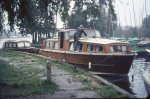
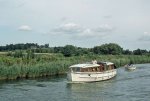
1960s Norfolk Broads River Cruiser Rebuild

Toadyboat

New Member
Joined
14 May 2022
Messages
9
Visit site
I am restoring the interior of my boat, a 1960s Norfolk Broads river cruiser which is 40ftx11.5ft, Mahogany on Oak, running a BMC Newage Commander 2.5 heartbeat. Although the previous owners made good of her, I am trying to do her true justice as to her original form and use of materials (eg previous fit out bypassed any use of stringers, had little to no inspection hatches, and used too much plywood for my liking)

I am struggling to really find any depth of information regarding the types of wood and their specific structural uses for boats of this class and heritage. Most noticeably because any reference to Norfolk Broads takes you to memories of yesteryear and future holiday bookings, with little to nothing of the build specifics.

In particular, I am yet to discover any reference to the type of wood used for floor cross beams, cross cleats and stringers. I would appreciate any information and advice on this matter, as well as any specific links or knowledge as to the wood choices and their structural applications for this kind of a vessel.

Based in UK, here is a list of the woods I am currently focussing on, and have access to, amongst others :

Afrormosia, Iroko, African and Brazilian Mahogany, European Oak, Teak, Utile, Western Red and Alaskan Yellow Cedar, Siberian Larch, and Pitch Pine.

Thoughts welcome, knowledge golden, wisdom priceless ;)
 
Welcome to the forum

1960s was the tail end of wooden boat building and choice of timber would probably have depended on what was available and cheap rather than what was "ideal". It would also have depended on who built the boat and whether it was a hire cruiser or not - the latter tended to be built more cheaply. If you are talking about framing for internal furniture such as bearers for cabin soles, berth fronts and tops, bulkheads etc I would not be surprised if softwood was used. I owned a 1960s wooden boat built by a medium priced yard and while all the structural timber was oak and mahogany all the internal framing was softwood. I am currently refitting a boat of similar type although later built and again the framing is all softwood - I am using Parana pine for new work, mainly because I have a supply of well seasoned over 40 year old stock. Using mahogany where it shows as most of the visible stuff on the boat is mahogany or teak. If I were buying new I would use Douglas fir as it is readily available and reasonable cost.

There is masses of material available on line and in books, magazines etc on boat building timbers - just google boat building wood types, but I doubt you will find anything definitive on what timbers were used on the boat you have (or similar) short of doing the rounds of the yards on the Broads to find somebody who has local knowledge. Inevitably such people are few and far between now, but many of the yards repair and maintain the old wooden boats so should be able to give you a guide.

My advice, however is not to get too hung up on originality on this type of boat as the way of building and materials used were driven by expediency rather than what was best for the job. My view having owned and worked on wooden boats for near 50 years is that if your objective is to have a functioning boat to use and enjoy then aim to use as much modern materials and equipment as you can. Old boats, particularly the utilitarian types were never as well built nor used the best of materials as one tends to imagine. It was tough making money out of boat building, particularly in wood in the 1960s and it is unwise to repeat the same too closely!

Good luck with your boat - would be nice to know more about it and perhaps some photos.
 
Commercial boats are built to a price so as to maximize the return over the expected lifespan of the boat. They were never built to last forever, so if the materials available were good enough to last for the expected commercial life of the boat, they were good enough, and if they failed after that no-one was going to lose money. Further, these boats had a hard life and would need frequent repairs - those done during the summer would be rush jobs done with whatever was to hand; those that could wait until winter might be a bit better but still using whatever was to hand. I've hired some old Broads boats (half-deckers) and it's clear that they have been kept going by an endless series of bodges!
 
Thank you all for your responses, I am sorry I couldn't get back sooner.

Well spotted The Q, for there are many reasons..

Firstly I have 'Bung On Another Thousand' for a few years now and as great as learning is, I want to get it done properly before I only see it all as a 'B**** Of A Thing'.

Everyone I have so far met has a different opinion, and yet wood has certain structural qualities and therefore specific uses. I am trying to discover how this is possible, and why one will categorically insist the use of Douglas fir, and another will not. True for all the woods I mentioned above.

I am yet to hear the words "it doesn't matter" and then subsequently informed what does matter. (Moreso when I find a bit of re-planking bodger made of an old plastic chopping board-hats off to you AntarcticPilot )

I have honed in on the heritage side because then I can get a full range perspective of 'pure breed to cross mix' and make decisions from how and why she was built to my own intended uses. Available knowledge and materials combined into form and expenditure planning. AKA once I know the range, I can pick my mark.

As you all know it is a lifetime of learning but when faced with a lack of history, coupled with a wall of opposing opinions ( "you don't need stringers/you absolutely must have stringers" ) then it is time to broaden, and yet at the same time pinpoint the issues.

Built as 1 of 3 hire fleet, I am amazed/proud she has lasted this long. I want to do her right and give her at least another 60 years.

Apparently the spiders Web has everything and anything on it.. Unless you want to know how these boats were made, or find a chart spreadsheet of vessel boat parts and required wood types ;)))

What a wonderful read Tranona - I am sure you are a fountain of knowledge. I will in time try and select some pictures where applicable, and have a think on what you've said.

Thank you all for your time and interest.

Kind regards
 
Thank you all for your responses, I am sorry I couldn't get back sooner.

Everyone I have so far met has a different opinion, and yet wood has certain structural qualities and therefore specific uses. I am trying to discover how this is possible, and why one will categorically insist the use of Douglas fir, and another will not. True for all the woods I mentioned above.

What a wonderful read Tranona - I am sure you are a fountain of knowledge. I will in time try and select some pictures where applicable, and have a think on what you've said.

Thank you all for your time and interest.

Kind regards

Look forward to seeing your photos.

You are right that woods have different properties and therefore potentially different uses BUT there is so much variability even within species that unlike man made materials that can have known and predictable properties one piece may be completely different from another, even before you consider how it is cut, seasoned and stored. Wooden boats are built largely by eye and experience using materials that are available and the builders think will do the job. Some designers have designed and built boats based on the engineering qualities of particular woods, particularly after WW2 when there was a lot of research on the subject. However in reality most boats designs do not depend on the structural qualities of the timber because they are largely unstressed so use oversized scantlings and rely on fastenings to keep the whole lot together.

Whoever designed and built your boat would have given little thought to the specific species used for each component as his experience would have led him to his preferred choice and if that was not available or would not fit the budget he would look at the alternatives and choose what he thought was best. Highly likely also that if building a series to the same design materials would vary from boat to boat - driven by expediency and cost. Just to give you an example from the designer I know best, Maurice Griffiths. His best boats pre war primarily used larch in full length for planking. Why? because the timber came from Russia as deck cargo and was offloaded at east coast ports where most of his boats were built. You find larch is the timber of choice for planking on pre war east coast boats in general. Move to the south coast in the same period and you find mahogany the planking of choice, from West Africa, the Caribbean and Brazil - imported through Southampton.

You will get differing and opposing opinions because life, and particularly building and owning boats is like that. One thing is certain and that is if you asked the builder of your boat to build it now with the knowledge of what has happened in between and what is available now he would not build it the same way out of the same materials. The reason why some old boats last well has little to do with how they were built or the original materials used, but how they are maintained. The biggest killers of wooden boats are fresh water from the top and drying out from the bottom, so when you are repairing or restoring look for the best materials and techniques to deal with those problems. I was reminded only today looking at a Griffiths designed boat that has a GRP hull and a wooden top. The coachroof was built traditionally with a ply top and a beading bedded in sealant around the edges. Inevitably this sealant has failed and water has got in resulting in localised rot in both the roof and sides. Really needs removing , rot dealt with and a new beading attached. Massive job - and if I were doing this I would use epoxy, as I did on a similar boat over 30 years ago. The learning point is don't be a slave to tradition - identify the potential problem and use modern materials. This applies equally to timber choices as for any job there is a range of types that will be suitable so choose the one that is available and economic, not necessarily the one that was chosen originally as chances are that was sub optimal even then!
 
Truly a wonderful read, the kind of broad and yet pinpointed detail that the very chaos of life is organised into.
I believe you have brought me closer to my mark, and thank you for breaking this kind of practical detail down.
Interesting thing life isn't it? I am sometimes amazed something like 'a boat' gets made at all for all it's natural combined dependency, and yet I am sure that somewhere out there, there is a stalwart vessel made of pure koto and hemlock!
Thank you for giving your time, sharing your wisdom, and I hope you have books out there ;)
 
Yes I do. Now long gone though I'm afraid. Forgive my innocence but what information would this provide outside of general craft data?
Well as I used to work as boatbuilder on the Broads (indeed served my apprenticeship there) it may be a boat I have come across and may even know about, and even then different yards had different ideas on boat building, maintenance or repair..
 
Well as I used to work as boatbuilder on the Broads (indeed served my apprenticeship there) it may be a boat I have come across and may even know about, and even then different yards had different ideas on boat building, maintenance or repair..
Oo lovely, you lucky and dare I say talented thing. She's Chumley and Hawke of Horning, Constellation Class
 
Oo lovely, you lucky and dare I say talented thing. She's Chumley and Hawke of Horning, Constellation Class
Yes, I know of the Chumley and Hawke yard, from memory the Constellation class where about 35ish ft in length, always well built, and have a good reputation. I seem to recall they only used the best woods and never cut corners, we never had one in for repair so I can not comment on the exact woods used, but suspect that the hull would be one of the mahogany family with Oak timbers, (frames) certainly the cabin sides were a lovely mahogany and typically stained slightly darker as was common on the broads at the time. Interior wise floors probably oak(!) and sole bearers etc in a generic softwood..
 
Here's a picture of sister ship S716 Touch wood, at... Horning Sailing Club, the Moorings S716 are on, are now controlled by the sailing club..11858706_391ErnieSwancornerHorning.jpg.1e8b0233ff2f6e5895f9143d499b939b.jpg
it it were today my, boat would be over the day boat the other side of the river, just to the right of the boat moored there..
 
your boat in Hire.. picture taken in Aug 82 on the River Ant..
Oh words from a Boat yard owner.." we painted them white because if hirers turned up and found it was varnished wood they'd be disappointed as they wanted to hire a modern boat"
1351967148_785aCaravelle2r_Ant.thumb.jpg.dae695d09f67ae1591ecbf6162b1bb2c.jpg
Knew I could find one..
 
Yes, I know of the Chumley and Hawke yard, from memory the Constellation class where about 35ish ft in length, always well built, and have a good reputation. I seem to recall they only used the best woods and never cut corners, we never had one in for repair so I can not comment on the exact woods used, but suspect that the hull would be one of the mahogany family with Oak timbers, (frames) certainly the cabin sides were a lovely mahogany and typically stained slightly darker as was common on the broads at the time. Interior wise floors probably oak(!) and sole bearers etc in a generic softwood..
How exciting, what a gem, and a pleasure to read you!
Maybe this will also highlight to viewers why I am splitting hairs over this and trying to get her right ? She's had too many 'cut corners' over the years (in my opinion), she deserves the best still ( or feels like she requires it when you step on board ), and where boatingly possible this is the last time I want her stripped down to her ribs, as she is at the moment.
Well built and (possibly) rarely in for repair could also explain why I have struggled a little along the way of my discovery quest too..
Thank you so much and if anything else pops to mind, be sure to say!
 
Here's a picture of sister ship S716 Touch wood, at... Horning Sailing Club, the Moorings S716 are on, are now controlled by the sailing club..View attachment 135520
it it were today my, boat would be over the day boat the other side of the river, just to the right of the boat moored there..
She's beautiful this one, to leave her natural as well (although I do appreciate my white in summer)
What a beautiful spot you have indeed.
Any idea what became of Constellation 3 T317 Larkspur at all? Think I have come across the least info for her of them all. Sometimes I do wonder if they'll all meet again one day, nothing to do with sentimentality, of course!
And yes, when all is said and done there may very well be a pilgrimage to her POB... Let's see how the seasons flow ?
 
your boat in Hire.. picture taken in Aug 82 on the River Ant..
Oh words from a Boat yard owner.." we painted them white because if hirers turned up and found it was varnished wood they'd be disappointed as they wanted to hire a modern boat"
View attachment 135521
Knew I could find one..
Love this pic, it is a keeper!
However I do believe this to be her cousin, Caravelle class (S622)
Thank you
 
Sadly Craig died a couple of years ago. But I believe others are now looking after his research .

Yep looks like I crossed numbers over.
 
Top