Slocumotion
Well-Known Member
Firstly, thanks to those who helped out with my previous queries - Darcy Lever's "The Young Sea Officer's Sheet Anchor was a good call. Reprints of various old works on ship modelling have been very useful too.
Now the reading glasses are on again for another crack at it and having examined some microfilmed copies of the Hudson's Bay Company Churchill Factory daily journal, and the almost complete run of ship's logbooks they have in the archive in Manitoba - I have found a gap in those of the Schooner "Frances" which the book I found would cover, and she doing precisely similar work around the Bay as "my" vessel.
So, Frances she is - a fore-and-aft rigged Schooner. And the meaning of the phrase "brought the Main Topsail to the mast.." thus means to furl it, brail it or what-have-you (to put it away ).
There was also a doubt about a column in the log which had no heading and seemed rather mysterious but by comparison with other ships in HBC service (they were punctilious about record-keeping ashore and afloat) - it's Leeway, in points.
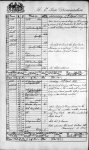
Log pages for all the vessels I've seen are laid out the same way, with columns headed "H" (hours, ie Time - 1 PM at the TOP of the day's page so the noon sight for Latitude is the last entry at the bottom of the Remarks column. When not at sea the log is kept in shore-style with just a daily entry describing the work being done by the crew. The last shore style entry will state that this days log contains only 12 hours. At the bottom of the first day at sea - "this days log contains 36 hours" So it's clear that the log page headed , say, 28th July, covers the period - noon on the 27th to noon on the 28th (as those ashore would know it).
Next Column - "K" (knots, no problem of interpretation there).
Next "F" This one is a problem -it comes before "Courses" (steered); "Wind" (Direction); "unheaded", (but now known to be Leeway) and "Remarks" - so it would seem to be navigationally as important as H, K and Courses , but what is it?
Well here are a few things it isn't -
Wind Speed ( in" Beaufort" - F = Force). Entries are all single digit and don't correspond in any way to comments about winds - Light Airs , Strong Gale etc , all pre- Beaufort terminology, and this is early in the 1830's, before Beaufort became common practise in the Merchant Service).
Fathoms ? No. Soundings are recorded in the remarks column, and I'm looking at an entry for September 10th, 6pm when "F" has been 4 since 3pm (and continues to be for the rest of the day) , while "Remarks " has - "Sounded and tacked in 25 Fathoms".
Feet (of water in the Pump well)? F can jump suddenly by 2 or 3 , or rise to 7, staying there for hours, without causing any action , or alarm.
Wave height (in feet). Doesn't seem to correlate with wind and weather remarks, though I could be more thorough in looking for correlations.
Compass variation is assessed at sunset, and noted in Remarks.
Temperature (Degrees Farenheit? - bit cold - always- even for Hudson's Bay. Unless it's water temp in degrees above freezing perhaps)
Atmospheric Pressure (change of .. - ) never any + or - recorded.
Visibility (F for Fog??) Any visibility issues are noted in Remarks.
Ice (condition) . As for visibility. And comparing to Ganymede - larger ship, generally larger F values and v much larger as she headed South from England on passage towards the Sandwich Islands.
That's me out of ideas.
For information - F continues to be noted, albeit by a series of ditto marks, throughout a night spent grappled to an ice floe.
I must be missing something pretty obvious, but what?
........................................................................................................................................................
Re-reading before posting and "water temp above freezing" leaps out as more of a possibility. Though why Ganymede would be bothered I don't know, unless it were that it was Company orders to collect meteorological data always and everywhere.
Now the reading glasses are on again for another crack at it and having examined some microfilmed copies of the Hudson's Bay Company Churchill Factory daily journal, and the almost complete run of ship's logbooks they have in the archive in Manitoba - I have found a gap in those of the Schooner "Frances" which the book I found would cover, and she doing precisely similar work around the Bay as "my" vessel.
So, Frances she is - a fore-and-aft rigged Schooner. And the meaning of the phrase "brought the Main Topsail to the mast.." thus means to furl it, brail it or what-have-you (to put it away ).
There was also a doubt about a column in the log which had no heading and seemed rather mysterious but by comparison with other ships in HBC service (they were punctilious about record-keeping ashore and afloat) - it's Leeway, in points.
Log pages for all the vessels I've seen are laid out the same way, with columns headed "H" (hours, ie Time - 1 PM at the TOP of the day's page so the noon sight for Latitude is the last entry at the bottom of the Remarks column. When not at sea the log is kept in shore-style with just a daily entry describing the work being done by the crew. The last shore style entry will state that this days log contains only 12 hours. At the bottom of the first day at sea - "this days log contains 36 hours" So it's clear that the log page headed , say, 28th July, covers the period - noon on the 27th to noon on the 28th (as those ashore would know it).
Next Column - "K" (knots, no problem of interpretation there).
Next "F" This one is a problem -it comes before "Courses" (steered); "Wind" (Direction); "unheaded", (but now known to be Leeway) and "Remarks" - so it would seem to be navigationally as important as H, K and Courses , but what is it?
Well here are a few things it isn't -
Wind Speed ( in" Beaufort" - F = Force). Entries are all single digit and don't correspond in any way to comments about winds - Light Airs , Strong Gale etc , all pre- Beaufort terminology, and this is early in the 1830's, before Beaufort became common practise in the Merchant Service).
Fathoms ? No. Soundings are recorded in the remarks column, and I'm looking at an entry for September 10th, 6pm when "F" has been 4 since 3pm (and continues to be for the rest of the day) , while "Remarks " has - "Sounded and tacked in 25 Fathoms".
Feet (of water in the Pump well)? F can jump suddenly by 2 or 3 , or rise to 7, staying there for hours, without causing any action , or alarm.
Wave height (in feet). Doesn't seem to correlate with wind and weather remarks, though I could be more thorough in looking for correlations.
Compass variation is assessed at sunset, and noted in Remarks.
Temperature (Degrees Farenheit? - bit cold - always- even for Hudson's Bay. Unless it's water temp in degrees above freezing perhaps)
Atmospheric Pressure (change of .. - ) never any + or - recorded.
Visibility (F for Fog??) Any visibility issues are noted in Remarks.
Ice (condition) . As for visibility. And comparing to Ganymede - larger ship, generally larger F values and v much larger as she headed South from England on passage towards the Sandwich Islands.
That's me out of ideas.
For information - F continues to be noted, albeit by a series of ditto marks, throughout a night spent grappled to an ice floe.
I must be missing something pretty obvious, but what?
........................................................................................................................................................
Re-reading before posting and "water temp above freezing" leaps out as more of a possibility. Though why Ganymede would be bothered I don't know, unless it were that it was Company orders to collect meteorological data always and everywhere.
Last edited: