
12 Volt refrigerator wiring

Little Dorrit

Well-Known Member
Joined
27 Jan 2010
Messages
1,295
Location
South Coast
Visit site
I'm hoping for some advice in wiring a Danfoss BD35F compressor on a recently installed a refrigerator. The cable run will be a maximum of 2.5 metres and the manual suggests 2.5mm (AWG12) should be ok. I'll have 10 - 15amp fuse on the positive and use a and 20 amp 12-volt switch. Is there a best practice way of wiring this? Does it have to be connected directly to the batteries? If there are options what are the relative benefits of doing it one way or another?
 
I would suggest 6mm2 or larger wiring to avoid issues in the future with voltage drop, where if your batteries are a bit tired or low, the voltage will fall below the low voltsge cut out and you will find the fridge not starting or cutting out.

In terms of wiring i would suggest following the same as other systems; fuse, switch (board), fridge.

Many fridge problems are voltage/wiring/corrosion on wiring relates.
 
I'm hoping for some advice in wiring a Danfoss BD35F compressor on a recently installed a refrigerator. The cable run will be a maximum of 2.5 metres and the manual suggests 2.5mm (AWG12) should be ok. I'll have 10 - 15amp fuse on the positive and use a and 20 amp 12-volt switch. Is there a best practice way of wiring this? Does it have to be connected directly to the batteries? If there are options what are the relative benefits of doing it one way or another?

I would increase the cable size because you are close to the max current vs length for 2.5 mm², to 4mm² perhaps.

If you want to power it through the battery isolator, so that when the isolator is off the fridge is off, connect to the switched side of the isolator
If you want to be able to run the fridge when all else is isolated connect it to the battery positive or the battery side of the isolator

The shorter you can keep the wiring the better and the fewer the number of connections the better
 
I'm hoping for some advice in wiring a Danfoss BD35F compressor on a recently installed a refrigerator. The cable run will be a maximum of 2.5 metres and the manual suggests 2.5mm (AWG12) should be ok. I'll have 10 - 15amp fuse on the positive and use a and 20 amp 12-volt switch. Is there a best practice way of wiring this? Does it have to be connected directly to the batteries? If there are options what are the relative benefits of doing it one way or another?

I agree with Greg, for the extra few pence that it will cost, use 6mm cable. As Greg says, if the batteries get a little bit discharged the fridge might not start.

I would wire it so that it is not powered when you turn the main isolator off, or you'll likely forget and arrive at the boat with flat batteries.
 
Would use nothing thinner than 6mm, its the volt drop when the batteries are a bit low or you have other things using current at the same time/.
If you are running new cables why risk it, use thick stuff first time and only do it once.
 
As you are focussed on the fringe and compressor - whilst you are at it I'd consider finding a way to pull fresh air to wherever the compressor is housed and or removing any warm air - if the compressor is in a sealed locker it will be less efficient than if you can provide fresh and remove warm air. A couple of computer fans wired to the compressor fan wiring and possibly some cheap ducting will reduce overall power consumption.

Jonathan
 
As you are focussed on the fringe and compressor - whilst you are at it I'd consider finding a way to pull fresh air to wherever the compressor is housed and or removing any warm air - if the compressor is in a sealed locker it will be less efficient than if you can provide fresh and remove warm air. A couple of computer fans wired to the compressor fan wiring and possibly some cheap ducting will reduce overall power consumption.

Jonathan
I agree.

I have a larger (120mm?) 12v computer fan in the compressor heat exchanger (its a cage type) that draws air over it and another smaller (80mm?) higher in the locker blowing out hot air out via a vent. My compressor has a set of fan connections. Both fans are in series to slow them down a bit. Near silent, but makes a large difference to the locker temperature, which must help the heat exchanger dump heat and hence increase efficiency.
 
I have now wired this as you have suggested with 6mm tinned cable so that the compressor is powered from the domestic battery (off when isolated), so while I have your attention ;)... what suggestions do you have for a suitable switch and inline fuse? The rocker switches I have seen are only rated up to 15 amps and the in-line car fuses which are rated 20 Amps only have 3mm wire?
 
As you are focussed on the fringe and compressor - whilst you are at it I'd consider finding a way to pull fresh air to wherever the compressor is housed and or removing any warm air - if the compressor is in a sealed locker it will be less efficient than if you can provide fresh and remove warm air. A couple of computer fans wired to the compressor fan wiring and possibly some cheap ducting will reduce overall power consumption.

Jonathan
That’s why I went for a watercooled one using the nearby sink outlet. So quiet and more efficient - and as an added bonus doesn’t warm the cabin on a hot day.
 
I have now wired this as you have suggested with 6mm tinned cable so that the compressor is powered from the domestic battery (off when isolated), so while I have your attention ;)... what suggestions do you have for a suitable switch and inline fuse? The rocker switches I have seen are only rated up to 15 amps and the in-line car fuses which are rated 20 Amps only have 3mm wire?
The 15A switch will be fine. Shorten the 3mm wires as much as possible, 3mm will carry the current, shorter wire will reduce the volt drop. You may be better buying blade fuses and a decent fuse holder.
 
I have now wired this as you have suggested with 6mm tinned cable so that the compressor is powered from the domestic battery (off when isolated), so while I have your attention ;)... what suggestions do you have for a suitable switch and inline fuse? The rocker switches I have seen are only rated up to 15 amps and the in-line car fuses which are rated 20 Amps only have 3mm wire?

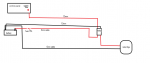
Buy a decent blade fuse holder and keep the wires short (as per post#13)
 
The 15A switch will be fine. Shorten the 3mm wires as much as possible, 3mm will carry the current, shorter wire will reduce the volt drop. You may be better buying blade fuses and a decent fuse holder.
I have already put a blade fuse with 3mm wire on as I had one so now simply use the rocker switch I have and all is good. Thanks for your advice.
 
That’s why I went for a watercooled one using the nearby sink outlet. So quiet and more efficient - and as an added bonus doesn’t warm the cabin on a hot day.
With respect, it doesnt warm the cabin, the ambient temp of the cabin is what heats the fridge up, so it is simply going around in a circle, the insulation of the fridge is more important. What the watercooled one does do is remove heat from the boat!
 
With respect, it doesnt warm the cabin, the ambient temp of the cabin is what heats the fridge up, so it is simply going around in a circle, the insulation of the fridge is more important. What the watercooled one does do is remove heat from the boat!
Not quite. The heat is removed from the food inside the insulated fridge so that is in a circle but the cooling is far from efficient so overall heat is added to the cabin at the rate of maybe 30-60w.
 
Top