11th Hour Emergency - Fitting Balmar ARS-5 Tips?

demonboy

Well-Known Member
Joined
11 Oct 2004
Messages
2,237
Location
Indonesia
www.youtube.com
Just a few days before we're about to leave India I've found myself in the position of having to fit a Balmar ARS-5 alternator regulator as a back-up charging system, but I'm unsure about the basic principle of charging more than one battery bank.

How do I charge both starter battery and house batteries using the one unit? Does it matter that my starter battery is sealed and the house are open lead acid? Any pointers gratefully received.
 
As a general rule the sensing voltage should come from your domestic batteries as these batteries will become depleted quicker than the engine battery.
So power in is connected to domestic positive. If you connected it to the engine positive the ARS-5 would think the batteries were charged.
The question arises though how is the alternator output currently charging both the engine and domestic batteries?
 
Just a few days before we're about to leave India I've found myself in the position of having to fit a Balmar ARS-5 alternator regulator as a back-up charging system, but I'm unsure about the basic principle of charging more than one battery bank.

How do I charge both starter battery and house batteries using the one unit? Does it matter that my starter battery is sealed and the house are open lead acid? Any pointers gratefully received.

I'd persevere with the Sterling first, trying the checks I've suggested. Fitting the Balmar isn't easy, as you're going to have to put a field connection on the new alternator.

How did you charge them both before? Diode splitter? 1-2-Both switch? The same method would work.
 
how is the alternator output currently charging both the engine and domestic batteries?
We've been stationary for three years, Talulah, so mains charger. Previously we had a cheap Turkish alternator regulator and 1-2-All switch, but that regulator died a long time ago.

I'd persevere with the Sterling first, trying the checks I've suggested.

On it. See other thread.

How did you charge them both before? Diode splitter? 1-2-Both switch? The same method would work.

Yes. I went for the Sterling because the previous alternator regulator (the cheap Turkish one) crapped out on me, and the diode appeared to be losing almost 0.8v in the circuit. I did have a 1-2-Both switch but I have bypassed this because it wasn't wired correctly by the previous owner. I could reinstate this. Re the field connection, I have two older alternators as back-up that now have external diodes attached to them to make this job a little easier (so I was told).
 
Re the field connection, I have two older alternators as back-up that now have external diodes attached to them to make this job a little easier (so I was told).

External diodes? Do these alternators have a wire coming out to give a field connection?
 
Yes, that's why I got the internal regulator by-passed, in the event of having to install the Balmar. And the new alternator has its own field terminal (assuming WL counts as field).
 
Yes, that's why I got the internal regulator by-passed, in the event of having to install the Balmar. And the new alternator has its own field terminal (assuming WL counts as field).

OK, but the WL terminal is where the alternator warning light connects.
 
The Balmar regulator has a single multi stage output doesn't it.
I know what your domestic batteries are and I have the impression you use them quite heavily.
If your starter battery never gets discharged much, I would suggest you make provision to disconnect it from the charging circuit if you expect to have prolonged engine runs with the domestic batteries at a state of charge where the Balmar regulator is in bulk/absorption mode rather than float mode.
Otherwise you are likely to dry the starter battery out.
If by sealed you mean a "sealed maintenance free" flooded starter battery, you may be able to top it up if you remove a label or clipped in top cover.
If you mean an AGM/SLA battery, once it's dried out it's had it.
 
I need to reinstate my 1-2-All switch in order to do this. The old procedure was turn to 1 to start engine and leave on to charge engine battery. After X mins/hours, turn to 2 to charge and run on house.

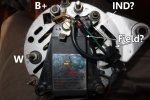
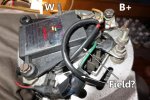
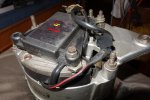
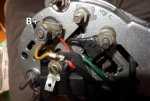
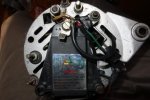
I know this is going to be difficult, but can anyone help with the Balmar installation according to these pictures? This is one of my older alternators with external regulator. It was wired to make installation of the ARS-5 easier but I don't know alternators well enough to instinctively understand what goes where.

In the first picture you can see a black wire to the right coming from inside the unit, which is why I think this is Field. It goes to a terminal (you can make out it's called '+A' on the external regulator). On the same terminal is an orange wire which comes from within the external regulator. A third red wire is attached to the terminal, which also comes from within the unit. The green wire, which turns red/black at the bottom of the picture, appears to be the connection between the old internal reg to the external reg. Finally, I am assuming I can still connect my IND to one of three spade connections for my warning light.

Does this make sense?

reg.jpg

reg2.jpg

reg3.jpg

4.jpg
 

Attachments

  • 20130221-DSC00619.jpg
    20130221-DSC00619.jpg
    95.5 KB · Views: 0
Sorry, Jamie, I'd only be making wild guesses if I tried to identify what those various wires might be connected to. Can't you take it to an auto-electric place and get them to sort it out for you?
 
You'd have thought, wouldn't you? There's a strike here in India so everything is closed. The one man who wired this up for me speaks no English and has not been available for weeks.
 
Sorry, Jamie, I'd only be making wild guesses if I tried to identify what those various wires might be connected to. Can't you take it to an auto-electric place and get them to sort it out for you?

+1, sorry.
Having just seen on your video the location of your starter battery, you definitely want to make sure you aren't gassing it! With your existing SR40 regulator it's not a problem but with the Balmar or any other single output multi stage regulator it would be.
 
...and to add to it all, I have just wired up the older alternator (the one pictured) and now the engine won't start at all. Getting very hacked off with this :mad:
 
Having just seen on your video the location of your starter battery, you definitely want to make sure you aren't gassing it! With your existing SR40 regulator it's not a problem but with the Balmar or any other single output multi stage regulator it would be.

I don't understand. Which video? My starter battery is under the chart table, not near the engine compartment.
 
I don't understand. Which video? My starter battery is under the chart table, not near the engine compartment.

Quite so. It's in the living area with no specific ventilation and probably near electronic equipment. Don't know how far from the galley it is.
 
Last edited:
Quite so. It's in the living area with no specific ventilation and near electronic equipment. Don't know how far from the galley it is.

Ah right. Well, it's in the same place it's always been, as per the original design of the boat. Perhaps I should consider moving it at a later date. It's the other side of the galley but I'm making sure SWMBO does not put the kettle on at the mo. I think I could do with a tea break right now though!

Back to the problems: I've just tried a second alternator and it wasn't providing power back to the WL so I wasn't able to start it. It would throw out power lasting one second so I was able to quickly start the engine in that one second. The alternator was throwing out 10.5v though. Now I'm trying my third alternator (these second and third alternators have the external regulator that I can by-pass to allow me to rig up the Balmar).
 
Last edited:
Ah right. Well, it's in the same place it's always been, as per the original design of the boat. Perhaps I should consider moving it at a later date.

I'm sure with standard 14V alternator as originally fitted charging it's OK.
Problem is if you start putting 14.5V or more from a smart regulator/charger onto a battery that's already well charged. Then it will gas abundantly.
 
Top