“Roger” or “Copy” or neither

Cerebus

N/A
Joined
4 May 2025
Messages
1,381
Visit site
Watching some Netflix drama about a trip to Mars and boring radio comms…

I have been watching more tv than sailing lately.

Tv uses both of the words in the title of this thread.

I can’t remember ever using either word at sea.

Are they used? if so is “Roger” with the “R” for “Received” better than “Copied”?

Possibly been watching too many American movies.

Do not allow me to get started on” Over and Out” ; makes my blood boil ; tv directors should have experts to advise them.

But that was a side point.

Roger or copy or something else?

Just asked chatGPT and I did not like the answer. I wonder what superior human intelligence and experience thinks?
 
I’m led to believe that “Roger” is used in aviation comms. It has a very specific meaning which I’m told is - “Communication is received and understood.” with emphasis on understood.
 
Leisure yacht VHF communications seem to fall in a half way house between the highly standardised radio procedures used in some contexts such as air traffic control and the highly individual styles normal in phone conversations.

So when talking to the Coastguard or port control most skippers veer more towards the formal (with varying success) and on intership channels more toward the latter. But for non adherence to any recognisable official procedure, it's hard to beat a call on an intership channel between two bored fishing boat skippers - although I don't think there is a standard radio terminology for how the team's new goalkeeper should never have left his home country and Jake's missus has taken up with that deckhand off the ferry.

On a related subject, the multiple informal variants of the phonetic alphabet can be amazing. I can remember being in stitches when a UK yacht with one of those weird multi-syllable names taken from a minor character in a Tolkien or Terry Pratchett novel was trying to spell it letter by letter to Port Control at Ventspils in Latvia.
 
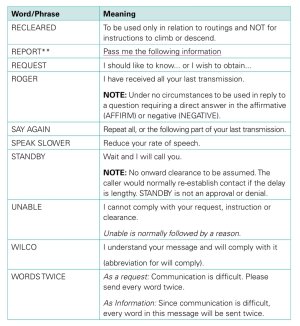
I’m led to believe that “Roger” is used in aviation comms. It has a very specific meaning which I’m told is - “Communication is received and understood.” with emphasis on understood.
It doesn't mean you've understood the message, just that you've received all of it. If there was a misunderstanding, you'd ask "say again". If you understood it and it requires compliance, you say "wilco".

"Over" and "out" are not used in aviation and as you say "over & out" is incorrect.

CAP 413: Radiotelephony Manual | UK Civil Aviation Authority

Screenshot_20250830_083908_Adobe Acrobat.jpg
 
So when talking to the Coastguard or port control most skippers veer more towards the formal (with varying success) and on intership channels more toward the latter. But for non adherence to any recognisable official procedure, it's hard to beat a call on an intership channel between two bored fishing boat skippers - although I don't think there is a standard radio terminology for how the team's new goalkeeper should never have left his home country and Jake's missus has taken up with that deckhand off the ferry.
Fishing boat skippers can chat for hours ....
One described his weekend in detail but amusing bit was not be able to leave his kids at Monkey World (monkey sanctuary in Dorset).
Conversation only seems to stop when they need to haul nets / lines.
 
RE: A lot of the YM candidates I examine who have worked or are working in the superyacht industry habitually say “Copy that” to indicate they’ve heard and understood a command or briefing. I find it mildly irritating.

So, John, what is standard acceptable response when you have received and understood a VHF message?
 
When a VHF message is received and understood, you do not need to say anything to verify that understanding. You can confirm that you will or will not perform an instruction. Otherwise, over or out as appropriate, or a statement that you are doing or can't do what was asked. There are protocols for clarifying or correcting misunderstandings.

IMO Standard Communication phrases https://wwwcdn.imo.org/localresources/en/OurWork/Safety/Documents/A.918(22).pdf

Advise for standard phrases if you have not understood the message: -

9 Repetition
9.1 If any part of the message is considered sufficiently important to need safeguarding, say:
"Repeat ... " - followed by the corresponding part of the message.
Example: "My draft is 12.6 repeat one-two decimal 6 metres."
"Do not overtake - repeat - do not overtake."
9.2 When a message is not properly heard, say:
"Say again (please)."
 
We’re mostly communicating with people we're on Christian name terms with, to transit the bridge, for instance. But it still makes sense to do it formally. Fewer words, less airtime, zero confusion. The harbour have the rest of you scurvy lot to deal with.
 
One source of unique expressions on the marine band is the world of CB. I suspect the over and out brigade are ex CB ers. They also enjoy a Roger Beep at the end of transmissions. Some Marine radios seem to have this facility or they are using ATIS to get the effect.
 
I never did a formal radio operator course. All of my boating is done in non English speaking areas. Over the years I've heard many skippers speaking English with marinas, ports etc. I put myself in the position of the person receiving the call and ask myself, did I understand the message clearly. I've tried to adapt my style to the ones I've found most clear. Roger, over, out, copy that do not feature in the most easily understood responses. I generally terminate a call with "understood thanks". In Türkiye most skippers terminate calls with "tamam" which means OK or will do.
 
RE: A lot of the YM candidates I examine who have worked or are working in the superyacht industry habitually say “Copy that” to indicate they’ve heard and understood a command or briefing. I find it mildly irritating.

So, John, what is standard acceptable response when you have received and understood a VHF message?
Roger? Or if you need to comply. ‘Wilco’.

Perhaps the mildly irritating part is they put ‘that’ after everything. So if they don’t say ‘Copy that’ they say ‘Roger that’.

Perhaps on board (for example) and they’re instructed to prepare the anchor ready to drop it they should just say ‘okay, I’m on my way’ or some other normal conversational English?
 
One of the more enraging of R/T behaviours is the practice of spelling a place- or vessel's name using a personally-invented nonsense 'phonetic alphabet'.
Many of these eedjits will have slumbered through an RYA-approved VHF/SRC marine radio course, led and assessed by RYA-approved instructors, and are holders of the requisite operators's certificate.

Bemused, they seem never to have heard of the International Phonetic Alphabet, and show even less interest when it is mentioned.

Bluntly, they shouldn't be allowed near a marine radio.....
 
A former colleague of mine said that though he was trained and experienced in standard local-area military radio use, when his guard post came under fire it all went out of his head and he erupted into Hollywood nonsense about tangos and x-rays and his six.

In general, I try to respond to information by repeating back the pertinent bits to confirm understanding. Understood, do not overtake, over.
 
Top