your ball valves - brass, DZR brass or bronze?

cimo

Well-Known Member
Joined
11 Nov 2009
Messages
737
Visit site
happened across a very down to earth article by boat surveyor Paul Stevens.

For no particular reason, I always assumed those two seized 1&1/2 inch ball valves were bronze. Since removing the engine I was able to get up close for the first time. Their "CR" markings makes them DZR brass apparently - didn't know that.

Thought the link may be of interest.

http://www.paulstevenssurveys.com/upload/Seacocks.pdf
 
Current ones - all DZR.

Ones on the new boat - well, we're going back on Thursday to have a look at that kind of thing :)

Pete
 
Paul was the man who started the YM campaign by highlighting some of the failed seacocks he had found during surveys. Despite all the attention it seems unlikely that the ISO standard will be modified anytime soon.

Many manufacturers have had their attention drawn to the campaign and the fact that the fittings they attach to their hulls are likely to fail in five years. With one possible exception, none has indicated that they will change their fittings and a couple even deny that the brass ones they fit are in any way substandard.

Interestingly it is often the up-market builders who fit the suspect seacocks, many of them leaded brass ones made by Guidi in Italy.
 
Many manufacturers have had their attention drawn to the campaign and the fact that the fittings they attach to their hulls are likely to fail in five years. With one possible exception, none has indicated that they will change their fittings

If I were buying a new yacht, though, I would insist on bronze or DZR seacocks - and try quite hard not to pay extra for it either on the grounds that that's what they should damn well be doing in the first place. Hopefully any informed yacht-buyer these days would do the same?

Pete
 
I went all through this on my last boat and had all mine changed over. In my many conversations and researches, it was generally the skin fittings and tails that were the weak points and more liable to fail if dezincing started. Ball valves are chunky lumps of brass (or whatever they are made of) and usually quite substantial. But the threaded parts on a skin fitting are thin (relatively) and can be subject to considerable forces during the operation of a stiff ball valve and the twisting/levering against them. IMO it is these that are more likely to break rather than the valves. The next weak point is the tail where the pipe attaches.
 
I had all mine changed last year, they were all brass, including the skin fittings. :eek:

A couple of the valves were close to failure, 2 were seized, and one of the hosetails was very thin.

All new DZR, should see me out now. :D
 
All my skin fittings and ball valves both above and below the water line are 316 stainless steel all are 3 part full flow valves so very easy to service between tides.
 
All my skin fittings and ball valves both above and below the water line are 316 stainless steel all are 3 part full flow valves so very easy to service between tides.

Apologies for such a late reply to this thread but doesn't the fit of the balls in the 316 ss ball valves lead to perfect conditions for crevice corrosion ?

Boo2
 
This is an old article (2011) which I have seen before but it's worth bringing to boatowners attention as I've seen some very dodgy 'seacocks' on boats I've been on.
 
Apologies for such a late reply to this thread but doesn't the fit of the balls in the 316 ss ball valves lead to perfect conditions for crevice corrosion ?

Boo2
Yes, that is the downside of 316, particularly the threads. However if you have a steel boat like roger it is the lesser of two evils. Bronze and DZR need to be isolated from the steel. Non metallic valves are probably the preferred option in metal boats.
 
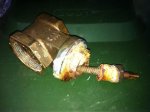
After discovering this on a seized heads gate valve just after purchase ...

image.jpg

(this happened when I was removing it for replacement fortunately)

... I now have DZR or bronze throughout !
 
Yes, that is the downside of 316, particularly the threads.

That would apply to any threaded items below the water line like the prop shaft and nut.

I have tried to seal all the threads with sikaflex. The one issue is the inside of the ball when closed, the inside could easy become devoid of oxygen.

Non metallic valves are probably the preferred option in metal boats.

Local regulations will not allow any plastic fittings sea side of the sea cock which include the sea cock itself.
 
Top