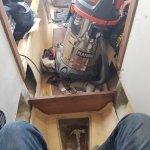
Yikes! Any one know what to do here? Fibreglass structural problem under mast

There seems to be a lot of focus on transferring the load of the mast to the hull (bottom). Wouldn’t it be better to think more of the connection to the chain plates where the bulk of the load comes from?
Good point, that I missed, but how should it be obtained? Putting in a new bulkhead will certainly reduce the usefulness of the settees as berths. To make a frame from the cabin sole up to the chainplates one would need to remove the liner. Other options?
The hull will also take the load to the chain plates. One of my concerns was that this should not be done in a way that the hull is experiencing a heavy point load.
 
Thanks for all the responses. Yep, Jan, you pretty much nailed all the ideas I've been thinking of, as well as all of the problems associated with each! I wish you'd advised me about the dust issue a few weeks back...that's when I started grinding a fresh surface, onto which to laminate a new underfloor bulkhead, as in misil-1's suggestion, taking NONE of the precautions you mention, and I'm STILL trying to find all the fibreglass dust in the duvets, squabs, etc, WEEKS later.

I'd pretty much decided (I think) a lot of what you're all suggesting: once the underfloor bulkhead is tabbed/laminated in, properly, i was going to construct a temporary compression post to take the load from those buckling panels, then do what misil-1 did, with his sistered supporting columns. However, I was also going to build substantial knees, both at the top, and at the bottom of the additional, sistered columns (think a ring of mahogany, rather than of steel!); this would (in effect) create a more substantial bulkhead, separting the saloon from the forepeak and locker area. This is what I termed the 'submarine bulkhead': something you would have to both step over, and duck through, in order to reach the forepeak. Not ideal, but much stronger. In addition to this, I was also going to try to reinforce those buckling panels, exactly how han suggests, by glassing new laminated ply behind them, but access here is a real bugger, and the shape is more complex than at first it would seem. I hadn't quite solved the problem of access, other than cutting the top of the settees, and trying to go through, there, (ie from behind), but it's still extremely tricky, with the locker/bulkhead arrangement that's there, in place, already. As I said, I've even toyed with the idea of simply ripping everything out, and starting again, but that would need a long lay-up, out of the water....due to the access problem, above, I may have to think again, as jan suggests, and cut away the old buckling panels entirely, (ie from the front), starting again, and constructing a new support frame under the columns, and inside the settees. Whatever I do, I'm going to follow your advice re dust, next time! And I think I'll wait until I've constructed my temporary compression post, before starting to cut away those load bearing, buckled panels...the mast is still up, after all....

Heavy point loads worried me, too. I've tried to spread the load on my underfloor bulkhead as much as possible, with extended tabbing, and placing foam strips in the join between bulkhead and hull. I think this is all I can do about this problem?

Ps I think you're right about your red line on your picture: I had assumed that any cutting there would produce a rapid influx of water!
 
Good luck and don't forget to loosen off the shrouds beforehand, and to tension them again afterwards ;0)

This is a good opportunity, while you will not be sailing her, to take the covers off all of the soft furnishings and put them in a washing machine for a few cycles, lest you be getting fibreglass rashes for the whole of the next season you do get to sail...
 
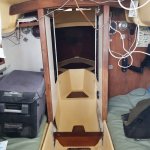
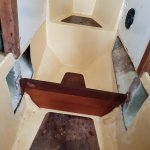
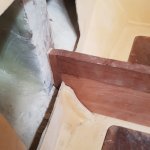
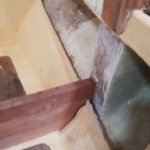
Ok reviving old thread for anyone interested. This is the solution I went for. Made to measure, thick laminated ply bulkheads inside the lining, under the mast support columns, and supporting the weight of the mast, (which was jacked up whilst doing the work), then tabbed and glassed-in. Then a mahogany plank between them, providing lateral support. Not finished yet, but I'm happy enough with the job. The only thing I'm a little uncertain about are the stress loads directly under the bulkheads, (ie the hard point loads, weakening the hull over time, creating potential folding point). What do people think?20200529_151656_compress23.jpg20200529_151656_compress23.jpg20200529_144053_compress33.jpg20200529_151628_compress92.jpg20200529_144033_compress42.jpg20200529_144037_compress73.jpg20200529_122544_compress15.jpg
 

Attachments

  • 20200529_144053_compress52.jpg
    20200529_144053_compress52.jpg
    569.8 KB · Views: 1
  • 20200529_144053_compress52.jpg
    20200529_144053_compress52.jpg
    569.8 KB · Views: 2
  • 20200529_144053_compress52.jpg
    20200529_144053_compress52.jpg
    569.8 KB · Views: 2
Nice photos well done. You have a quadrilateral of load mast with cap shroud attached to the chain plate down through the hull to the keel then up to the mast base. Wind blows from the side you get this quadrilateral trying to move to mast top to leeward. The cap shroud then tries to resist this movement . Now in the hull you have the mass of the keel (and boat) working initially against the buoyancy of the turn of the bilge then at knock down the keel itself trying to right the boat. (the mast)
So if you draw a cross section of the boat at the mast you can see how in 2 dimensions these forces work. Not the only forces but certainly the most significant.
You will see that the cross members under the mast where they attach to the hull are pulled up by the cap shrouds rather than pushed down by the mast. Those loads being taken by your 2 uprights in board. This assuming the chain plates are close to the cross members structurally if not in distance. NB there will also be some force trying to pull chain plates int to the centre of the boat but this should be adequately handled by the bulkhead and cross member.
So it really is all about the chain plate attachment and load carried through to the keel. Of course I might have it all wrong ol'will
 
Thanks. The chainplates are weird on this boat. They are made from bronze, encapsulated completely in fibreglass, and run longitudinally under the length of the deck, (as far forward as the bow; I havent yet been able to trace how far aft they go!)...they seemed in good condition under the bit of glass I've stripped away to check them, but they're impossible to check, properly, (at least, nondestructively). But because they're longitudinal, I also think that they may create weird and significant upward forces, both fore and aft of the new support bulkheads which I've glassed in, when the shrouds are tensioner against them. Hence my hard-point concern, as, presumably, these upward forces, from tensioning the standing rigging against the longitidinal chainplates, could erode the strength and integrity of the hull over time, at which point, these new bulkheads I've lovingly made, may create rather a nice fulcrum, around which the entire hull can bend! I did initially think that, for this reason, I needed to make and glass-in additional bulkheads, anout 3feet forward of these I photo'ed, (around the forward end if the locker, hence the hole I've cut in the starboard lining runs the entire length of the locker, and beyond). This would ideally spread these shroud/chainplate loads more evenly, along the length of hull. I'm still wondering about this, tbh....but it's been such a mission getting this far, it's not funny.

Get a fibreglass boat, they said. It'll be nowhere near the maintenance demands of my beloved old wooden boat, they said.

Yeah, right...

As I say, any opinions welcomed...


Nice photos well done. You have a quadrilateral of load mast with cap shroud attached to the chain plate down through the hull to the keel then up to the mast base. Wind blows from the side you get this quadrilateral trying to move to mast top to leeward. The cap shroud then tries to resist this movement . Now in the hull you have the mass of the keel (and boat) working initially against the buoyancy of the turn of the bilge then at knock down the keel itself trying to right the boat. (the mast)
So if you draw a cross section of the boat at the mast you can see how in 2 dimensions these forces work. Not the only forces but certainly the most significant.
You will see that the cross members under the mast where they attach to the hull are pulled up by the cap shrouds rather than pushed down by the mast. Those loads being taken by your 2 uprights in board. This assuming the chain plates are close to the cross members structurally if not in distance. NB there will also be some force trying to pull chain plates int to the centre of the boat but this should be adequately handled by the bulkhead and cross member.
So it really is all about the chain plate attachment and load carried through to the keel. Of course I might have it all wrong ol'will
 
A long fore and aft chain plate base sounds horrible. The loads must be transmitted to the keel via the hull. It seems to me from your descriptiuon the whole deck could be lifted by the chain plates. If that is the case (and your concerns) then a bulkhead from deck down the hull towards the keel will spread the loads. Easiest is to extend the chain plates from under the stay attachment down to this bulkhead. However you could also alleviate the situation by attaching a saddle or similar under the deck to the chain plate base. Onto this you attach a wire with turn screw which goes down to a plate glassed into the side of the hull at widest point. ie turn of the bilge. The plate should be fairly large in fore and aft direction as well as down wards with holes in to take epoxy. Perhaps a 25cm triangle. Or perhaps attach to bunk base at the hull. Put a little tension on the turn screws to ensure load is carried downwards. Not pretty but can be less intrusive than a full bulkhead. Appologies if I have the wrong impression. ol'will
 
Yep I've never come across chainplates like this in my life either. They're weird alright. And yes, I think you've understood my description of them.

But you cant get away from the fact that there were only ever 200 of thes boats made, (in the late 60's, early 70's), and a lot of them still seem to be sailing, loved and cared for, some 50 years later! So mebbe not such a bad idea, in the fullness of time? Mind you, I know of at least one person who felt similarly uneasy about the chainplates, and elected to replace them with some of a more traditional design, so how many of these boats still sailing made similar modifications, I don't know! I'm actually having the standing rigging all replaced in the next two months or so, and had considered using the opportunity to replace the chainplates with conventional ones...may still do so but it will add significant time and expense to the job. But the peace of mind would be worth it, I think....

I'll have a look at some of your ideas when I'm back on the boat, (I've been so focused on the downward forces from the mast, I'd been completely neglecting the upward forces, at the chainplates!), but I suspect that if I'm going through all that time and effort, to try to support a system which is always going to be somewhat questionable, then I'm probably better off just biting the bullet, and fitting new (more traditional) chainplates, and reinforcing these...

Thanks for your input...its certainly got me thinking about replacing those chainplates again!

A long fore and aft chain plate base sounds horrible. The loads must be transmitted to the keel via the hull. It seems to me from your descriptiuon the whole deck could be lifted by the chain plates. If that is the case (and your concerns) then a bulkhead from deck down the hull towards the keel will spread the loads. Easiest is to extend the chain plates from under the stay attachment down to this bulkhead. However you could also alleviate the situation by attaching a saddle or similar under the deck to the chain plate base. Onto this you attach a wire with turn screw which goes down to a plate glassed into the side of the hull at widest point. ie turn of the bilge. The plate should be fairly large in fore and aft direction as well as down wards with holes in to take epoxy. Perhaps a 25cm triangle. Or perhaps attach to bunk base at the hull. Put a little tension on the turn screws to ensure load is carried downwards. Not pretty but can be less intrusive than a full bulkhead. Appologies if I have the wrong impression. ol'will
 
Top