Yanmar 3GM30 Ehaust-manifold/mixing ellbow and anti-siphon

jfkal

Well-Known Member
Joined
17 Aug 2001
Messages
1,486
Location
Singapore
Visit site
The new type of exhaust manifold/mixing elbow is not working well. It starts with the question where to locate the anti-siphon loop, any recommendation? Please see the attached pictures as well. The purpose of the two blind plugs cannot even be explained by the Yanmar dealer here. I thought first they are for the anti siphon hoses but since they are internally connected (see arrow) they are of no use here.
So my thinking was to block the internal passage way to make them usable. Any thought or ideas or better solutions?
 
Last edited:
I am no expert but what I would not do is start blocking things off. On my Yarmat 2GM20 on previous boat, the anti siphon loop was fed by the water outlet immediately prior to the mixing elbow (I don't mean next to it I mean the last exit from the block/waterjacket) so the hot water went through the antisiphon device and then into the exhaust elbow.
 
although i have a different make and engine, the principle should be the same, the anti syphon goes from the feed after the thermostat thru the anti syphon and into the water injection point at the exhaust elbow.
It would not be a good idea to inject the water before the elbow as indicated in your diagram as you would be in risk of injecting water into the engine..
 
You have a hose going from the thermostat cover to the nipple #6 on the exhaust manifold? it should be possible to put the loop with the A/S valve in that hose.

An alternative position for an a/s loop used by some is in the outlet hose from the water pump.

In either case the loop will still have to go well above the waterline with the a/s valve at the highest point.


I would have thought as you did that the two plugged positions were for an a/s loop but unless Yanmar offer a means of plugging the connection between them they arent any good
 
Last edited:
I know. That was the "old" type which worked fine. The new manifold does not have that anymore. Water goes in at one end and is fed internally directly into the new type elbow.
So what I am trying to do is to 'simulate" how the old system works: Water goes into the manifold, out of the manifold to a anti siphon loop and into the elbow.
 
Hi,

your picture also shows the "old" discontinued type. There it was quite simple. I guess I put it where your arrow indicated, before the exhaust manifold then or block the passage and pipe it in there.
 
I see your point. However that is how Yanmar altered the design to. (Not really injecting INTO the manifold. THe water circulated through the manifold cast in its own cavities cooling the manifold. However the old design was that it exited after the manifold catering for the correct setup of the loop into the elbow. Nowhere in the Yanmar documentation is a anti siphon loop mentioned. I guess they assume that nothing would siphon in in the first place. That may be true as long as the pump impeller is intact. But what happens if it is not .......
 
Just put the antisyphon loop in the pipe between the thermostat and the manifold. (The pipe that I have arrowed in red.)
It will work just as well in that location.
There is no need to block anything else.

Alternatively you could put it in the pipe after the pump. The dotted red arrow.

Do not rely on the water pump impeller to stop the water syphoning.
If the water inlet to the exhaust outlet bend is less than 15cm above the water line you need the antisyphon loop and valve.
The valve should be approx 40cm above the water line.
 
Makes sense - however, it is not clear from the picture of the new manifold that there is an external hose from the thermostat housing to the manifold. It seems that the waterways may be all internal, right up to injecting into the exhaust pipe - hence no hose to break into for the valve.
 
it is not clear from the picture of the new manifold that there is an external hose from the thermostat housing to the manifold

The existing thermostat to manifold hose would surely surely connect to the nipple # 6 in the diagram of the new manifold.

It merely has to be re-routed now to form the loop with the a/s valve at the top.
 
Am I really missing something?

Why cannot the a/s valve go in the hose between the thermostat to the new type manifold?
 
Last edited:
Old New

I know. But Yanmar does not do it that way any more. Meaning what you see in the picture is currently no longer available.
 
this link shows the correct system, its on ebay but the pictures are good. nothing to do with me blah blah.

http://cgi.ebay.co.uk/Yanmar-3GM-Ra...at_Engines_EngineParts_SM&hash=item3f00b2f77e

Steve

Steve, Please read the OP and look at his diagrams. The link you have posted shows the old design. The new design has eliminated the hose between the exhaust pipe and the manifold, (the one on the left) which is now provided internally.

I see no reason why VicS' proposal will not work. The intention of the anti-siphon break is to prevent water from being drawn through the pump and siphoning into the exhaust pipe, there to back-fill the engine. I can't see why putting it before the engine, instead of after it, will make any difference. The right-hand hose in Steve's link.
 
putting the antisyphon inbetween the thermostat to the exhaust manifold, which then goes internally to the exhaust elbow, is really the only place which would be practically possible with the new manifold setup as vic has mentioned, i initially didnt realise that the new manifold goes internally thru to the exhaust elbow.
 
Re: Yanmar 3GM30 Ehaust-manifold/mixing elbow clogged

Hello,
This thread seems as close to what my issue is as anything, without starting a new one (how does one do that anyway?)
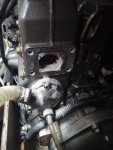
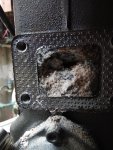
Has anyone seen this happen to your yanmar 3ym30 exhaust manifold/elbow (inverted U shaped)? My engine is 3 years old(Feb 2014 install) has only 200 hrs on it. The boat has been hauled out every year by the beginning of a hurricane season and saltwater cooling flushed out with fresh water religiously, every time, once on the hard. Then I would disconnect the exhaust hose and stuff a rug into the elbow exit and cover with plastic and secure it with a rubber band so no water or salty air gets blown into the manifold.
What you see in the pictures is salt crystals mixed with something resembling a very fine white powder (aluminum oxidation?). Mechanic that did the installation is as befuddled as I am. Does that section need a yearly maintenance? Have not seen that being mentioned in the service/user manual.
Any ideas and help greatly appreciated 100352.jpg109353.jpg
 
Top