Yanmar 2GM20F starting problems when left for a day or two.

vas

Well-Known Member
Joined
21 Jun 2011
Messages
8,200
Location
Volos-Athens
Visit site
evening all,

I have a MASE 7 generator which runs of a 2cyl yanmar 2GM20F. F means it is closed circuit cooling.
Generator is on a motorboat, sitting above w/l, has a silencer and exhaust is above w/l.
Yanmar has 1K hrs on the clock, had to rebuilt the raw water impeller (shaft shafted), and also had to replace the starter motor due to extensive cranking by myself and PO.

I always had problems with that motor starting from stone cold and especially if left for a day or two.

What I have done:

  • replaced the imho useless yanmar main filter for a CAV296 one (it's not leaking!). Fabricated a mounting plate to fit in the space of the old one.
  • changed oil and oil filter (ok, not related but did it nevertheless)
  • removed and replaced all copper washers on the banjos along the diesel line to the pump.
  • bled the engine numerous times, at the beginning I had problems with a piece of hose that was slightly oversize and would leak (CAV to pump) replaced with right dia hose, eventually all is dry and clean
  • Bleeding was done after reading manuals, looking umpteen how-to videos on youtube and employing common sense:
    • first from lift pump to CAV,
    • then on the pump input (keeping current to the stop solenoid which is mounted there else diesel wont go through...)
    • then cracking open the pipe coming into the two injectors one at a time
    • then the return pipes.

When I do all that, engine will start OKish, when I leave it say for a day I'll need 3-4 3sec crank sessions to fire up.
Of course if I run it once, then within the next few hours it will start on first crank.

Some more observations:
  • Motor runs at 3K rpm, even from stone cold. I mean governor is winded and stop is locked up there. I find it harsh and awful for a tiny motor to work like that but I guess all generators work like that although most recent ones are 1500rpm jobs and not 3K
  • I'm not impressed with the lift pump output but my only other experience with diesel engines is the 6.7lt IVECOs, and yes I do know and turn the flywheel in order to get the maximum travel and output of the lift pump. I mean replacing the CAV, I probably pumped a 80-100times to bleed the filter!
  • Tank pickup is through a smallish day tank, exactly where the two main engines get their fuel so no issues there. Fuel line is new and only 3m long. Lift pump approx 40cm above bottom of tank, or at the half full level- doesn't help no matter how much fuel is in the tank
  • getting air out of the main pump is fine, but opening up the return nuts on top of the injectors I practically get no diesel coming out (with engine running at 3K, but also at idle) I would have thought there'd be plenty of juice going back to the tank.

Ideas on where to look at are very much welcomed. I hope you wont suggest I have a tiny leak as I'm running out of ideas, paper towel is dry, engine is dry, cannot see somepoint where it would leak tbh!

Next (and only atm) actions to take are:

replace lift pump (assuming output is indeed low and that can relate to the issue) would like confirmation that it's worn though as I've no idea how much it is...
check and measure injectors (I'll do that next month when the engineer will come to remove the IVECO injectors for testing) but not sure that would help.

Projected generator use is not a lot, a few half hour sessions at night to cool the boat down before going to bed (if in a marina that is), 10-15h per season for the watermaker and immersion heater.

cheers

V.
 
Tee in a pressure gauge between the lift pump and injector pump.

But is a few 4s bursts to start a diesel beyond what you should expect?

Also how fast is it cranking?
 
Tee in a pressure gauge between the lift pump and injector pump.

But is a few 4s bursts to start a diesel beyond what you should expect?

Also how fast is it cranking?

I'll try and do the pressure gauge, probably stick it on top of the CAV temporarily, don't want to mess with the banjos!
What sort of pressure should I see there? any idea?

Considering the main engines start instantly even if left for a few months, I'd have thought that this small one should also start on the first go.
Further, I'm controlling it from a TFT screen on the lower helm (original MASE control panel died...) so I've programmed the start button and rather not go through a start, wait5-10sec, check if running, if not start again, etc...
Cranking pretty fast with the new starter, not complaining there. Previous one was really slow.

cheers

V.
 
Surely a typo ? You can't mean you're only cranking for 3 secs ?

not a typo I'm afraid.
Main engines start at less than that.
I've no easy way of checking QUICKLY that engine is up and running and I don't want to destroy this new starter, nor do I want the engine firing and starter still cranking and holding it as I guess it's no good for the starter motor.
Remember I'm not manually turning a key, nor keeping a button pressed to start the thing, just press a button and the stop solenoid gets current to let fuel through and the starter solenoid gets current for 3.5secs iirc.

Wrong approach? How long should I crank and what's going to happen when it's nice and hot and fires up on the first half second?

cheers

V.
 
not a typo I'm afraid.
Main engines start at less than that.
I've no easy way of checking QUICKLY that engine is up and running and I don't want to destroy this new starter, nor do I want the engine firing and starter still cranking and holding it as I guess it's no good for the starter motor.
Remember I'm not manually turning a key, nor keeping a button pressed to start the thing, just press a button and the stop solenoid gets current to let fuel through and the starter solenoid gets current for 3.5secs iirc.

Wrong approach? How long should I crank and what's going to happen when it's nice and hot and fires up on the first half second?

cheers

V.

3 seconds isn't enough for one of these engines when cold Vas. But i understand your comments regarding when it's hot. I think you need a different approach, as no set time will be correct every time.

How about something along the lines of a normally closed relay, fitted to the starter solenoid cable ? As it's normally closed it will allow the starter to run until something causes it to open. You can try wiring the relay coil to -VE and the generator alternator +D terminal, if it has one. This would stop the starter as soon as the alternator starts charging. You could add a light at the panel to show when it's running too if you wanted, by fitting a buld with a -VE supply and a feed from the generator alternator +D. Set the time on your panel to 20 or 30 seconds.
 
nice thought Paul,

problem is bloody thing hasn't got an alternator...
It does have two pick up points in order to charge it's starter battery but don't seem to produce 12V. and yes I'm using main lumps starter batteries for starting the wee motor (180Ah and one gazillion cranking amps for 2 tiny cylinders...)
I could have a 220V check from the actual generator, but it gets complicated, it's slow to come up (maybe 3-5secs) and not happy to sense 220V for such a task.
Note all control/start/stop is now done via an arduino Due, a 4relay board and a TFT screen which doubles as the fin stabs controller.
Reasonably complex code already, not difficult to complicate it a bit more, but I'm lacking a decent and quick "engine is up and running" trigger.
Oil pressure is the only thing I could use but it's not really that reliable as yet. Binary on off to run originally a small bulb in the old dash, now connected to a digital pin of the arduino and still needs some tuning as I have false low pressure warnings occasionally.

I wonder if anything else could be to blame. Why are my 6.7lt lumps up and running in 2 starter turns (I'm not exaggerating I'm talking circa half a second!)

cheers

V.
 
I wonder if anything else could be to blame. Why are my 6.7lt lumps up and running in 2 starter turns (I'm not exaggerating I'm talking circa half a second!)

cheers

V.

Different engines, some start as soon as you look at the key, others take a good few seconds of cranking.

You should be able to find a relay with a 220V coil that would make/break a 12v circuit. Another option might be to fit a crankshaft sensor and connect that to the Arduino, if RPM > xxx then Open relay

Could also trigger a lamp with the same code, or use a changeover, when the starter contacts break a second circuit is made, which puts a "engine running" light on.
 
Back to the unwillingness to fire, we have an elderly Yanmar 3HM which has always started instantly with no "throttle" in the summer and with the recommended full "throttle" in winter. Like a diesel car, and like your big engines I guess. I wonder what throttle or governor setting it is trying actually to start with? Ours isn't keen on half-throttle.
 
hi, interesting post. I have the same engine, except that for me it is the main source of mechanical propulsion. I've always had this problem when starting from cold. 3000 rpm is about what I would see as the upper limit of comfortable cruising revs. However, if I set the throttle lever at that point it's a pig start. If I wedge the lever as far as it will go (i.e. maximum) it will start instantly even if very cold. Once it has been run, it will then start easily at any speed setting!

As your engine is driving a generator I assume that it doesn't have an easily accessible lever. However, it might be worth rigging something up to try it. If it works it might then point you in the right direction for a solution.

If you find out what the problem is please do let us know, perhaps then I can sort mine out. cheers!
 
My 3GM30F starts almost instantaneously from cold, even after a long stationary period. This year it was 18 months since it last ran and it started within 1 second. One suggestion - what is the state of the injectors? I wonder if fuel leaks out of poorly seating needle to body join over a period? When it does start is there a lot of smoke?
 
thanks for all the comments and ideas, sorry for my late reply, just now had the time to spend an hour on the boat and test some of the ideas, more at the end of the post.

You should be able to find a relay with a 220V coil that would make/break a 12v circuit. Another option might be to fit a crankshaft sensor and connect that to the Arduino, if RPM > xxx then Open relay
yep, will probably do something like that, but I can wait for the cold winter nights to do the programming...

Back to the unwillingness to fire, we have an elderly Yanmar 3HM which has always started instantly with no "throttle" in the summer and with the recommended full "throttle" in winter. Like a diesel car, and like your big engines I guess. I wonder what throttle or governor setting it is trying actually to start with? Ours isn't keen on half-throttle.
Didn't know there's a recommended procedure tbh!
Well, as I said, having the generator permanently mounted on the crankshaft, it's meant to start and run throughout its life at 3K rpm, which is definitely NOT nice.

hi, interesting post. I have the same engine, except that for me it is the main source of mechanical propulsion. I've always had this problem when starting from cold. 3000 rpm is about what I would see as the upper limit of comfortable cruising revs. However, if I set the throttle lever at that point it's a pig start. If I wedge the lever as far as it will go (i.e. maximum) it will start instantly even if very cold. Once it has been run, it will then start easily at any speed setting!

As your engine is driving a generator I assume that it doesn't have an easily accessible lever. However, it might be worth rigging something up to try it. If it works it might then point you in the right direction for a solution.

If you find out what the problem is please do let us know, perhaps then I can sort mine out. cheers!
Always try to close any Q threads I ask for this exact reason. Hope I'll get to the bottom of it!

Right, having left the engine for almost two days, I tried this morning to start it with the governor stop completely removed and the lever dropped to the right all the way. In hindsight, that was maybe stupid as it almost started after 2X15sec sessions. Then got bored and lifted the lever to half (or thereabouts) and it fired, but that's not conclusive, maybe it was about time to fire up anyway.
For the record, I've wired an old detroit diesel engine keybarrel onto the yanmar contorl box mounted on the engine, so I can start it on the spot and play with the governor.

Now tomorrow morning I'll try starting it with WOT and see if its any better.
For the record temps were rather mild, this morning 16C+ and sunshine

My 3GM30F starts almost instantaneously from cold, even after a long stationary period. This year it was 18 months since it last ran and it started within 1 second. One suggestion - what is the state of the injectors? I wonder if fuel leaks out of poorly seating needle to body join over a period? When it does start is there a lot of smoke?

thanks for yet another idea that I hadn't thought of! No smoke on startup, although after all this lots of cranking there's a small diesel leak on the water by the exhaust, but I guess that's expected.
I'll get the two injectors removed, checked and serviced by a pro but probably next month. Considering they have 1000h at 3K rpm and pretty sure never serviced, I think it's about time for some tlc.

Now, some extra info that I forgot to mention on the original post:

A. occasionally after it starts and runs with moderate load (but could even be with minimal load...) it starts hunting, lowering revs (and consequently output Voltage which is not nice). Some times it recovers, sometimes it dies off and anyway if that goes on for more than 10secs, I kill it and start it again in which case it's probably going to run ok for sometime (or as long as I need it!)
I'm currently doing some testing with the fin stabs I've installed and I need the generator to run a 5.5KW inverter that runs the 3p motor that runs the hydraulics (complicated, but a cheapish way to test things and size them for the proper motor mounted hydraulic pump). For all that it means I turn it on, push it for a 10-15mins, then idle a bit while I'm messing with my laptop reprogramming, then maybe off then on, etc you get the point, within an hour it may run 20-30mins and start stop 6-10times. It's not like it's up and running for hours to no end and at constant load.
So it did it 3-4times this morning, hadn't done it for some time now.

B. tanks are low on fuel and lift pump is probably 20cm or more higher than tank level. Any chance lift pump not man enough?
Did change oil and filter in July and probably hasn't run more than 3-4h, I'll check oil level (although I hardly remember where it was on the stick back then...) was thinking of maybe a minor leak of diesel from the lift pump ending in the sump. Seems like an easy job to remove the liftpump, wonder if it's worth it and wonder if it's easy to spot a leak on the back side of it.
OTOH, I can bleed the engine (filter, pump, injectors) with it although as I said injector return lines don't seem to return much (if any!)
So, not sure if there can be such a small leak at the lift pump that's enough to bring some air in and make next start difficult, but most likely not leak lots of diesel in the sump (I'll check that dipstick in the afternoon anyway)

C. there's a two bolt cup protruding from the pulley face of the engine above the crankshaft pulley which I found it's covering the camshaft, beats me why it's not fully enclosed in the engine... There's a bit of oil leaking out of it, could it be somehow an indication of some other issue, or just irrelevant?

I'm running out of any other ideas/issues to report, so see what ppl think of all the above.

cheers

V.
 
evening all,

small update!
discussed it with my mechanic after two incidents where it stopped and when trying to restart felt like there was no compression whatsoever, engine spinning easily, not firing. Tried again same thing. Left it for 10mins, fired straight up.
Didn't like that together with the fact that over the last weeks stab testing I can see some diesel on the water surface around the (above WL exhaust outlet) after starting the engine from cold or oil after stressing it for a while.
This noon he came to have a look, and he confirmed that slow starting is due to basically starting on one piston, second one seems to pick up after a while (hence the diesel and smoking at startup that has developed recently)

So, plan is to disconnect it from the generator, remove it have it rebuilt, tested and refitted.

His opinion is that this running from stone cold at 3K rpm and then stopping again from 3K without idling for a couple of mins or so to drop temps a bit is killing the motor.
He has rebuilt a good number of low hours 3K rpm marine generator motors, and none 1.5K ones (unsurprisingly...)

Planning to either devise a system (again using an arduino and a step motor or linear actuator) to start the engine at idle, and up the revs after 2mins and do the same when turning the gen off.
Second (more expensive option) is to get a s/h 1.5K 8kW generator to mate to the yanmar 2GM SAE whatever bellhousing... Anyone selling one cheap?

cheers

V.
 
Running any engine straight from cold to 3000 RPM (where a small Yannie needs to be to provide it's rated output) seems brutal and wrong, as is stopping it from that regime without a couple of minutes at idle. But Yannies are made of tough stuff as are most diesels and given decent oil - the one utterly critical thing - are hard to damage no matter the abuse.

From reading this post from the beginning my thought was either lack of compression on at least one cylinder or an air bubble you somehow haven't eradicated in the fuel system.

I sympathise because my relatively good-looking 1500hr 3GM is doing almost exactly the same thing. Despite this I've refurbed injectors, tested all three pots for compression and found them equal (ie unlikely at fault) and bled the fuel system a dozen times. But it still does it.

My last 3GM was a knackered 30yr old ex flotilla lead-boat engine that made such a din a friend named him Mr Clatter yet he started at the first turn after either 4 or 8 months every single time for 12 years, never had an injector cleaned, never been bled except when I ran out of fuel once. Never gave a problem.

So what is up with (y)ours is a mystery I will watch being dicussed here with great interest.
Have you done a compression check?
 
Last edited:
happy new year to all, short update!

on the 24th was the last time yanmar actually run and died after 20mins.
Tried starting it up on the 27th, no luck, so next week (expecting a cold weather front from tomorrow onwards...) I'll start taking things apart in order to disconnect it from the generator and get it overhauled.
Actually I'll try removing the cyl.head first and see what's it like, if it's foobared, I'll save the effort and redo the cyl head instead.
Last attempts to start it had puffs of smoke from the airfilter (already removed) so compression issues and/or valve seating need to be addressed.

cheers

V.
 
good morning

since I started this thread I may as well document the work as carried out. Mind I've seen threads/videos with small yanmars being rebuilt but all were raw water cooled so some new things to see here.

First interesting observation is that everything seemed to unbolt easily, no stuck bolts/nuts, no excessive strength needed anywhere.
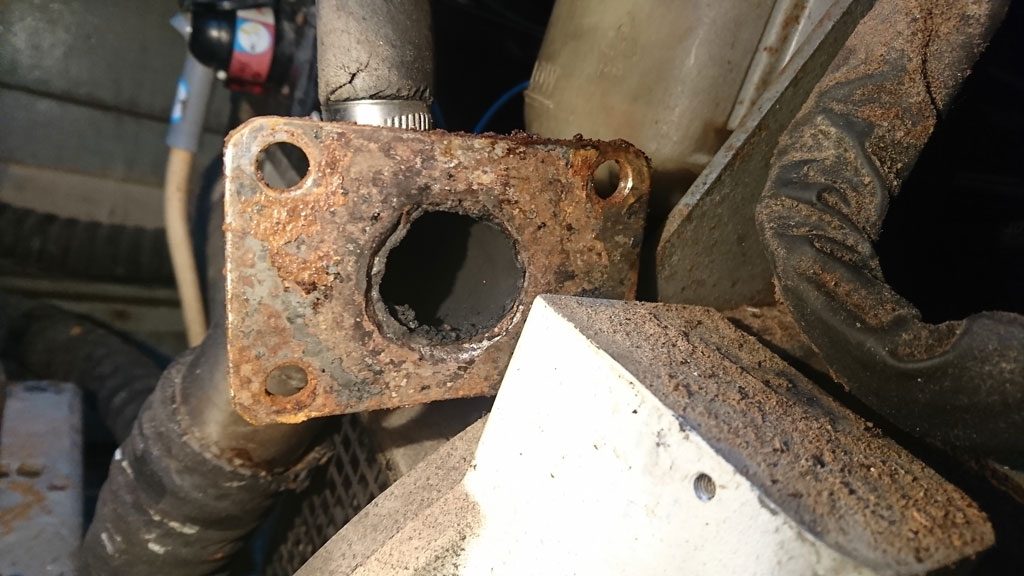
Exhaust mixer elbow looks fine (once cleaned of the soot deposits), will bring it home and clean carefully, it's a s/s one though. Hose bring seawater from the exchanger is not in v.good nick (not leaking but perished), will replace.
2gm_exhaustelbow_1.jpg


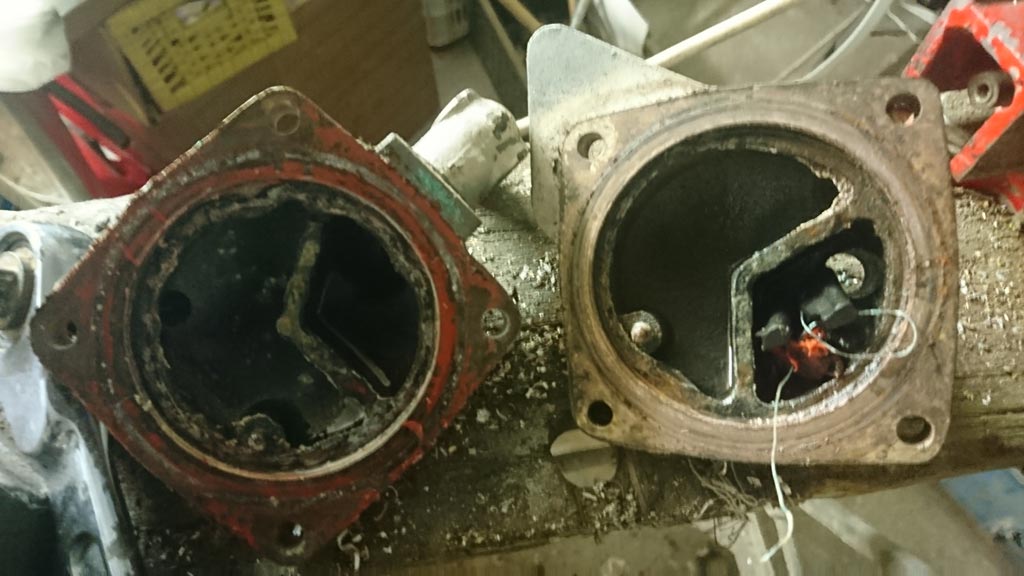
Heat exchanger did unbolt easily after removing the coolant pipework and the raw water fancy shaped hose from the pump. Workshop manual only shows the heat exchanger on the 3cyl yanmar and there you have three ports going through the exhanger body (below the heat exchanger copper core thing), in order (I guess) to cool the exhaust gasses (a tiny bit as route is probably rather short...) and then off to the mixer.
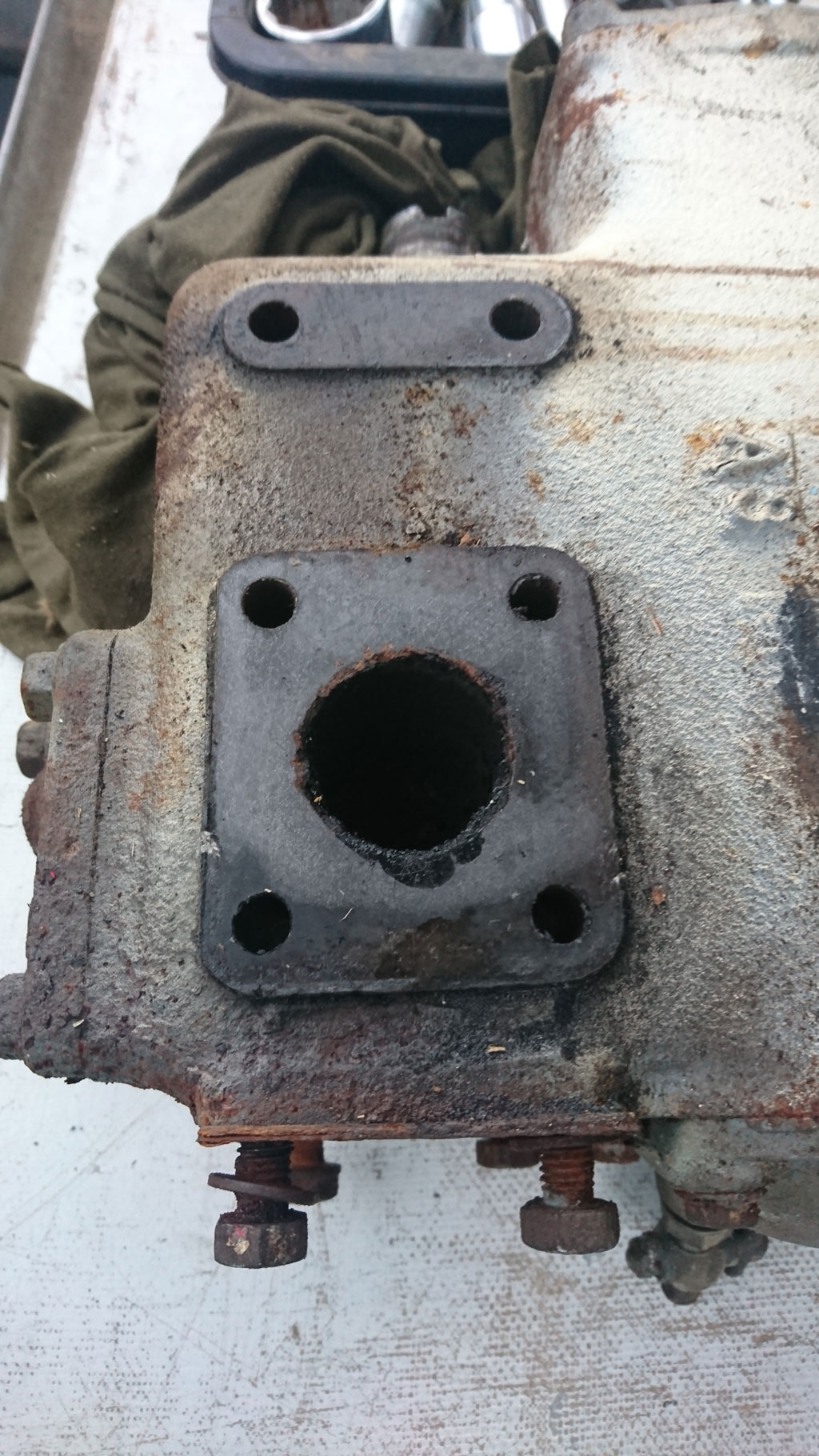
Now on the 2cyl there's only one port from the cyl head (ok, make sense) and the heat exchanger assembly accomodates a imho awfully badly cast elbow approx 80mm long before the exhaust elbow mixer piece. Cyl head twin port to exhaust was fine, clean and in really very good nick.
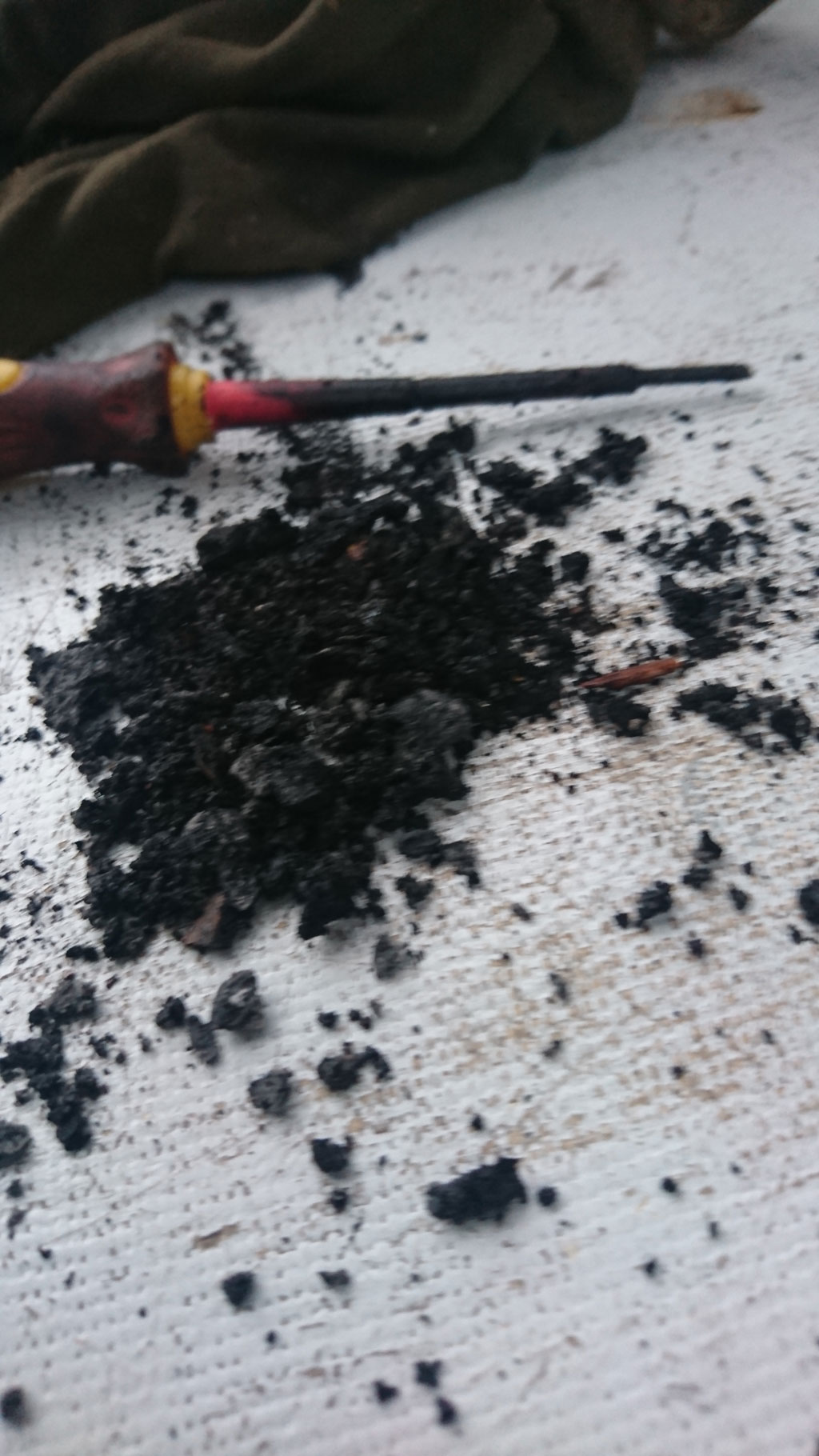
The same cannot be said about the elbow within the exchanger body. It was full of carbon deposits reducing the 35or so mm dia pipe to maybe a 15mm. Mind even fully clean there's a reduction in section somewhere half way the elbow, may be cast related. Have it at the workshop/garage to clean carefully and examine but it's too cold today to work there.

next pic outlet to mixer elbow looks nice and clean:
2gm_heatexchanger_1.jpg


er, not quite like that on the other side though:
2gm_heatexchanger_2.jpg


a minute attempt at removing crud:
2gm_heatexchanger_3.jpg


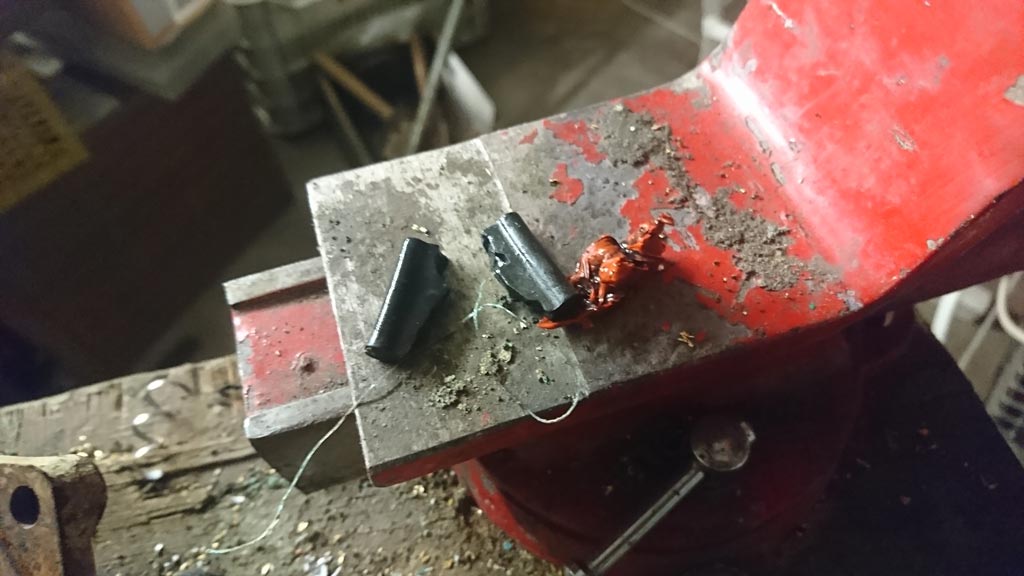
back at home removed the endcaps, two vanes and a bit of fishing line and a blob of sealant all courtesy of previous owner...
2gm_heatexchanger_4.jpg


2gm_heatexchanger_5.jpg


Obvious signs of removed and cleaned core as they couldn't be bothered to use new o-rings but stuffed the place with red instant gasket thing :(

Haven't removed the core as yet, hit it with a mallet, wouldn't move and left it for the time being.

Continuing with stripping cyl head, turned the flywheel does have compression at only one point, think pulley side cylinder, made sure that all valves move up and down (always start with the basics :D ) but confused as seems that exhaust valves have a serious opening overlap, it's my first diesel engine that I take apart and looks slightly odd, no? Check in this pic:
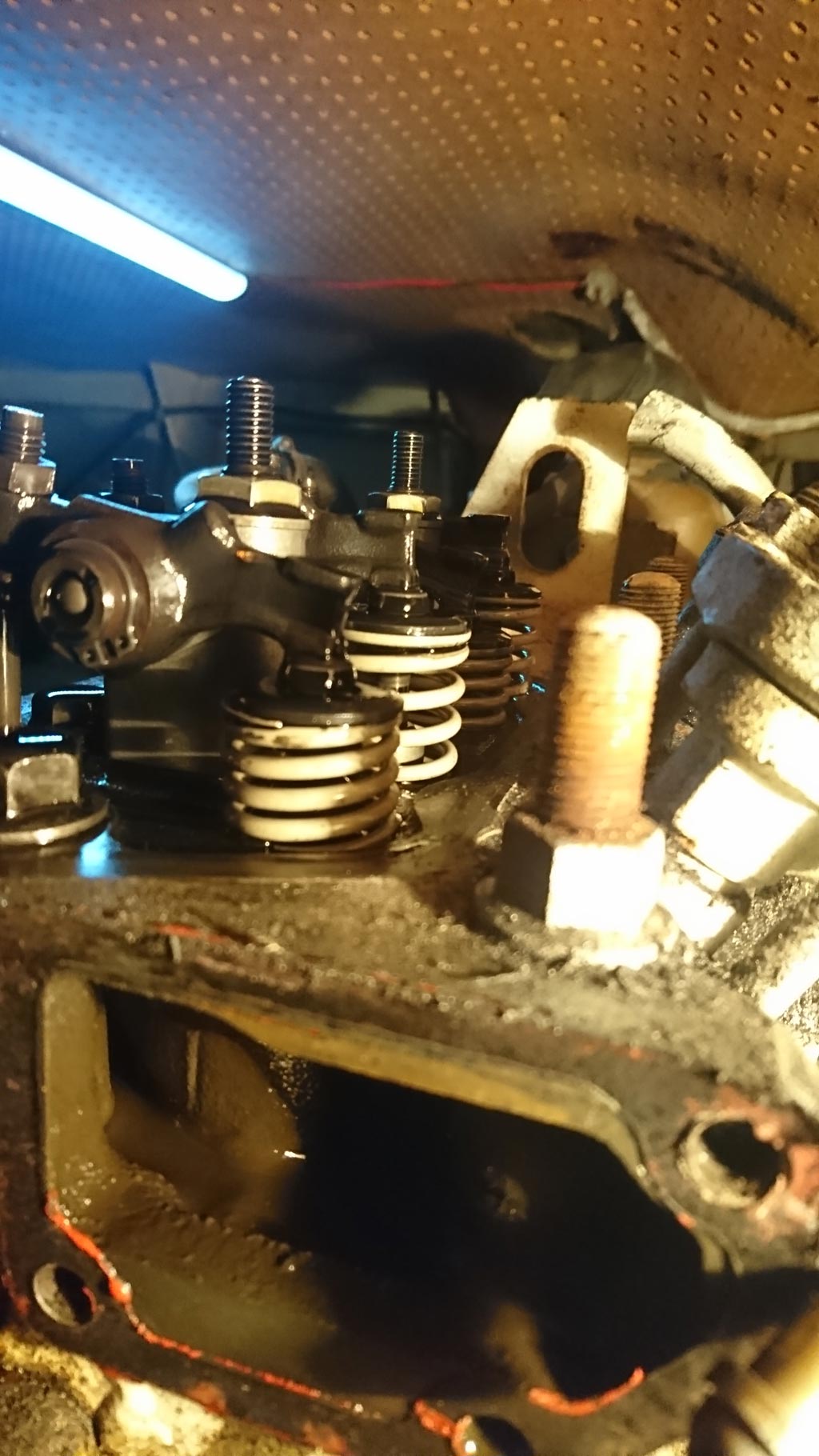
2gm_cylhead_3.jpg


Anyway, removed the rocker assembly and that's how it looks now:
2gm_cylhead_4.jpg


Would be nice to have it now at home, but a 20cm long 17mm spanner wasn't enough to undo the cyl head bolts/nuts. The long lever was at home and I had no suitable hollow section to use as an extension so another visit today or tomorrow to retrieve the cyl head.

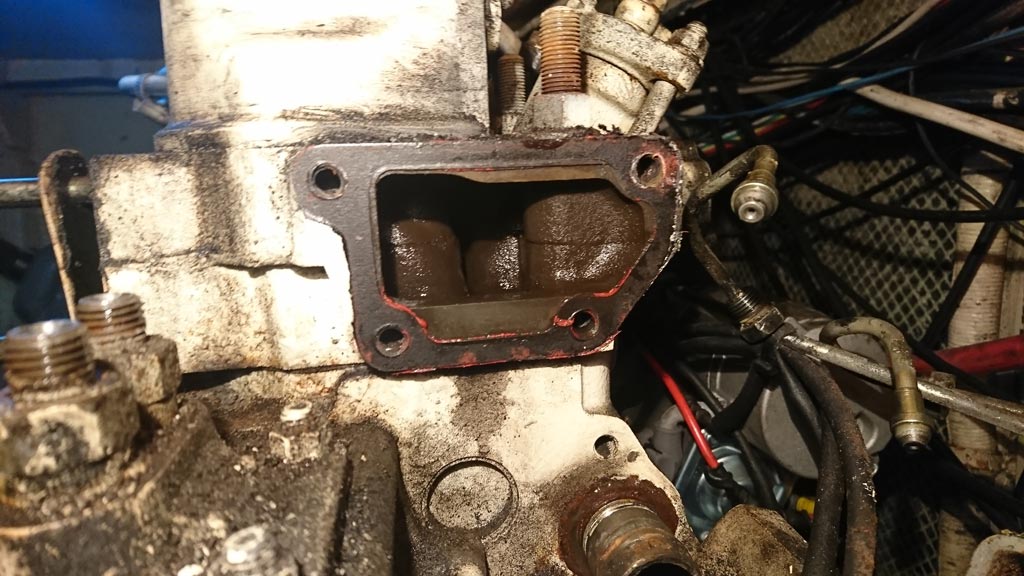
Closing with the main issue identified which is that the freshwater coolant circuit has LOTS of oil in it. I mean when I removed the hoses, clean water came out, but when I removed the heat exchanger and turned it around in order to clean the crude, I ended up with approx a ristretto portion of nice clean oil. Failed head gasket?
water passages look and feel clean (on the sides and top, oily on the bottom) No rust though anywhere though :D :
2gm_cylhead_2.jpg


Curious to see how the cyl head looks like!

cheers

V.
 
Would be nice to have it now at home, but a 20cm long 17mm spanner wasn't enough to undo the cyl head bolts/nuts. The long lever was at home and I had no suitable hollow section to use as an extension so another visit today or tomorrow to retrieve the cyl head.

Useful tip for tight bolts (assuming you have combination spanners), Put the 17mm ring on the bolt/nut, then put the ring of a bigger spanner onto the open end of the 17mm spanner. :encouragement:
 
Useful tip for tight bolts (assuming you have combination spanners), Put the 17mm ring on the bolt/nut, then put the ring of a bigger spanner onto the open end of the 17mm spanner. :encouragement:

thatks, yes used to do it when I was younger, but since I managed to get a permanent damage on my right shoulder and a sort of constant tendonitis up there, I try not to force it too much and not to get it into shocks, so rather wait and do it carefully on a robust longer lever. Curious though why they are so tight. Got the tool in the car, if it's not snowing or freezing cold tomorrow I'll have a go.

cheers

V.
 
My 1GM10 was like this, it was a knackered exhaust valve seat that was the culprit. It had to get really warm to be of any use. OK now although not the best starters as they don't have glowplugs so has to turn over for a bit on very cold days to generate heat to start. Mine is raw water cooled though.
 
Closing with the main issue identified which is that the freshwater coolant circuit has LOTS of oil in it. I mean when I removed the hoses, clean water came out, but when I removed the heat exchanger and turned it around in order to clean the crude, I ended up with approx a ristretto portion of nice clean oil. Failed head gasket?

cheers

V.

Oil in the coolant can usually only be a failed head gasket or a perforation in the block, liner or head caused by corrosion. Your engine looks to be in good nick so you can probably rule out the latter. :)

The good news, as you say, is that the coolant circuit should be corrosion-free. :o

Richard
 
Top