Yachting world dayboat. Repair or replace cracked plank and stem

jrt123

New Member
Joined
21 Mar 2011
Messages
11
Visit site
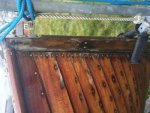
Apologies for asking question already covered, but what are people's views on this? A clinker yachting world dayboat. Mostly good nick, but very dried out. One split plank as shown below and a partially rotten stem.
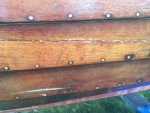
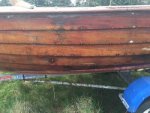
plank crack.jpgplank crack2.jpgstem.jpg

Would you fill/glue the plank (crack runs much of length as shown), or replace. Similarly, is the stem a single piece that "caps" the plank ends and so easily replaced, or major integrated part of hull? Rest of hull, planning to fill plank gaps with appropriate mastic and let it take up, see if it sinks. Are the plank ends a problem where they meet the stem or fill with mastic again? Any advice gratefully received.
 
I have a long liking of these boats, my Dad & i built a glued clinker one in 1976 , no 596, wonder where she is now? I have also restored another 4 of them one of which was a major rebuild. Im currently on no 5 which is a Venables boat built in 1963.
Is yours a Walker boat? i ask as the plank runs are quite distinctive. Walkers also used to spray the inside of the boat with wilkinsons polyurethane varnish, this tended to glue the planks together which could lead to full length splits in the topsides. I have seen 3 like this. Taking the plank out can be done or rake the split out & glue a spline in with epoxy.
The stem in walker boats was often in two pieces an inner apron & an outer stem. Removal is relatively easy in these asthere is a line of rivets down the centreline inder the stem band. A good tool to take the heads off the roves is a black & decker powerfile. If you are lucky the inner apron will be sound! Its worth replacing the copper hood end nails with screws especially if she is to be painted.
I am fitting a new stem to my one at the moment.
 
If you change the plank it will be hard to match the colour. Also most dinghies are built of the same timber stock, so preserving the plank is preferable to changing it. Also changing it is not easy.
I would simply clean out the split and fill with brown Sikaflex or similar, but not silicone.
You may need small support wedges behind the timbers.
As suggested above you could spline it. I prefer a carefully fitted tapering spline to a parallel sided one. Finally, just filling with epoxy filler would be the wrong move. It's hard, and would look terrible. Whatever you do apply plenty of varnish inside and out to stop it happening again, ditch the dark coloured cover and get a cream or white one. Finally, if possible, store the dinghy under a shady apple tree........


Bostik Findly MSR sealant in brown would do it all. Can be varnished over.
 
Last edited:
Keith66- thank you for the advice. This is a 1966 Walker boat, which I'm looking forward to sailing once it's sorted. I'll have a closer look at the stem.

Seanick- that certainly seems like a good starting point. I bought some Bostick MSR already as the boat is dried out (>10 years out of water) so my plan is to fill gaps with mastic, let it take up and see what gaps remain. Not sure whether to re varnish before or after this and whether suggestion of treating wood with linseed oil is a good one? Makes sense to fill plank crack and varnish over as you suggest. Boat is actually beneath shady tree now, but oak, not Apple, should I move it?

Ps. I'm up to episode 11 of Getting Afloat and really enjoying re watching them, thanks for making them available. Looking forward to attempting plywood deck replacement and wishing I'd been a boatbuilder...
 
Walkers also tended to skimp on centreline fastenings, this tends to cause gaps between keel & hog under the mast step area, worth checking fastenings here & add a few if necessary. Re mastic, best stuff for boats like this is good old Evomastic, it is oil based & cheap. It does not dry out & is compatible with Linseed oil. A mix of linseed oil & cuprinol is a good thing to soak an old clinker boat with.
 
The varnish seems mostly intact and I don't think there's any rot. It's bone dry after 10 years in a garage. Would it still be best to take the hull back to bare wood? Then what order? Linseed, varnish, mastic in the gaps, refloat/sink? Or if current varnish intact, mastic and refloat? What happens to the varnish layer when the planks take up, does it need replacing again after this?
 
The varnish seems mostly intact and I don't think there's any rot. It's bone dry after 10 years in a garage. Would it still be best to take the hull back to bare wood? Then what order? Linseed, varnish, mastic in the gaps, refloat/sink? Or if current varnish intact, mastic and refloat? What happens to the varnish layer when the planks take up, does it need replacing again after this?
If the varnish is generally intact and the boat is nice and dry then just give it a flatting down with 240 grit or finer and apply a couple of coats of 'conventional' varnish. It stays soft for long enough to allow the planks to move and take-up. You will find that a couple of good coats inside and out will seal the hull quite well.
This method works well on Redwing dinghies of similar construction and materials although Redwings are planked in Agba which is lighter than normal west African mahogany.
 
Top