

Portofino
Well-Known Member
Arh thats something else .Yes the metal work block + metal ancillaries like coolers etc are indeed the bits bonded to the transom anode in as I say a simple electrochemical circuit with the anode rightfully taking the hit .Nowhere, myself. My point is just where are MAN going with their requirements?
Transom anode bonding is similar in my boat, and many others MAN powered that I've seen.
But if you check MAN installation requirements, the whole engine DC circuit should be completely isolated by the rest of the boat, grounding included.
They must have had a reson to recommend that, which I fail to understand.
Particularly in the light of the fact that I've yet to come across any builder sticking to it.
Metal lumps , salt solution the sea water , and zinc , as long as they are connected up the zinc takes the hit .
Yes the D.C. running , the alternator, ECU s and anything else DC wise is isolated in a separate circuit ..Not connected to the metal work . Theres no neg Earth on the block like say a car , hope that makes this easy to follow .
Presume so you do not get stay currents potentially interfering with the simple anode , salt solution circuitry .
Makes perfect sense .
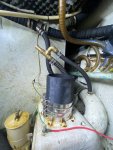
This red wire comes from the ECU box mounted out of shot adjacent.Looks like it’s some sort of grounding? As a tank earth wire can be seen also ( green ) bolted on too .NB the rubber hose isolates the engine exhaust .
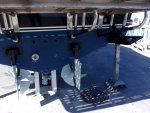
For clarity for those getting lost with this , one anode fitted , the other is off with the bolt exposed .Rudders , steering ram as well as the engine block are attached to these , one each side .There are no separate pencil anodes littering various seawater components on the engines .All there anodic protection is done with just one of theses per side .
This is the moot point where MapishM and myself differ .With this system there is no need , or any conferred benefit of bodgeflow , fresh water dockside flushing post engine running , from a preventative electrolytic corrosion pov .
You need an electrolyte salt water , it’s one of the components along with the zinc for it to work .Kinda all built in you can switch off and chillax .
Historically with the pencil anodes systems , many genys eg because the anodes are tiny and degrade invisibility there becomes potentially a point whereby the critical zinc mass diminishes so a fresh water flush to attempt to decrease the salt content to the below the level what little zinc is left ( you can’t see it and it may be forgotten ) might be beneficial.
This is separate to mitigating salt build up in coolers .Thats another issue ,
This is also separate to CATs differing metals with there early charge air coolers , coupled with poor design location of the pencils leading to drying out .CAT recommend now there CAC s on certain engines are a throwaway part changed every 7 years btw . Potential buyers will be going through the SH records with a fine toothed comb looking for that .
No amount of previous bodge flow changes that requirement , how ever well intentioned.
Bodge flowing MAN engines is a false precept imho .
It the whole DIY none OEM self instal of fresh water flushing aptly named bodge flow can’t be without risks of cocking up the timing re water on / off , engines on / off and ending up with water where it’s shouldn’t running back into the turbo s or worse open exhaust valve .
From the pic ^^^ props shafts have there own anodes as do the tabs and the bathing platform architecture as seen .
” As seen “ I see them reassuringly every time snorkelling in the Med .
Last edited: