wooden boat buying

Unfortunately we have to agree to disagree on this issue.

Regards

John

+1

Only last month I surveyed a yacht planked with 30mm iroko. It was in pretty much A1 condition, except for localised heavy decay around the seacocks, which had been bonded to the anode. Some of the decayed sections were so soft that the valves showed substantial movement when pushed. Luckily they had been well-maintained, so required very little effort to operate: had anyone had cause to try to "persuade" a seized valve, it may easily have pulled through the planking.

Iroko seems particularly prone to electrolytic decay, but the action takes place in all timbers to some extent, particularly oak and phillipine mahogany. Older teak and pitch pine seem quite resilient, but the "sustainable" teak currently available commercially doesn't seem to have the same resistance.

As with John, I have also found this a common problem with timber (usually plywood) backing pads on GRP yachts.

Bonding seacocks to the anode was a "bright idea" that arose about 20 years ago, probably as a response to the use of brass rather than bronze below the waterline. However, as the MAIB report into the near-sinking of the Sea Harvester a few years back makes clear, it causes more problems than it alleviates.

Dom
 
>brown furry stuff on the wood

I had to replace skirting board in a house I bought which had dry rot, it's white.

>reddish water

Could it be rusty water from something, the engine perhaps?
 
with plywood or solid wood backing plates, the timber backing softens & goes fibrous as does any backing timber used on seacocks that are wired to the anode. This is also quite regularly seen but not picked up by owners & surveyors, just making the assumption that it is bacterial decay & nothing else.

Unfortunately we have to agree to disagree on this issue.

Regards

John
Exactly my experience with an anode bolted through a Cascover sheathed plywood hull. Although some sealer used where the bolts went through the ply there was softness and decay around the bolt holes. Cut out the decay, epoxied in a graving piece and filled the holes with epoxy before drilling for new bolts. Laminated glass/epoxy over the repair inside so hopefully no direct contact between bolts, anode and timber now.
 
Sorry, if I am being thick here....

Are you saying that a wooden boat should NOT have an anode? Or just that the anode should be conencted to the battery and engine and not everything else in sight?
 
Sorry, if I am being thick here....

Are you saying that a wooden boat should NOT have an anode? Or just that the anode should be conencted to the battery and engine and not everything else in sight?

Not to the battery or the engine, but to the stern tube and shaft/prop which maybe through the gearbox housing and a bridge across the flexible coupling if you have one. No need to connect to seacocks.
 
Not to the battery or the engine, but to the stern tube and shaft/prop which maybe through the gearbox housing and a bridge across the flexible coupling if you have one. No need to connect to seacocks.

And be sure to insulate the anode studs where they pass through the hull! See instructions (link in post #20).
 
there is also a fair chance that any water that's made it's way through 2 layers of mahogany planking will have a redish tinge to it :)

good point...bit scary all this anode stuff, I can just about remember reading an article somewhere about anodes doing more harm than good if wired up incorrectly on a wooden boat, but that was a long time ago..i would tend to listen to the surveyors on here who have first hand expert knowledge of such stuff.
 
good point...bit scary all this anode stuff, I can just about remember reading an article somewhere about anodes doing more harm than good if wired up incorrectly on a wooden boat, but that was a long time ago..i would tend to listen to the surveyors on here who have first hand expert knowledge of such stuff.

That would be post #19 then.
 
In the end. as lots of other people have pointed out on these forums, owning a pleasure boat is about just that: pleasure.

There are some very capable wooden boats out there: I've met the current owner of this one http://en.wikipedia.org/wiki/Spirit_of_Mystery - fabulous boat by the way - and it has been to Australia and back with not much more maintenance than a couple of coats of paint.

There are some very old boats out there that are still going strong, as can be seen from eg Old Gaffers or various Smack Preservation societies etc. These can need a lot of maintenance, but mainly because they're old, not because they're wooden.

Either way, good luck, and if you buy the boat, hope all goes well and that you get much pleasure out of her.
 
Sorry, if I am being thick here....

Are you saying that a wooden boat should NOT have an anode? Or just that the anode should be conencted to the battery and engine and not everything else in sight?

I am also being really thick (as a plank haha)...I thought wood was an organic substance, so therefore the ultimate destination is to release its carbon back again through rot - caused by funghi and bacteria - both of which need moisture as the catlyst. So what does a metallic anode do to wood? What's the chemistry there?? Go on., educate me...I might learn a new thing
 
I am also being really thick (as a plank haha)...I thought wood was an organic substance, so therefore the ultimate destination is to release its carbon back again through rot - caused by funghi and bacteria - both of which need moisture as the catlyst. So what does a metallic anode do to wood? What's the chemistry there?? Go on., educate me...I might learn a new thing

It's a result of increased alkalinity in the wood - read the link I posted in post #20.
 
Exactly my experience with an anode bolted through a Cascover sheathed plywood hull. Although some sealer used where the bolts went through the ply there was softness and decay around the bolt holes. Cut out the decay, epoxied in a graving piece and filled the holes with epoxy before drilling for new bolts. Laminated glass/epoxy over the repair inside so hopefully no direct contact between bolts, anode and timber now.

The risk still remains at the point internally where the bonding wire connects to the stern gear or rudder tube as this cannot be protected by sleeving but the damaging chemical still builds up as the anode erodes indicating an electrolyte is constantly forming.

Sleeving definitely does help to a degree but unfortunately on the inside where the structure is damp the risk of chemical damage in the area still exists. It is not just the fact that the timber is in contact with the anode, close proximity is enough for the possibility of deterioration. Sleeving protects the end grain from drawing in the primary source of the electrolyte where it draws deeper into the timber much faster, but eventually the timber will succumb.

Even vessels with the bonding externally using copper strip from the anode to the external stern gear gradually deteriorate which one would think unlikely. I recently inspected a Gauntlet class 1936 that had external bonding but this too has anode related damage to the external timber around the stern gland. This damage had only occurred following the fitting an anode.

Part of the problem is that vessels now have much more electrical equipment aboard including electric pumps which are live all the time, burglar alarms,wind generators & solar panels which have to be 7 day a week active. any slight leakage from these translates into a possible electrical pathway helping any anode erode much faster accelerating damage. Shore power is another possible destructive source of stray current.

The domestic system should always be fully isolated when the boat is vacated & left unattended. Any losses from this are restricted by isolating from weekend to weekend.

Possibly it is a problem that cannot be totally eradicated in that you either have the risk of serious structural damage caused by the fitting of an anode or you have the risk of metal corrosion problems requiring possible new propeller & other other relatively easily replaceable parts at intervals, although if there is no great mixture of metals this last risk is reduced.

Wooden vessels can have an unlimited life if a degree of care is taken but also can be destroyed by careless build & ill advice. A short while ago I was asked to assess a 34ft Norwegian build sailing yacht of a Colin Archer type design that was still afloat and with every intention of remaining afloat built in 1870 & . from what I could see, still mainly original.

John Lilley

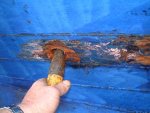
Below:


The result of anode damage where the backing washer & nut & anode remains simply dropped through the plank once the forward bolt had been released. The vessel could have sunk so easily without obvious warning.
 

Attachments

  • anode-damage.jpg
    anode-damage.jpg
    43.4 KB · Views: 1
For thirty years I owned, maintained, and sailed a large wooden boat, built in 1938. I NEVER fitted any hull anodes, but did have one on each side of the large steel rudder. No problems.

To the OP. People here have been saying that with a wooden boat needing repair work, "you can chop it out and replace anything.....". Please be very aware that this does not apply to double diagonal construction, which is an absolute nightmare, if repairs are required to the inner skin.
 
For thirty years I owned, maintained, and sailed a large wooden boat, built in 1938. I NEVER fitted any hull anodes, but did have one on each side of the large steel rudder. No problems.

To the OP. People here have been saying that with a wooden boat needing repair work, "you can chop it out and replace anything.....". Please be very aware that this does not apply to double diagonal construction, which is an absolute nightmare, if repairs are required to the inner skin.

thanks, will bear that in mind.
 
Top