Wiring suggestions

Thanks for all your input but what seems to be the issue with a 1-2-both-off type switches? Have never been a problem before, isn't it easier than having to fit 3 separate switches?

The 1,2, both, off switch is the simplest way of adding a second battery to what is essentially a single battery system.

The downside is the ease with which you can select "off" ( with some but not all) when changing from battery 1 to battery 2, with dire consequences for the alternator diodes if the engine is running. Also at one time there were some very cheap/inferior versions on the market.


The advantages of separate switches is that you can now separate engine and domestics, have dedicated batteries for the two functions and eliminate the need to swap from one battery to the other.
 
The advantages of separate switches is that you can now separate engine and domestics, have dedicated batteries for the two functions and eliminate the need to swap from one battery to the other.

Just to add to what VicS says for Aquaholic.

The requirements for an engine battery and a domestic battery bank are significantly different. The batteries that best meet those requirements are significantly different in design and construction.

Using three separate (and pretty cheap) battery switches means you can match the battery to the right circuit, with the third switch being only for an emergency start - bearing in mind that by the time you ever have to use the third switch you've either got a serious problem with the engine/fuel supply etc. or you're starter battery has suffered considerable degradation of its useful working life or both.

The problem with switching a 1-2-both switch to off and damaging the alternator can be overcome with good circuit design. The problem of trying to treat two dissimilar battery banks as swappable alternatives, or even worse trying to use an identical pair for different purposes, is just fundamentally ****.
 
The main problem with 1-2-Both switches is that they can be accidentally left on the wrong setting whilst the engine is off, leading to flat batteries and inability to start the engine. Probably a fair proportion of RNLI tow-in "rescues" are down to this. With separate switches and a splitter/VSR, the system is absolutely foolproof, and there's no reason ever to touch a switch apart from when you arrive at the boat and when you leave it.
 
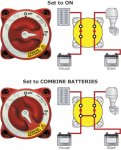
If this switch isolates the house bank from the engine battery, does the 'combine' position need to be selected in order to charge the house bank?

switching_solutions_1.jpg
 
Top