
Wiring problems

barryassheton

Well-Known Member
Joined
18 Jul 2010
Messages
77
Location
Ryde, Isle of Wight, England
Visit site
Hi,

I will be rewiring my boat early next year having ripped all the wiring out last year to refit and i am having problems with the wire gauge.

This is just one example, I have 2 tap micro switches drawing about 3 amps each so I intend to use a 10 amp fuse the run of the wire is about 16m round trip so I used an online calculator and and got a cable of 6 AWG or 16mm² with a voltage drop of 5%.

To me this seem extremely excessive for 2 small low amp taps.

Can anyone Advise.

Thanks, Baz
 
My Excel calculator for 3 amps, 16m round trip with 16mm wire gives a voltage drop of about 60 millivolt.

2mm wire shows app 1/2 volt
 
Last edited:
Hi,

I will be rewiring my boat early next year having ripped all the wiring out last year to refit and i am having problems with the wire gauge.

This is just one example, I have 2 tap micro switches drawing about 3 amps each so I intend to use a 10 amp fuse the run of the wire is about 16m round trip so I used an online calculator and and got a cable of 6 AWG or 16mm² with a voltage drop of 5%.

To me this seem extremely excessive for 2 small low amp taps.

Can anyone Advise.

Thanks, Baz

I am not sure if you are sizing the wiring for 3amps or 6amps

but according to my calculations you will need AWG13, or 3mm², for 6amps and AWG16, or 1.5mm², for 3 amps


I always calculate the gauge of wiring required from the data in this table rather than using the " calculators".

http://www.engineeringtoolbox.com/wire-gauges-d_419.html
 
I am not sure if you are sizing the wiring for 3amps or 6amps

but according to my calculations you will need AWG13, or 3mm², for 6amps and AWG16, or 1.5mm², for 3 amps


I always calculate the gauge of wiring required from the data in this table rather than using the " calculators".

http://www.engineeringtoolbox.com/wire-gauges-d_419.html

Thanks. I was using the fuse rating to size the wire I needed.
 
Thanks. I was using the fuse rating to size the wire I needed.

I though you were basing it on an acceptable volts drop of 5% at the current drawn

You dont need to size the wire to keep within a certain volts drop at a current equal to the fuse rating just at the current actually drawn
 
ok thanks. I will go through my list and recalculate the wiring.

Thanks

I think we need to stop and take a look at exactly what you are doing with these " tap microswitches "

Presumably you have two taps fitted with microswitches to control a pump ??

If so the current which you need to consider is the current the pump takes , unless the pump is switched by a relay which is controlled by the tap microswitches.

I suspect the 3 amps you say the micro switches draw is the maximum current rating of the switch contacts. ??????
 
I think we need to stop and take a look at exactly what you are doing with these " tap microswitches "

Presumably you have two taps fitted with microswitches to control a pump ??

If so the current which you need to consider is the current the pump takes , unless the pump is switched by a relay which is controlled by the tap microswitches.

I suspect the 3 amps you say the micro switches draw is the maximum current rating of the switch contacts. ??????

Thanks. I would have noticed eventually that I forgot to included the pump lol but I am glad you mentioned it. I haven't purchased the pump yet but going on the one I have in mind it states a minimum of 16 gauge wire on 20a circuit. I was planning to wire the taps in parallel. so if I am looking at a 20A on the pump and 3a for each tap then I would need a 30A fuse.
 
Thanks. I would have noticed eventually that I forgot to included the pump lol but I am glad you mentioned it. I haven't purchased the pump yet but going on the one I have in mind it states a minimum of 16 gauge wire on 20a circuit. I was planning to wire the taps in parallel. so if I am looking at a 20A on the pump and 3a for each tap then I would need a 30A fuse.

If the taps micro switches can only handle 3 amps you will need a 20 amp relay to handle the current of the pump.
 
Thanks. I would have noticed eventually that I forgot to included the pump lol but I am glad you mentioned it. I haven't purchased the pump yet but going on the one I have in mind it states a minimum of 16 gauge wire on 20a circuit. I was planning to wire the taps in parallel. so if I am looking at a 20A on the pump and 3a for each tap then I would need a 30A fuse.

Looks like I am half asleep today lol. That pump was for the power toilet not the taps. the one for the taps is only 8.5A so I would need a 17a fuse and AWG 12, 3.3mm².
 
Looks like I am half asleep today lol. That pump was for the power toilet not the taps. the one for the taps is only 8.5A so I would need a 17a fuse and AWG 12, 3.3mm².

If the taps can only handle 3 amps you will still need a relay otherwise you will burn out the switched in the taps.
 
ok thanks. I will have to have a look in to it a bit more as relays are not my strong point. Whenever I have used them in the past I have always had a wiring diagram to go by.

Plenty on Ebay, they usually have a small diagram on one face and numbered pins.
Pins 85 and 86 do the switching of the relay, Pin 30 12v supply for load, pin 87 gives the 12v to load once the relay has been energised.
http://www.ebay.co.uk/sch/i.html?_from=R40&_trksid=p2050601.m570.l1311.R4.TR9.TRC2.A0.H0.X12v+relay.TRS0&_nkw=12v+relay+4+pin&_sacat=0
 
I don't mean to be rude but I'm a little worried you are re-wiring your boat with very little knowledge of electrical wiring, please be very careful.

All switching contacts (relay contacts, micro-switches, on/off switches, etc) will have a rated current, above this they may fail and failure could be benign as in open circuit or it could be more dangerous as in weld closed and overheat.

As you know, your micro-switches are rated for 3A and your pump is 20A so you need to use a relay with contacts rated above 20A.

As an example a quick search resulted in the following relay with 40A rating:

http://www.maplin.co.uk/p/12v-40a-dc-relay-for-automotive-applications-ar32k

You will see in the specification a coil current of 133mA +/-12mA, so a potential max of 145mA (0.145A). Well within the rated current of your micro-switches. So you would need a 12VDC supply with say a 0.5A fuse running through your micro-switch and to the positive terminal on the coil, the other side of the coil goes to -ve. Now your wire size for this piece of wiring can be calculated for 0.5A to 1A over the length of the run, much smaller wire than you previously looked at.

Then you need to get a 20A supply to the pump via the relay contact, best to keep this wire length as short as possible. You could mount the relay close to the 20A source (fuse/circuit breaker) then take the most direct route to the pump. Of course this wiring needs to be sized for 20A based on the length of run you end up with.
 
Hi,

I have 2 tap micro switches drawing about 3 amps each so I intend to use a 10 amp fuse

Just curious, will each switch circuit be separately fused, otherwise given the fusing factor for a 10A fuse and the size of the component end user wire section, you could be faced with a potentially dangerous source of heat in the event of a fault occurring!
 
Hi,

I will be rewiring my boat early next year having ripped all the wiring out last year to refit and i am having problems with the wire gauge.

This is just one example, I have 2 tap micro switches drawing about 3 amps each so I intend to use a 10 amp fuse the run of the wire is about 16m round trip so I used an online calculator and and got a cable of 6 AWG or 16mm² with a voltage drop of 5%.

To me this seem extremely excessive for 2 small low amp taps.

Can anyone Advise.

Thanks, Baz
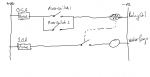
Hi Baz,
The fuses (or breakers) are there and caculated to protect the wiring from overload and risk of a subsequent fire, not the device.

A 10 amp cable will have say a +15% tolerance margin, the fuse device may have +10% (you need to read up on the makers actual specs).

If the fuse exactly match the cable capability, short inrush spikes to say a motor would trip the fuse far more often, likely causing great and constant inconvenience.

If using modern LED lighting, you can use a heavier cable than needed for physical stregnth, and use a lower rated main fuse.

ideally a lower rated fuse would be local to the device as they tend to have much thinner, lower currant rated wiring.

Depending on the device youu may be affected by voltage drop caused by cable ressistance over longer runs, it is wgere a thicker cable can help overcome this problem when dealing with water or fuel pumps as example.

Alan
 
Top