Wind or current - most influential on boat drift?

ruvane

Well-Known Member
Joined
24 Nov 2005
Messages
190
Location
Ashkelon Marina
www.techno-laser.com
I'm trying to figure out which of these two will be the more influential on a boat adrift in the open sea presenting no sails.

Naturally there are factors specific to the boat, such as, underwater area and shape, above water area and shape, etc.

Is there a major mover, or is it too craft specific? Any opinions welcome.

Ruvane.
 
I think you've answered your own question. Both factors will act on the boat, and in the open sea there is usually very little current, but their proportional effect will be different from one boat to another. The current will probably move any two boats at a similar speed, but the direct effect of the wind could be very different.
 
Ahhh, this is sort of why I was asking!

Is a sea anchor a good way to stop drifting (given that we're not talking about storm conditions)? Or is this just making it easier for the current to drag the yacht?

Ruvane.
 
The effects from the wind are very much boat specific, but will fall into gross generalisations due to boat type. For example a catamaran will be considerably more affected by wind than a long keeler.

All boats will be equally affected by current.

An anchor or drogue will have no impact on current, but will have a considerable effect on rate of drift.

It is theoretically possible for a parachute anchor to drag you though a major storm due to the effect of the current. The forces on the boat will be enormous.
 
Open sea current runs at approximately 0.5 knots. Running under bear poles and surfing down a wave, with no sea anchor a boat could easily do 10 knots.
 
0.5kn ?????

It may in some large areas ... but there are also many areas that figure is definitely not true ......

Ocean currents ............... not a simple matter.
 
Are you considering drift relative to the sea bed (ground speed / GPS positions) or relative to the water surface?

A sea anchor will reduce your leeway which is drift through the water due to the effect of windage and underwater profile.

Your resultant ground track and speed will be a combination of your water track plus a component due to any current or tidal stream.

If we knew why you were asking we could possibly give a clearer answer.
 
What started me thinking about the problem was that I was sitting in the boat one day, wondering how to keep the thing from moving as little as possible relative to the sea bed. (And it being too deep to anchor)

Hove to?
Sea anchor?
.........?

Ruvane.
 
In which case a sea anchor (which opens another can of worms). If it is correctly sized, and they have to be big, you will drift very slowly down wind and with the current.

Hove too tends to take you fairly slowly diagonally down wind and to leeward, but much depends on rig and hull form. Modern dinghy like hulls lack the lateral resistance to heave too properly. Again you will also be carried by the current.

Experiment with heaving to first though as it is much less hasle than rigging and recovering a sea anchor. I used to heave to for lunch breaks etc in my previous boat to make life more comfortable in lively conditions.

The only way to counter the current is to sail into it at the same speed as the current.

Have fun.
 
A vexing question, the text books say the current is king but I think it depends on how much of the boat is in the water, BUT - and this is sort of relevant, the rubbish in the water splash ride at margate will always end up in the grating round the pump regardless of which way the wind is blowing - just a thought.
 
[ QUOTE ]
I'm trying to figure out which of these two will be the more influential on a boat adrift in the open sea presenting no sails.

Naturally there are factors specific to the boat, such as, underwater area and shape, above water area and shape, etc.

Is there a major mover, or is it too craft specific? Any opinions welcome.

Ruvane.

[/ QUOTE ]As others have said craft and orientation specific, but loosely speaking you simply need to "drift" downwind as fast as possible, so the stronger the current, and depending on the boat, the more beam on you need to be (the extra profile presented to the current underwater is irrelevant, as the force from the tide is only a resistance force and tied to the increasing speed of drift). If the current is in the exact opposite direction then you may drift faster than it, or slower, depending on the wind and tide strength. If it is not at 180 degrees, then the boat will move forwards or backward, so you will spend all your time trying to achieve an equilibrium.

Remember that the water is neutral as far as the boat is concerned; with no wind, the boat will sit dead in the water and move along with it; it is not concerned with whether the land and seabed is passing by or not.

If you are at anchor, so now the boat does care about the seabed, as both wind and tide now are acting on it in a relative sense, then generally speaking wind quickly becomes more of an issue than tide.
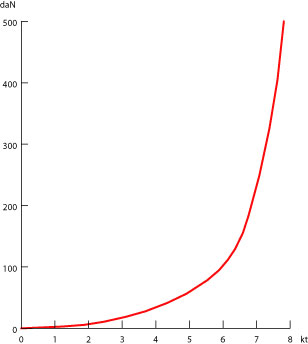
http://alain.fraysse.free.fr/sail/rode/forces/forces.htm Section 2.2

fig33.jpg

"...the force exerted by the current on a typical 10 m (33 ft) waterline sailboat" (presumably facing into both wind and tide for the sake of simplicity)

"We can see a 6 kt current - which is unlikely in most anchoring situations - has about the same effect as a 20 kt wind."

(This is not the same as saying that a 20 knot wind will drift any boat at 6 knots, so holding it constant in a 20-knot-wind-against-6-knot-tide scenario, but it helps address your query re which is more influential)
 
his later posts say he wants to stay stationary with relation to seabed, not to move with tide. So he really needs an exterior force of some sort. Anchoring he ruled out. So really, it's either a sail, or an engine

[ QUOTE ]
What started me thinking about the problem was that I was sitting in the boat one day, wondering how to keep the thing from moving as little as possible relative to the sea bed. (And it being too deep to anchor)

[/ QUOTE ]
 
Trying to stay in one place in an ocean drift is like trying to stay in one place with the world rotating under us. In other words the only way to stay in one pllace in a drift is to move through the water against that drift. Thats obvious
However it might seem that a boat can have more or less resistance to drift when also under wind force. My mooring area is affected by a small tidal movement such that in this season (winter) we have light winds and boats while tethered by a swing mooring vary as to whether they swing to the tide or the wind. Every boat is different perhaps largely dependant on growth build up on neglected boats, keel size and shape and superstructure.
So your question should.... be does my boat move through the water under wind influence very fast and in what direction. sideways or backwards or forwards. and how does this compare with the drift. The answer is only in the situation itself. good ole GPS olewill
 
Top