Why do the French have higher tides?

NPMR

Well-Known Member
Joined
14 Feb 2006
Messages
2,295
Location
Cornwall
Visit site
In the posts on tidal heights no-one seemed to touch on something I have never understood.

When the tide comes in, at our end of the world particularly, if you take a line of longitude from say, Falmouth to L'Aber Wrach, the tidal rise/fall in France is higher (and even worse around Jersey).

But they say water finds its own level.

So, are we sailing uphill and downhill when we cross the Channel?
 
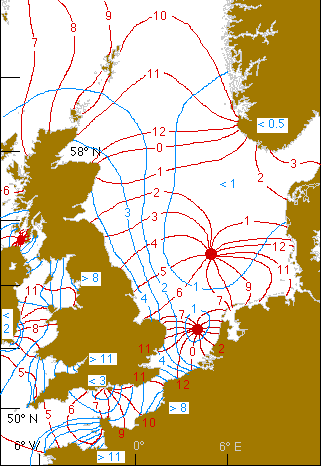
It is to do with the distance from the amphidromic point (this is the point of no-tide, a bit like the rotation point of the tidal wave). The further away you are from it the bigger the tide.

Marc.

Edit: This map shows these points

co-tidal.jpg
 
They say it is the Coriolis effect. The flood tidal current travelling up the channel bends towards the French coast increasing their high tide and so mitigating the English high tide.

On the way out the ebb current bends towards the English coast which amplifies the low tide on the French side.

This all makes sense until one considers which way a weather depression spins in the northern hemisphere. Wind heading up the English Channel tends to spin towards the English coast, so now I am confused.
 
Sounds like you and my computer use the same circular logic. I just had a message "cannot clear DNS cache because cannot clear DNS cache". So why do amphidromes exist, then?

My understanding of tidal phenomena is based upon sitting in the bath and playing with plastic ducks. If the tide rushes up the Channel from the Atlantic it either runs into something (the Cotentin peninsula) or it doesn't (South Coast) In the former case it piles up, in the latter it doesn't. Same occurs in the Severn Estuary and Liverpool, both enjoying spring tides of 10 metres plus.

At points roughly in the middle of double-ended seas, e.g. North Sea, North Channel off Kintyre, etc. two tides meet and due to the timing of these two events the middle bit doesn't change at all. In the North Sea the amphidrome moves about a bit but off Kintyre it barely does. Irish sea doesn't have one because the floods and ebbs are nearly coincident.

Purists are welcome to criticise but I prefer the simple approach.
 
Essentially for the same reason that any wave rotates when encountering refraction of energy from the coastline, and the effect of the Coriolis force.
 
Here is explanation. It is not only because of Coriolis force but also because of configuration of area. Reason why in Med tides are much lower....
"Inertial circles

Schematic representation of inertial circles of air masses in the absence of other forces, calculated for a wind speed of approximately 50 to 70 m/s. Note that the rotation is exactly opposite that normally experienced with air masses in weather systems around depression's air or water mass moving with speed subject only to the Coriolis force travels in a circular trajectory called an 'inertial circle'. Since the force is directed at right angles to the motion of the particle, it will move with a constant speed, and perform a complete circle with frequency f. The magnitude of the Coriolis force also determines the radius of this circle:

.
On the Earth, a typical mid-latitude value for f is 10−4 s−1; hence for a typical atmospheric speed of 10 m/s the radius is 100 km, with a period of about 14 hours. In the ocean, where a typical speed is closer to 10 cm/s, the radius of an inertial circle is 1 km. These inertial circles are clockwise in the northern hemisphere (where trajectories are bent to the right) and anti-clockwise in the southern hemisphere.

If the rotating system is a parabolic turntable, then f is constant and the trajectories are exact circles. On a rotating planet, f varies with latitude and the paths of particles do not form exact circles. Since the parameter f varies as the sine of the latitude, the oscillations associated with a given speed are smallest at the poles (latitude = ), and would increase indefinitely at the equator, except the dynamics ceases to apply close to the equator.

The dynamics of inertial circles are different from those of mid-latitude cyclones. In the latter case, the Coriolis force (directed outward) is in an approximate balance with the pressure gradient force (directed inward), a situation known as geostrophic balance. In particular, cyclones rotate in the opposite direction as inertial circles."
....or very simple Coriolis force is imagination for dynamic calculations. If you cover sea area of North hemisphere with thousands small hurricane circles than one of them cover Chanel and push water from England to France because of Earth inertia.
http://i34.photobucket.com/albums/d127/branko1/Coriolis_effect14.png
 
I love threads like this one.

Such a flood of erudition.

But nobody has answered your question 'Do we sail uphill to France?'

YES /forums/images/graemlins/grin.gif
 
[ QUOTE ]
The amphidromic point does not make sense

[/ QUOTE ]

I'll go along with that! Someone on here was 'In Search of the Degenerate Amphidrome' a while back.

Did he find it? And did it do what he wanted, when he got there?

/forums/images/graemlins/grin.gif
 
That's because the first pic gives you the major "oceanic" points. For the channel it looks more like this:

den79.gif


Which show why the tides are smaller in the Solent than in Saint Malo.

There is more info here if you want to read up on it.
 
It is of course because they have no tide on their mediterranean coast. they accidentally left all the lock gates open in he same direcion and it all ended up on the other coast!
 
[ QUOTE ]
That's because the first pic gives you the major "oceanic" points. For the channel it looks more like this:

den79.gif


Which show why the tides are smaller in the Solent than in Saint Malo.

There is more info here if you want to read up on it.

[/ QUOTE ]The amphidromic point argument is a bit chicken and egg as one might also argue that the amphidromic point is a RESULT of the way the tides behave. The causes of tidal flow and heights attained is an immensely complex subject. There is a harmonic motion of the whole of the Atlantic in which many factors play a part. Try reading NP120 - Admiralty Manual of Tides. If you are not sleeping too well, you can try reading it all the way through again.
 
I agree. The question as I understood it was 'Why are tidal ranges bigger in France'? The answer I was trying to give was that it was distance from the location around which the tidal wave rotates which dictates the range.
I was not attempting to explain all the factors which determine why the amphidromic point is where it is.
 
Top