Which Impeller Kit - 'Impeller', 'Service', or 'Rebuild'?

The most expensive option there is a rebuild kit including bearings for the shaft. I only used that when the pump was leaking from the weep holes behind the impeller. Routinely all you need is a new impeller and gasket. I buy all my stuff from parts4engines.
 
It should only need the impeller and gasket, if anything. Probably worth fitting a new impeller and keeping the old for a spare. Check the old one for any cracking at the root of the vanes. If it was left in the pump housing then you might find the vanes have taken a "set", but after a while out of the housing it relaxes. Does not affect the operation. The overhaul kits include bearings and seals for the shaft which you should not need. When you get it running you will know if it needs seals as you will see a drip from the back of the water pump. life of seals is unpredictable - my first Volvo, same pump as yours was original after over 3000 hours! Be aware that removal of the pump to replace seals and bearings is a "challenge", although the actual replacement is relatively easy.
 
So I was inspection how this work would be done, and as usual (never look closer at anything on this boat!) I found other issues.
So the 'water' in the bilge under the engine is apparently not water, it's slippery, so I'm guessing it's coolant.
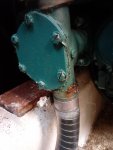
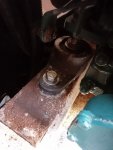
And when I looked closer at the fresh water pump housing I found corrosion. The corrosive stuff seems to have sprayed all over the starboard forward engine mount causing rust. Is it possible this engine was overheated and blown? Yikes!
Now I'm really wishing I'd seen the engine run for myself.
Anyway, once again, what do you guys think?
Does this look like cause to order the other impeller kit?
Water pump (1).jpgWater pump (2).jpg
 
I declined c.£100 rebuild kit for my leaking Jabsco. I bought a £2.00 seal from Ebay which has worked ok. Not a 'mission critical' issue if it started to drip again. (FYI I had a scored shaft and a metric lip seal worked on the worn imperial shaft. Specify a ss gaiter spring.)
 
That is the raw water pump so would not be a source of coolant. Looks typical - you tend to get a tiny bit of seeping and it looks far worse than it is. You can clean the front cover up and check the hose is tight when you change the impeller. The rust on the mount may be historic and indeed is what happens if the seals in the water pump leak. Unfortunately no way of checking short of removing the pump and changing the seals. There are 2, one keeping oil out of the water and the other water away from the oil. between the 2 is a gap and a hole in the housing so that if the seal fails you see fluid (usually water) dripping out of the hole when the engine is running. However the rust could be from water coming from a leaking front cover.

There is no engine coolant on that side of the engine - it is in the cylinder block, head and the heat exchanger on the other side (and the calorifier if you have one).
 
As in other posts, I keep the bilge clean under the engine and include running blue tissue under filters and joints every few engine checks to monitor what's going on. Clean up, then run the engine several times while monitoring any issues & work on resolving the ongoing ones, if any.
 
I went with a service kit as onboard spares and an impeller kit to replace. Tranona is right that the old one can be used as a spare but you'd need to be careful taking it out, and the benefit is questionable. Most of us yank them out with pliers, and this causes damage so don't count on the old on if you do this, using a (quite pricey) removal tool won't damage it, but it's still a worn item. They are extremely cheap in the context of boating so for me I just bought a spare which is next years replacement. Both systems cost the same, you'll still buy one for each service interval but having a new one in hand means you have a new one. Keeping the old as a spare means you have £16 in hand and a potential failure in your spare, you'll still bin it and buy a new one next year as you rotate them.
 
OK, so I will order an impeller kit and a rebuild kit. And keep the rebuild for just in case, and keep the old part too BC you never know... I'll try to take care in removing it. Oil and Coolant need changing anyway so I'll check for signs of mixing when I do.

On cars at least oil turns white when water enters. Typical with say a broken head gasket. Don't know if diesel oil does the same. Trying to picture what Tranona is saying about having two seals with a space between, which leads me to think then the two should never mix, and whichever is leaking from the space between is the side with the broken seal. If I'm picturing that right then this really is a pretty 'safe' system and I may be worrying too much.

I'll clean up the rust on the mounts and in the area with WD-40. It's become my rust 'go to'.
Maybe cut off a little bit of that hose when i re-attach it, and maybe a new clamp as well. We'll see how it clamps up.

My eventual goal when all the servicing is done is to have the engine and the engine bay spotless. I want to be able to look in there and see right away if a new leak has formed.

Weird about the glass. But that's another thread...

Thanks again everyone for the feedback. I think if not for these forums I might have given up on this boat by now. Or at the very least be overwhelmed!

So motto of the day is- keep calm and carry on :)
 
and keep the old part too BC you never know... I'll try to take care in removing it.
Sorry yes, I didn't mean to imply it wasn't sensible to keep a bunch of the old ones on board, just that the first "spare" ought to be a new one as it's cost neutral. It's possible to have a very bad day and need a few though. If you go with the rebuild kit just be comfortable you'd be able to use it. I went service kit because I didn't think rebuild would be an emergency activity so decided to save the money - I wouldn't know how to fit it without a bit of research anyway.
 
Sorry yes, I didn't mean to imply it wasn't sensible to keep a bunch of the old ones on board, just that the first "spare" ought to be a new one as it's cost neutral. It's possible to have a very bad day and need a few though. If you go with the rebuild kit just be comfortable you'd be able to use it. I went service kit because I didn't think rebuild would be an emergency activity so decided to save the money - I wouldn't know how to fit it without a bit of research anyway.

Right so that's a good point. So maybe an impeller kit and a service kit would do.
If I need the rebuild kit, I won't be in a rush and I'll definitely be back here first ;-)
 
It is almost always the water seal that goes because of silt in the water. Rarely the oil side.

OK, good to know. So I'll get one service kit to be safe. Maybe keep some extra coolant onboard as well.

Also I'm thinking about installing some kind of overheat alarm with an audible.
It's not like a car where the gauge or red overheat light is just right in front of your face all the time.
And I don't want to be distracted with weather or situational awareness, while I'm cooking my engine.
Any recommendations for such an alarm if they actually do exist?
 
It is almost always the water seal that goes because of silt in the water. Rarely the oil side.
This is probably correct but if the water seal goes and the telltale hole is gunged up then the water is likely to end up in the oil particularly if it’s an older style with rather than cast in gap
I also suspect that many are damage in fitting
 
OK, good to know. So I'll get one service kit to be safe. Maybe keep some extra coolant onboard as well.

Also I'm thinking about installing some kind of overheat alarm with an audible.
It's not like a car where the gauge or red overheat light is just right in front of your face all the time.
And I don't want to be distracted with weather or situational awareness, while I'm cooking my engine.
Any recommendations for such an alarm if they actually do exist?
No need for coolant - this is the seawater side as I explained. Check the engine coolant via the header tank.

You can get exhaust overheat alarms which are a reliable warning of overheating. I am fitting one because it was already on the boat, although TBH the Volvo overheat buzzer would wake the dead (if it is working!)
 
Top