What to use to mould a GRP base for a Houdini hatch?

MYStargazer

Well-Known Member
Joined
5 Jan 2006
Messages
1,379
yachtstargazer.wordpress.com
I'm looking to remount my Houdini hatch onto a curved GRP deck. It can't go straight on as the curve's too tight.

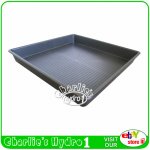
I was thinking of using one of these plastic trays Tray.jpg as a female mold, to make a raised section, then cutting away the molding to fit the curved deck, then glassing into place on the inside to leave a neat join when seen from the exterior. The trouble is that this plastic tray is 60cm x 60cm x 7cm, and is just too small.

Can anyone think of an alternative everyday item to use as a female mold instead? The next largest size for this product is 100cm x 100cm which will be too big...
 
Take the bigger tray and cut out a cross with say 38cm widths to reduce the dimensions correctly whilst not disturbing the corners.
 
Have you thought of making a base in situ using the technique described in the WEST manuals in the Hardware Bonding (Casting a Base) section?

http://www.westsystem.com/ss/bonding-hardware/

see Fig. 19

Thanks - it's a thought. I'm thinking that the finished result might look a little DIY, unless I could cover it all in flocoat - but then how would that blend in with the base gelcoat?
 
True, it probably wouldn't make an exact match, but if you produce straight masked edges it'll look better than many manufacturers' efforts - if in doubt use a contrast colour.

Rob.

Hmm - perhaps use a sheet of grp (http://www.ecfibreglasssupplies.co.uk/p-2141-4mm-white-fibreglass-flat-sheet.aspx) to widen the area in which the hatch sits, then bond that to the curved deck using this...

Have you thought of making a base in situ using the technique described in the WEST manuals in the Hardware Bonding (Casting a Base) section?

http://www.westsystem.com/ss/bonding-hardware/

see Fig. 19
 
Make a plug in mdf of the correct shape,spray varnish it with two pot varnish (or paint) make a female mould and then make the part.It's a lot of work but you'll get the correct shape and a good finish.
 
Make a plug in mdf of the correct shape,spray varnish it with two pot varnish (or paint) make a female mould and then make the part.It's a lot of work but you'll get the correct shape and a good finish.

This might be the way, as I need to make three final (male) moldings. Does it need to be two pot varnish/paint in particular?
 
Thanks - it's a thought. I'm thinking that the finished result might look a little DIY, unless I could cover it all in flocoat - but then how would that blend in with the base gelcoat?

If it's for the boat on your website, I would paint it the same colour as the deck.
 
This might be the way, as I need to make three final (male) moldings. Does it need to be two pot varnish/paint in particular?
It's safer to use two pot because it won't react with the polyester.Theoretically one pot would do because the mould release agents(wax and PVA) would keep the resin away from it but things sometimes go wrong.The reason for painting/varnishing is that you must make the plug as smooth and shiny as possible.
 
It's safer to use two pot because it won't react with the polyester.Theoretically one pot would do because the mould release agents(wax and PVA) would keep the resin away from it but things sometimes go wrong.The reason for painting/varnishing is that you must make the plug as smooth and shiny as possible.

I see - thanks!
 
Could you make a frame out of layers of ply - you should be able to make a curve to fit more or less, then screwfix and epoxy / glassfibre seal this onto the deck? I'm pretty sure this is what the OH did with the new hatch on our boat - but I'd have to check as I sort of left him to it.
 
Could you make a frame out of layers of ply - you should be able to make a curve to fit more or less, then screwfix and epoxy / glassfibre seal this onto the deck? I'm pretty sure this is what the OH did with the new hatch on our boat - but I'd have to check as I sort of left him to it.

I'm replacing rotten plywood as it is - rainwater always gets in through the screws, it seems, so I'd rather there was no structural wooden parts. It's done both with and without fibreglass covering - the fibreglass covering looks a bit naff as it was painted with deck paint but not flocoated.
 
I imagine that you want a wall of GRP at the sides of the hatch and at the front of the hatch but diminishing in height to give a level surface from a curved surface. It seems to me that much of this wall will be covered at least from,above by the hatch surround. So a wall about 2cms wide would suffice.
I would mark the area that the houdini hatch will cover on the deck. Masking tape then goes around to protect the deck except for that area to be covered by the wall. I would then build up GRP using woven roving or Chopped Strand Mat until the height is acheived to get it level. The sides of the wall can be ground flat and covered in something like flow coat or gel coat of suitable colour. I did something similar for under a flat mast base. ie a square block profiled to the deck with flat level top. I think it turned out OK. Only the sides are seen.
good luck olewill
But hey if you really want a smooth finish then as said make a famale mold to build up the wall in. good luck olewill
 
Top