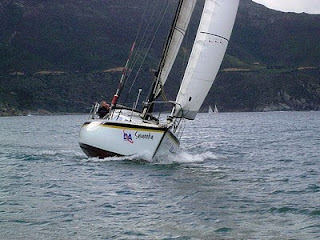
What model is this yacht?

Rum_Pirate

Well-Known Member
Joined
23 Aug 2004
Messages
27,971
Location
A tiny Island, Caribbean
Visit site
What model is this yacht?

Boat4salePZ.jpg


It is advertised here as 32'0"

Great condition
 Recently painted
exterior topside
and below
 Sleeps 5
 Head and Galley
 Includes dinghy

Asking US$22,000.00 about £13,500.00.

On first glance is it over priced ?
 
Last edited:
Found out a bit more:

Beam about 11'0'

Sails will need replacing in the next year or so.
There is a storm sail as well.

Spinnaker hardware, but no spinnaker.

two anchors - danforths.

Has a Yanmar diesel engine - original.

Fin keel (bolted on lead)

Made in South Africa about 1992 by 'ERB'(?) ie about 20 years old.

Apparently about 120 were built.


Anyone know anything about these 'Erb' boats.
 
"ERB South Africa" seems to be an unknown maker according to a couple of search engines, sorry. Any other ID ? Mast maker, sails, ... ?
 
Assuming its seaworthy and not subject to any major survey problems then seems fair enough asking price. How much do you think its worth?

Have to think quite a bit about how much do I think its worth to me.

I have to pay 35% import duty etc on it as I buy it. :cool:

I did pass by it - have to go back to take pics - and noticed a few items of possible concern.

Mast paint(?)back to bare metal above spreaders.

Seems like some corrosion at mast base.

I have no idea if the solar panel or the wind generator works.

Sails (furled - from what I could see from the pontoon) looked a bit worn.

Dinghy is rubbish.

Other questions, what works/does not, what needs replacing etc.

Yacht did make it here (Caribbean) from South Africa.
 
Tax & new sails if needed make it a £20K project, new rigging another £1k; dinghy, maybe solar panel, maybe mast re-paint....... starting to look less of a bargain........
 
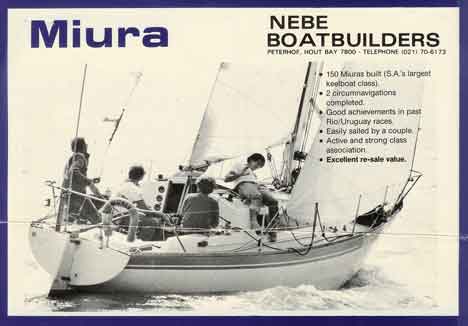
Could it be a Miura 31? See here...
It does have a tiller and stern hung rudder That seems to fit the appearance spot on.

I guess there was a miscommunication about it being a 'ERB' and is actually built by 'Nebe'.

MiuraAdv1.jpg

the Miura remains one of South Africa’s favourite yachts, and one of the most successful designs to come out of this country. . . At just over 30' long, it is an incredible allrounder, for it seaworthiness, seakindliness, general performance and cruising abilities.

I have only heard praise for the Miura, from all the right people. I once heard the Miura being described as the VW Beetle of the oceans – it is solid, goes anywhere, inexpensive, and quite round! It is however relatively more sophisticated than a Beetle I have to say. The name Miura derives from the Spanish word for “fighting bull” as I understand – Berckemeyer named several boats with Spanish names originally.

The Miuras were designed by Oswald Berkemeyer, his second boat after the Flamenca 25, (with which it shares some DNA), in the late 70s. I am not sure what the design objective was exactly – but it yielded a beautiful small yacht, inexpensive and simple, capable of sailing anywhere, and rugged as they come. They were designed for GRP production, and more that 250 were built, the majority right here in Hout Bay by Nebe. There are three Miuras in the Hout Bay Marina – Tenacity (2 x circumnavigations), Wings (1 circumnavigation), and Savannah (unknown). The Miura is a strong contender for the argument of which class of yacht has the most circumnavigations . . .

Overall a Miura is 30.5’. Displacement around 4700 kgs gives it a moderate displacement by modern standards. Underbody shows a swept fin keel, and a skeg-hung rudder with tiller steering. The single-spreader mast is relatively low, and the Miura carries most of its power in a large genoa, with smallish mainsail. They perform amazingly well upwind and in fresh to strong winds, a bit sluggish in light airs though. The most distinguishing feature of the Miura is the pronounced tumblehome evident at the beam. This gives it loads of strength, a good IoR rating apparently, and loads of cabin room. The swept up canoe stern makes it completely unable to plane, and therefore not great downwind speed, but a very good sea boat nevertheless. The late great Bertie Reed campaigned several Miuras in local offshore races with some suprising results. Reed held the overall record record from Cape Town to St Helena and back for many years in a Miura.

Berckemeyer lived in Cape Town in the 70s – at a time when racing classes were dominated by van de Stadt designs – viz. The RCOD and the Buccaneer for example, and many others. At that time, van de Stadt was already a legend in yacht design circles – sometimes known as the “S&S of Europe”! – and his modern design concepts of fin keels and spade rudders were still quite leading edge. GRP was also a brand new idea - so when Berckemeyer decided to design something new to compete with the Stadt boats, well he must have been pretty confident. At the time, the Miura was a radical looking boat – the roundness of it, the full beams with pronounced tumblehome, the swept fin keel, large Genoa were all quite novel then. How such a round boat would compete with the likes of an RCOD with similar waterline remained to be seen. In fact it outperforms the RCOD by a small margin – while carrying twice the weight , and with far more room. According to the RCYC database of club ratings, Miuras sail off a club handicap of 0.935, while RCODs sail of a club handicap of 0.91, for example.

In the Hout Bay Yacht Club, the Miura “Savannah” is actively raced by skipper Keith Gemell, often short or single-handed, in any conditions.

The Miura went on to become the most popular keel boat in South Africa for many years – I guess there are still more Miuras in South Africa than any other class of keelboats? Miuras became the keelboat of choice for Sailing Schools, first time keelboat owners, and people wanting to do the Cape to Rio on a budget. Not to mention those who wanted to circumnavigate, or even round the Horn. The Miura class remains quite active, and still often races as a class. Long live the Miura!

Vital Statistics LOA 31' LWL 28' * Beam 10' Draft (Laden 6') * Displacement 10700 lbs * Capsize screening formula 1.8 (good) * Sail Area / Displacement 14.8 (a bit under canvassed) * Displacement / Length 218 (moderate) * Max Hull Speed 7.1 kts

Thanks for finding that. Seems a great little boat.

Unfortunately I will not be buying it. :(
 
Last edited:
Found a bit more here for anyone that is interested.

http://www.van-vugt.com/miura/SpecialFeatures.htm


MiuraBull.jpg


RudderSkegStrut.jpg

Rudder, Skeg, Propeller, Strut

Keel.jpg

Keel (4000 pounds of solid lead)

CabinForward.jpg


This page (be warned - it's a long one) describes the history of the Miura design, its purpose, reputation and the many unique features that have make it such an outstanding sailboat.

HISTORY

Design: The Miura was designed around 1980 by Naval Architect Oswald Berckemeyer, a German émigré than living in South Africa.

Purpose: The main purpose of the design was to have a lower-cost entry that could participate in the annual cross-Atlantic race/cruise from Capetown (South Africa) to Rio de Janeiro (Brazil). That is a distance of nearly 3,800 miles or 6100 km. Of course, the design also had to take account of the difficult seas and oceans around the Cape of Good Hope at the southernmost point of Africa where Miuras are built and sailed.

International Offshore Rules (IOR): The Miura was designed according to IOR. Under this rule, seaworthy boats were designed that were "tweaked" to get the best possible handicap rating that were available under this rule. It often resulted in a hull design that has a marked "tumblehome" or rounded sites, that improves stability and speed and creates a lot of additional living space in the boat. (See comments by another Miura owner > Tumblehome)

Reputation: The Miura quickly built up a reputation as a sound, safe and seaworthy boat that would excel under tough sailing conditions. The Royal Capetown Yacht Club claims that more circumnavigations have been completed with Miuras than with any other class of sailboat. Just talk with any Miura owner, particularly South Africans, and hear how and why the Miura provides such comfortable accommodation and performs so great under all weather conditions.

Bojangles Log: The first owners initially sailed "Bojangles", as they had named the boat, along the South African coast to gain sailing experience. They then embarked upon a cross-Atlantic cruise that, via St. Helena, took them to Brazil where they made landfall in Recife. From there they sailed to and spent time in the Caribbean. Eventually, they sailed along the US East Coast to arrive in Annapolis MD sometime in 1986. They wished to settle in the US but had to move to California to do so. They reluctantly sold their boat to the current owners.

The new owners initially explored with Bojangles every nook and cranny of the Chesapeake Bay and tributaries. After retirement they refitted and re-powered Bojangles at a cost of US$50,000 in 2000/2001. They then took off on a major 8-month cruise that covered a distance of nearly 3,000 leisurely miles. The cruise included the transit of the Atlantic Intracoastal Waterway, from Annapolis MD to Fort Lauderdale FL then crossings of the Atlantic Gulf Steam and spending several months exploring the Bahamas Islands.

Distribution: It is estimated that more than hundreds of Miuras were built since the first hulls were launched in about 1980. They are still being built for aficionados of the class. Because of their popularity, and the then declining value of the South African currency, many boats were sold by their South African owners to other sailors around the world. Miuras can now be found around the globe with a distribution that stretches from northern Europe to as far south as New Zealand. There are a dozen or so Miuras at various ports in North America.

Class Association: There is a Miura Owners Association in South Africa. However, because most owners are outside that country, membership now is more international. The association and individual US and Canadian owners of Miuras can be a useful source for information and anecdotes about the Miura.

FEATURES:

The designer followed, apart from the IOR, a design philosophy to keep everything as simple as possible. Particular attention was paid to: (1) making the boat easy to sail; and (2) making it easy to service, maintain and operate the vessel's systems. This is particularly important when in remote locations where the usual marina facilities, such as, travel lifts may not be readily available. The end result is that the boat can be easily "singlehanded", that is, sailed by one person only. Also, it can be easily maintained without sophisticated marine support services. These special features are briefly described below:

Hull and Deck shape: The hull has rounded sides. This results in it having the smallest "wetted" area, thereby reducing drag and giving a kindlier sea motion. The design objective of the above-water portion of the hull was to have the minimum windage, that is, the lowest possible wind resistance. As can be seen from the photos, the Miura has slanted surfaces on deck that thus deflect the wind load on the superstructure. These design features contribute to stability and speed.

There are many reports of Miuras having successfully weathered foul conditions in the infamous Algulhas current off the South African east coast. Bojangles, when reaching Brazil on completion of her cross-Atlantic crossing, coped well with heavy seas when near Brazil.

Skeg-hung rudder: Hanging the rudder on a skeg greatly protects it from damage by underwater obstacles, like submerged logs or shallow water. The solid lead keel is lower than the lowest part of the rudder and thus gives even greater protection. Also having the rudder as far aft as possible increases longitudinal stability. The Miura's rudder can be removed while the boat is in the water by undoing four bolts only. It can be replaced the same way. The photo at the right shows the assembly.

Bojangles' rudder was once removed by the present owners, with the boat still in the water, when a crab-pot line got wrapped around the skeg and rudder. No sweat!

Tiller steering: A steering wheel might look "sexy" on a boat but it is impractical as it takes up too much valuable space in the cockpit. Also, because of its mechanical complexity with cables, gears and quadrants it can increase the risk of malfunction while underway at sea. A tiller reduces the need for maintenance.

The other practical advantage of tiller steering, as explained by the designer, is that the helmsman can instantaneously change course to avoid a navigational hazard or tack or gibe when racing. Boats steered with a wheel respond much slower.

Keel: Most cruising sailboats have a long "cruising keel." The Miura has a fin keel. It is narrow and quite deep. The traditional cruising keel has the advantage of good tracking. However, the Miura designer achieved the same result by lining up the fin keel with the rudder blade set far aft. The fin keel also contributes to the Miura's ability to quickly turn around on a dime. The fin keel has another advantage. A boat with a long cruising keel can usually not be turned around quickly to extricate itself if it runs aground it. With a fin keel it is relatively easy to turn 180 degrees boat around and retrace one's course to find deeper water.

When "gunk holing" like in the many tributaries to the Chesapeake Bay, or tracking the ICW or exploring the Bahamas Islands, all boats will touch bottom sooner or later. Usually, this is not dangerous but sailors feel embarrassed when it happens. The ability to get off a sandbank quickly will reduce serious grounding risks and tension onboard.

Hauling Cable: Knowing that Miuras might venture to the remotest corners of the world, the designer provided: (a) a heavy steel cable; (b) an eyebolt attached to the keel in the center bilge; and (c) a deck plate in the cabin roof, so that the boat can be hauled out of the water and re-launched with the simplest of industrial cranes.

Bojangle's current owners observed that, for example, in the Abacos in the Northern Bahamas, many marinas on the islands had no travel lifts but nearly always had industrial cranes available.

Rigging: A racing boat has the highest possible mast so that the maximum sail area can be carried. However, high masts and large sail areas make a sailboat more unstable. Sailing them requires large experienced crews. Fortunately, the top of the mast of a Miura is only about 45 feet above water. Because it carries a large headsail and a small mainsail it is easier to handle the sails and significantly improves stability.

Bojangles has extra heavy duty standing rigging, that is, an appropriately sized mast and boom and stays and shrouds that are one size heavier than would normally be specified for this size of vessel. The running rigging, that is, the lines and halyards that control and hoist sails aloft were all replaced with new yardage when refitting the boat in 2000/2001. With its relatively short mast Bojangles can pass all fixed bridges along the Atlantic ICW and even reach the Gulf ICW via Lake Okeechobe in Florida.
 
continued


Engine: Virtually all larger cruising sailboats have an auxiliary engine to power the boat to get in and out of harbors or crowded anchorages or get the boat safely home if the wind dies down or blows from the wrong direction. Real sailors will minimize the use of the engine. Also, they tend to not overpower their boats because the additional weight of a too-large engine would slow the boat down. For safety and economy most auxiliary engines run on diesel fuel.

Bojangles has a new 20 hp Yanmar freshwater cooled Marine Diesel engine. It uses about half (1/2) a gallon of fuel per hour.

Anchoring: Sailors normally like to anchor out. Staying in a marina for the night might cost, on average, US$2.00 or more per foot of boat. Anchoring out is free. It's also more private and secure from interference by curious landlubbers.

Anchoring depends on having good ground tackle; that is, anchors, chain, nylon rope and shackles. The design of a boat must ensure that anchors can be securely stored while underway and can be easily set and retrieved when anchoring. When looking for a boat to buy, always look first at the boat's stemhead, that is, the point of the bow where anchors are stored. If it is strong and can hold two large anchors you are looking at a serious boat.

Bojangles has an extremely strong stemhead and for secure anchoring in different bottoms, three anchors are available, that is, a Bruce and a CQR at the bow and a spare Danforth anchor carried at the stern.

Lifelines: Lifelines run from the stern pushpit forward to the bow pulpit. Along the way they are supported by stanchions. The lines are made of steel stranded wire and are usually covered with plastic. It is the first line of defense to prevent crew from falling overboard. To protect small children and pets, owners sometimes put special netting along the lifelines.

Bojangles has new stanchions and lifelines that are covered with plastic. At the bow are pelican hooks that can be undone to make it easier for elderly or infirm people to get onboard.

Jacklines: These lines run along the side decks and are the second line of defense. In windy conditions or when single-handing, sailors should wear a harness with a lanyard that is securely attached to a jackline. It facilitates sailors moving along the side decks with less risk when needed for sail handling other tasks while underway .

Bojangles has new jacklines on both port and starboard side decks.

Fuel Storage: Boats try to carry as much fuel as will provide a reasonable cruising range. Power boats carry as much or more than 400 gallons (costing about US$1600) in fixed built-in fuel tanks. It might give them a cruising range of 400 miles.

Bojangles, in addition to its internal steel fuel tank, carries in its hold four (4) Jerry cans that each hold 6 gallons of fuel. Cans have a tremendous advantage for cruisers when in remote locations. These can be taken onshore in places where there are no accessible fuel docks and then filled and brought back onboard. The quantity of fuel carried by Bojangles allows a motoring range of close to 500 miles. Moreover, because sailboats sail as much as possible, the fuel onboard might be enough for the whole sailing season or a year.

Water Storage: An adequate supply of drinking water is essential, especially, for long distance cruisers in tropical areas. Water must be judicially managed. Never use a pressurized water system and instead rely on hand pumps to conserve water. Take showers with an atomizer like the plastic pressurized agricultural spray cans. With prudent water use the available supply should support the period between watering stations but allow for some reserve. If you can afford it; have the space for it; and plan to sail in clean salt water areas, install a watermaker.

Bojangles has two fixed water tanks, and when cruising can in addition carry two (2) or more Jerry cans and other containers on board. She has a "SunShower" and an atomizer spray. Bojangles' portable containers are handy when ferrying water from shore to the boat. Also, Bojangles' sun cover can be used for catching rain water to top up the water tanks. Raw water pumps will provide seawater for rinsing pots and pans, washing the anchors and decks and flush the head.


Bojangles received a comprehensive refit in 2000/2001. Further improvements were made after returning from the 3000 miles cruise to the Bahamas Islands. Additions were made as recently as early-2010. The cost of the refit was in excess of US$50,000. Improvements are described below.

BOAT

Mast and Boom: The mast unstepped, checked and reinstalled; Boom gooseneck and end plate renewed $ 2,000

Rigging: Standing rigging: Head and twin backstays replaced with new oversized cables. Running rigging all new $ 3,000

Hull: All bottom paint removed, barrier coated (three layers) repainted with Petit APC Ablative bottom coat $ 2,500

Keel: Removed; faired; joint cleaned; reattached using 3M5200 as sealer, repainted; reattached $ 1.500

Rudder: Removed; opened; re-cored with reinforced epoxy; painted; reattached $ 1,000

Hatches: New watertight hatches manufactured and installed in cockpit $ 2,000

Boarding Ladder: Obtained; modified; polished; attached at stern $ 500

SAILS

Sails: New furling headsail designed and manufactured by Quantum. All other sails re-built $ 3.500

Furler: New Profurl Headsail furling gear installed $ 2,000

Lazy Jacks: Installed by Madden Masts & Rigging $ 500

INTERIOR

Carpentry: Pilot berths converted into double berth; new custom overhead cabinets; door to head repaired $ 3,500

Floor boards: Strengthened; installed ventilation holes; improved molding $ 800

Instrument Panels: Designed and installed at Navigation desk $ 2,000

SYSTEMS

Plumbing: All water hoses, drains pipes, hand pumps replaced; thru-hulls checked and greased $ 1,500

LPG lines and equipment: Two new horizontal aluminum tanks installed with valves and copper tubing $ 1,000

Refrigeration: New refrigeration unit together with thermostat and controller installed $ 1,200

Deck Wash Pump: Deck wash pump with intake and outlet valve installed; flexible hose and sprayer provided $ 800

Head: New GRACO head with pump and new inlet and outlet hoses installed $ 800

Bilge Pumps: New bilge pumps for skeg and shower bilge together with hoses installed $ 900

Anchoring: New Bruce Anchor (33 #), anchor chain and nylon rope; new mooring lines and fenders $ 2,000

Lifelines: All lifelines, jack lines and stanchions replaced; Pelican hooks installed; improve pulpit $ 1,500

ELECTRONICS

Radar: Raytheon 24 mile Radar 71 LSR with display at Navigation Station and radar dome on mast $ 2,200

GPS: RayMarine GPS and matching instrument panels for depth, speed and wind instruments installed $ 2,000

Other: Cellular hands-free phone unit with mast antenna installed; new VHF Radio; Compass; Autopilot $ 1,700

ELECTRICAL:

Wiring: All electrical wiring in mast and throughout the vessel replaced; new House an Starter Batteries $ 1,500

Distribution Panels: New 110 Volt and 12 Volt panels with circuit breakers installed $ 1,000

Wind Generator: AeroGen6 wind-driven electric generator on stainless steel pole and supports $ 1,000

Light Fittings: New halogen, incandescent and fluorescent lights installed in cabins $ 600

PROPULSION

Engine: Latest Yanmar freshwater cooled 2GM20(F) engine, engine control panels and engine hour meter $7,500

Drive train: New DriveSaver, new drive shaft; stuffing box checked and repacked; new cutlass bearing $2,500

Propeller: New Vetus three-blade propeller installed $ 500
 
Top