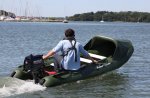
What kind of inflatable for 6 HP Tohatsu for best speed?

S.P.

New Member
Joined
27 Nov 2016
Messages
2
Visit site
Hi, it's my first post here.

I'm going to obtain a 6 HP Tohatsu outboard and want to use it on an inflatable. My main interest is to have as fast as possible inflatable with a 6 HP outboard. Considering this is there anything to keep in mind when buying an inflatable? Any characteristics which should guarantee better speed? Or something to be surely avoided? Advice much appreciated!
 
Something as light as possible with a flat bottom.
10kts with a 5hp 2-stroke and one FB is possible with a Quiksilver 240 slatted floor :D
 
2.30 to 2.50 ali or wood deck with an inflatable keel should get you to 15 to 17 knts. Mine does at least.
 
My vaillant 2.70 with a 6HP goes so fast I felt it was unsafe to let the kids use it on their own. Downgrade to mercury 4HP. Still planes with one adult and light kid.
 
I had an Avon 3.1 rib that I could get to plane with a 4hp Mariner 2s...it was a fairly shallow V and I had to move my weight forward. If you can get hold of one they are great boats.
 
Thanks for the comments! I have better understanding now.
TQA, I'm going with 6 HP Tohatsu simply because I have an opportunity to get it with a really low cost.
 
Hi, it's my first post here.

I'm going to obtain a 6 HP Tohatsu outboard and want to use it on an inflatable. My main interest is to have as fast as possible inflatable with a 6 HP outboard. Considering this is there anything to keep in mind when buying an inflatable? Any characteristics which should guarantee better speed? Or something to be surely avoided? Advice much appreciated!

I hope this is not breaking forum rules, it is kind of promotion but also intended to be informational. I think we have the answer to your question. First of all the fastest inflatables on flat water will have a flat or near-flat bottom. However flat-bottomed inflatables tend to get blown around more in wind and bounce (ie become uncomfortable and wet) as soon as there's any chop. Unless you're a masochist then a flat-bottomed inflatable is not fast in waves simply because you won't want to go fast. A V-shaped hull makes a big difference, both to grip on the water (ie not being blown around) and comfort (the V-shape parts the waves rather than slapping down on them). You probably want a V-bottom if you're planning to use it anywhere other than a canal or protected river, where the speed limit is often (or at least should be!) be the speed limiting factor anyway.

So, how do you make a V-bottomed inflatable plane with 6hp and more than one person on board? This is precisely the question we were asking ourselves when we were developing our new SpearFish inflatables. The 6hp limitation arises because it's effectively the largest engine - at 24-27kg, depending on manufacturer - that can truly be defined as portable. But 6hp is not enough to get most V-bottomed inflatables, even those with RIB (ie hard hull) bottoms, on the plane with two or more real-world weight adults on board. In fact 6hp probably is enough to keep them on the plane, but not enough to get them onto the plane... 6hp won't get you over the "hump" or transition between displacement (low) speeds and planing.

The answer is to break the conventional "rules" about displacement etc, by going long and relatively narrow. SpearFish is 15ft long and not quite 4ft wide, giving it a 4 to 1 length to beam ratio, where the smaller inflatables are typically 2 to 1 or less (ie short, fat and blunt). When motoring SpearFish there is almost no transition between displacement speeds and what must be planing speeds (well into the teens of knots, even with two on board). More power, go faster, it's close to linear. Compared to other inflatables it has what one could almost call a sharp bow, and a forced V in its high-pressure drop-stitch floor, so it behaves astonishingly well in waves (far better than we even hoped). And when you're really going for it there's a fairly large inflatable frame canopy that sheds the worst of any spray that may be thrown up.

We don't claim SpearFish is the right solution for all potential dinghy users, but if you want to extract maximum performance from a small motor in a wide range of conditions, we (are obviously biased but) happen to think it's a very good one! There are other "inflatable motor canoes" on the market but SpearFish is the only one with a V-bow and has been more optimised to the motoring than the paddling end of the spectrum. That said, it also rows or paddles better than most inflatables, simply because there is less drag.

The next obvious question is stability and clearly SpearFish is not as stable as a 14ft inflatable that's 6ft wide. However it is plenty stable enough for a 100kg single user to sit on one side without excessive heeling. (15ft of 34cm diameter tube is a huge amount of buoyancy to try and immerse.) In more extreme conditions - we have tested it in conditions far above its Category D rating - of course it feels safer to sit in the middle, but if there are two of you and you find sitting offset is more comfortable for helming then you can counter-balance each other.

More information here: https://nestawayboats.com/shop/spearfish-inflatable-motor-canoe/

SF15 pro Suzuki 5.jpg
 
I can highly recommend the Excel Volante 290 for several reasons:

I replaced my lovely, but rather heavy Avon 280 Rib with one of these 18 months ago, it had a 6hp Johnson 2T twin, and went like a rocket, just planing with 2 adults, but would nudge 19mph on GPS, or 21mph one up! A great tender, but heavy.

The Excel and a 3hp Mercury 4T weigh as much as the old Rib on it's own, so the motor lives on the boat and doesn't strain the davits. 15 seconds and she's in the water ready to go...

Astonishingly, the 290 planes with the feeble Mercury, and hits 14mph on GPS, although if taken to the rev limiter planes too well and cavities, at which point it drops back in, so 12mph is 'it'

A 6hp would be awesome on this tender!! (8-10max HP)

It is capacious (TWO Thwart seats!!) well kitted (decent pump, repair kit, 2xseats, bag, decent oars etc all inc) and appears to be very well made.

This is the inflatable V floor, so can be chucked around like a go-kart, and is comfy and stable...
 
I hope this is not breaking forum rules, it is kind of promotion but also intended to be informational. I think we have the answer to your question. First of all the fastest inflatables on flat water will have a flat or near-flat bottom. However flat-bottomed inflatables tend to get blown around more in wind and bounce (ie become uncomfortable and wet) as soon as there's any chop. Unless you're a masochist then a flat-bottomed inflatable is not fast in waves simply because you won't want to go fast. A V-shaped hull makes a big difference, both to grip on the water (ie not being blown around) and comfort (the V-shape parts the waves rather than slapping down on them). You probably want a V-bottom if you're planning to use it anywhere other than a canal or protected river, where the speed limit is often (or at least should be!) be the speed limiting factor anyway.

So, how do you make a V-bottomed inflatable plane with 6hp and more than one person on board? This is precisely the question we were asking ourselves when we were developing our new SpearFish inflatables. The 6hp limitation arises because it's effectively the largest engine - at 24-27kg, depending on manufacturer - that can truly be defined as portable. But 6hp is not enough to get most V-bottomed inflatables, even those with RIB (ie hard hull) bottoms, on the plane with two or more real-world weight adults on board. In fact 6hp probably is enough to keep them on the plane, but not enough to get them onto the plane... 6hp won't get you over the "hump" or transition between displacement (low) speeds and planing.

The answer is to break the conventional "rules" about displacement etc, by going long and relatively narrow. SpearFish is 15ft long and not quite 4ft wide, giving it a 4 to 1 length to beam ratio, where the smaller inflatables are typically 2 to 1 or less (ie short, fat and blunt). When motoring SpearFish there is almost no transition between displacement speeds and what must be planing speeds (well into the teens of knots, even with two on board). More power, go faster, it's close to linear. Compared to other inflatables it has what one could almost call a sharp bow, and a forced V in its high-pressure drop-stitch floor, so it behaves astonishingly well in waves (far better than we even hoped). And when you're really going for it there's a fairly large inflatable frame canopy that sheds the worst of any spray that may be thrown up.

We don't claim SpearFish is the right solution for all potential dinghy users, but if you want to extract maximum performance from a small motor in a wide range of conditions, we (are obviously biased but) happen to think it's a very good one! There are other "inflatable motor canoes" on the market but SpearFish is the only one with a V-bow and has been more optimised to the motoring than the paddling end of the spectrum. That said, it also rows or paddles better than most inflatables, simply because there is less drag.

The next obvious question is stability and clearly SpearFish is not as stable as a 14ft inflatable that's 6ft wide. However it is plenty stable enough for a 100kg single user to sit on one side without excessive heeling. (15ft of 34cm diameter tube is a huge amount of buoyancy to try and immerse.) In more extreme conditions - we have tested it in conditions far above its Category D rating - of course it feels safer to sit in the middle, but if there are two of you and you find sitting offset is more comfortable for helming then you can counter-balance each other.

More information here: https://nestawayboats.com/shop/spearfish-inflatable-motor-canoe/

View attachment 61350

Well I gues it might be breaking forum rules but I found it very interesting so thanks for posting :)
 
Anything but green really! ... very bad luck going to sea in a green boat ... like setting sail on a Friday (or Sunday if you live in St.Ives!) .... seriously, it is a bid of a dull colour so I'd buy one in white, red, blue, even grey.
 
Anything but green really! ... very bad luck going to sea in a green boat ... like setting sail on a Friday (or Sunday if you live in St.Ives!) .... seriously, it is a bid of a dull colour so I'd buy one in white, red, blue, even grey.

Does the setting sail on a Friday extend to Mobo's, because if it does I'm in dire need to seek out a friendly priest / shaman / druid to lift the curse. :disgust:
 
It is a niche product so we have to keep it fairly simple, but yes we probably will offer different colour option(s) for SpearFish when we order production batch two. Do you have any particular suggestions?

White / Light Grey is going to offend the least number of people.
 
I have a 8 Hp two stroke yamaha weight 27 kg powering a Rib eye 3.2 m Rib weight 45 kg , also fitted fins to the outboard , flies onto plane two up . Did have 6hp yummy two stroke then realised 8 Hp same weight. Iv since found the Tohatsu 9.8 two stroke is 26 kg but they are in great demand second hand . Iv had three four strokes as small engines and glad to see back of all of them ! Maybe its just me but I find my two strokes have been way better in every respect particularly starting which is usually first pull on the yamaha 8 Hp .At 27 kg I can move it around relatively easily although this year I invested in a pushpit davit which makes things very easy .
 
Top