what is the purpose of a small, water discharge tube amidhips?

Shearwater

Well-Known Member
Joined
19 Oct 2005
Messages
428
Location
Felixstowe Suffolk UK
Visit site
24 ft yacht, Yanmar 1GM. Spent the morning over-revving the motor under load due to experiencing black smoke and soot, and have now reviewed previous threads on the subject. During the rev-up I noticed for the irst time a small plastic fitting in the hull, just below the rubbing strake and abeam the engine emitting a small but steady stream of warm water. Hopefully (!) this is coming from the cooling system and there is, sure enough, a tube visible under the engine going in the right direction but why? there´s plenty of available capacity from the exhaust pipe itself as that just spurtles and blubbles along as usual. Thanks in advance as always.
 
+1 tell tale for the anti syphon. Must have been bunged up with salt before so may need a clean.

+2

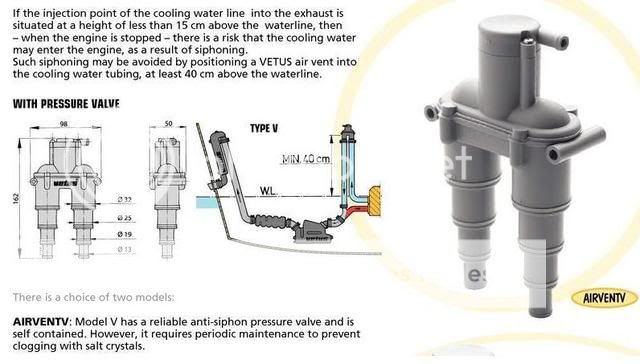
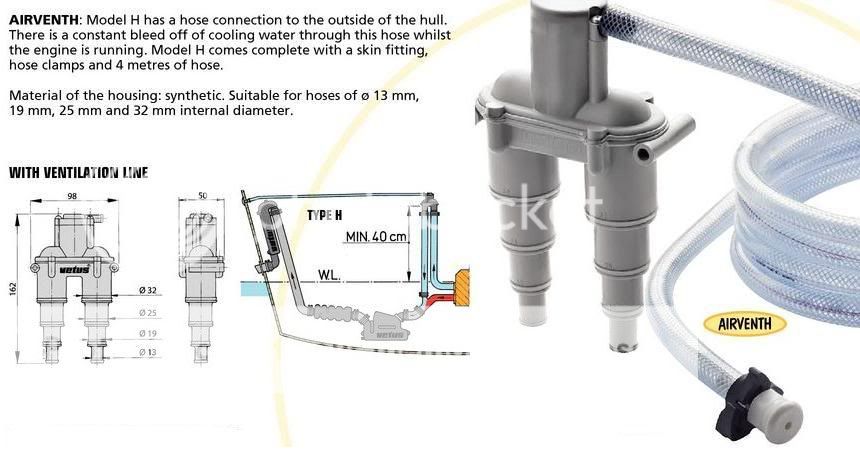
There are two types of antisyphon device that you may commonly come across.

One type has a valve on the top which opens when the engine is not running allowing air to enter the top of the antisyphon loop in order to break the syphon.

They can become blocked and fail to open. When they work they often dribble!

They need to be checked for correct operation periodically


The other type has no valve but discharges a small continuous stream of water while the engine is running. This may be overboard or into a cockpit drain.

Easy therefore to check/ be aware that its not blocked.

Investigate the reason if the stream ever fails.


Examples of the two types available from Vetus

VetusV.jpg


VetusH.jpg
 
Last edited:
One type has a valve on the top which opens when the engine is not running allowinig to enter the top of the antisyphon loop in order to break the syphon.

They can become blocked and fail to open. When they work they often dribble!

They need to be checked for correct operation periodically

How ?
 
Visual check is all that's needed. If water is coming out, all is fine - if not it has got blocked, or ( unlikely) the hose has come off. It is absolutely normal, as earlier posts have said.


Not always.

I have the same arrangement on my main engine and on tick over I get no water from my tell tail pipe but as the revs increase the flow increases. My water cooled generator has a constant flow all the time with the flow stronger that my main engine yet I have a much higher raw water flow into my main engine that my generator.
 

Visual check is all that's needed. If water is coming out, all is fine - if not it has got blocked, or ( unlikely) the hose has come off. It is absolutely normal, as earlier posts have said.

I assume that Pladdatoo was asking how to check the valved type ....... as that is what I said to do. It a good question

One type has a valve on the top which opens when the engine is not running allowing air to enter the top of the antisyphon loop in order to break the syphon.

They can become blocked and fail to open. When they work they often dribble!

They need to be checked for correct operation periodically


You cannot check them visually. All you can do is periodically dismantle, inspect and clean
 
I assume that Pladdatoo was asking how to check the valved type ....... as that is what I said to do. It a good question


You cannot check them visually. All you can do is periodically dismantle, inspect and clean

Yes, thanks VicS.

I have checked Vetus at http://www.vetus.com/exhaust-system...32-mm-hose.html#product_tabs_support_contents

And I don't find their instructions for maintaining these especially clear. It would seem that you don't know they are not working, only if they are!
Taking them apart and cleaning regularly seems to be the safest option - which I never have...oops!
Off to the boat tomorrow me thinks
 
Yes, thanks VicS.

I have checked Vetus at http://www.vetus.com/exhaust-system...32-mm-hose.html#product_tabs_support_contents

And I don't find their instructions for maintaining these especially clear. It would seem that you don't know they are not working, only if they are!
Taking them apart and cleaning regularly seems to be the safest option - which I never have...oops!
Off to the boat tomorrow me thinks

The advantages of the continuous flow type are obvious. You can see at a glance if all is well. No flow then you potentially have a problem.

I'd not like to comment on Roger Shaw's experience. I am certain that he will have made certain that all is well despite there being no "pee" at low revs. I suspect just a characteristic of his installation.
If I saw no flow in Tom, Dick or Harry's AWB Id want to investigate.
 
Whoever fitted the dribbler to my boat obviously never intended to sail her - it dribbles into the cockpit over where your foot ends up when sitting to starboard.
 
Whoever fitted the dribbler to my boat obviously never intended to sail her - it dribbles into the cockpit over where your foot ends up when sitting to starboard.

Have to learn to live dangerously then and turn the engine off when sailing. :)
 
As mentioned earlier check your exhaust elbow is not choked up - you haveto remove it to inspect properly, mine was choked up with only a 10mm hole down the middle! Had to have a new exhaust elbow.
 
Whoever fitted the dribbler to my boat obviously never intended to sail her - it dribbles into the cockpit over where your foot ends up when sitting to starboard.

Re-position it somewhere else. All the ones that I fitted were placed at the aft end of the cockpit above the drains; easy to see at night and useful for rinsing the hands after handling freshly caught fish.
 
Re-position it somewhere else. All the ones that I fitted were placed at the aft end of the cockpit above the drains; easy to see at night and useful for rinsing the hands after handling freshly caught fish.

Some boats have the drains at the front of the cockpit
 
Some boats have the drains at the front of the cockpit

If the cockpit has 'duckboards'(?) the water will still flow beneath them to the drains. If the cockpit floor is bare, then fit the tell-tale above the drain, usually in a corner and out of the way. It only needs to be a couple of inches high.
 
This thread has got me worried because I have never cleaned my non-venting version and have 1000 hours on the engine. How does one clean it? Do I have to dismount it or can it be cleaned in situ?
 
Top