

You are using an out of date browser. It may not display this or other websites correctly.
You should upgrade or use an alternative browser.
You should upgrade or use an alternative browser.
What is the car in this 1959 Pathe clip about DIY catamarans?
- Thread starter Zen Zero
- Start date

RichardS
N/A
I've never seen anything like that!
I wonder if it's a one-off / home made thing?
Richard
I wonder if it's a one-off / home made thing?
Richard
lw395
Well-Known Member
British reg, but LHD.
The back suggests some sort of golf buggy/utility vehicle?
not exactly mainstream!
The back suggests some sort of golf buggy/utility vehicle?
not exactly mainstream!

pvb
Well-Known Member
It's an early version of the Fuldamobil Bambi Sporty, possibly a prototype, based on the Fuldamobil S-6, which was built in the mid-50s, see pic...
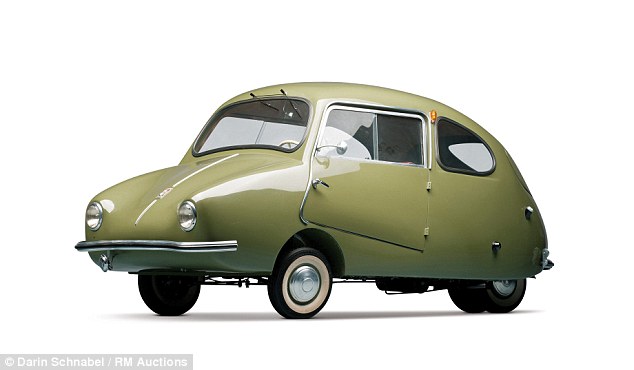
The Bambi Sporty was built in Argentina under licence in the early 60s, and was based on the later Fuldamobil S-7. Apparently only 20 were made. It bears a strong resemblance to the car in the Pathe clip, see pic...
View attachment 62523
The Bambi Sporty was built in Argentina under licence in the early 60s, and was based on the later Fuldamobil S-7. Apparently only 20 were made. It bears a strong resemblance to the car in the Pathe clip, see pic...
View attachment 62523

Mistroma
Well-Known Member
British reg, but LHD.
The back suggests some sort of golf buggy/utility vehicle?
not exactly mainstream!
I think that there were a few manufacturers making 3 wheelers in those days. I think there was a tax advantage and remember a friend who had something with a huge long bonnet, almost empty with a single wheel and motorcycle engine. Pretty unstable with a single wheel at the front.
This one isn't a Morgan but is similar to a Meadows Frisky in some respects but don't think it is one.
EDIT: Beaten to it by PVB who hit the mark. Odd that the Bambi had 4 wheels with rear ones very close together. Looks like someone was trying to avoid the tax advantage of a 3 wheeler but keep the disadvantages.

Last edited:

Concerto
Well-Known Member
Did anyone notice the mainsail lashing went around the main halyard, making it difficult to raise the gaff.

dombuckley
Well-Known Member
Did anyone notice the mainsail lashing went around the main halyard, making it difficult to raise the gaff.
And at the very moment that the commentator was saying how well they'd done their ropework, too!

Minchsailor
Well-Known Member
I think that there were a few manufacturers making 3 wheelers in those days. I think there was a tax advantage and remember a friend who had something with a huge long bonnet, almost empty with a single wheel and motorcycle engine. Pretty unstable with a single wheel at the front.
Not sure about the tax advantages, but I do know a 3 wheeler could be driven on a motorcycle licence, rather than a full car driving licence.
lw395
Well-Known Member
Some Isetta bubble cars had very similar twin rear wheels.
most of the ones I saw in the BMW museum some years ago.
AIUI, if the wheels were close enough together, they counted as one!
May not be a UK 'factoid', I only recall actual three wheel Isettas here. ?
Isettas are 'quite interesting' on lanes with gravel down the middle!
most of the ones I saw in the BMW museum some years ago.
AIUI, if the wheels were close enough together, they counted as one!
May not be a UK 'factoid', I only recall actual three wheel Isettas here. ?
Isettas are 'quite interesting' on lanes with gravel down the middle!

JumbleDuck
Well-Known Member
Odd that the Bambi had 4 wheels with rear ones very close together.
That was quite common: some BMW/Isettas, Heinkels and Messerschmitts, among others, had dual rear wheels. I think there was a maximum centreline spacing under which they counted as three-wheelers.
Heinkel:
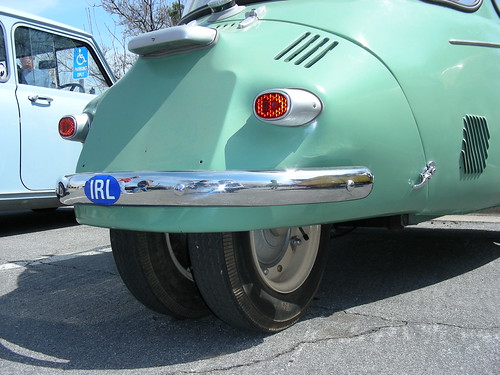
Isetta:

Messerschmitt:
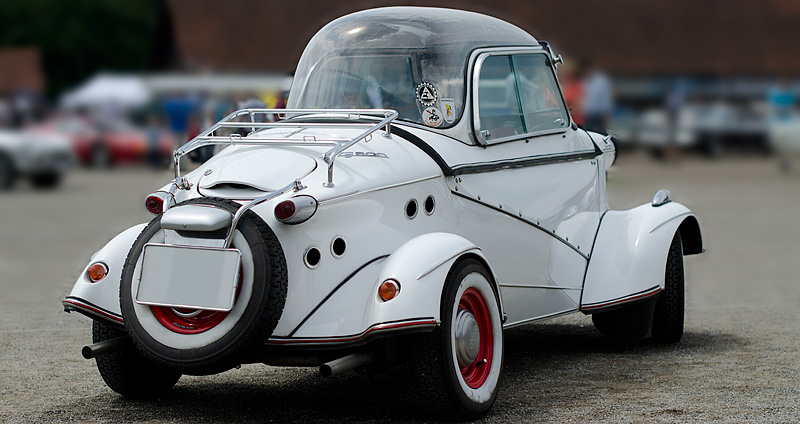
Not sure about the tax advantages, but I do know a 3 wheeler could be driven on a motorcycle licence, rather than a full car driving licence.
Yes indeed. Originally the regulations were very restrictive: small engine, lightweight and no reverse gear , which traditionally caused fun when the proud owners drove their new Isetta home and right up to the back of the garage. Later on things were more relaxed, and it was basically a just a weight restriction at something like 1000lbs empty. Reliant three-wheelers (Regal, Robin, Rialto) came under that rule. I had a Rialto for a while, which had 40bhp and weighed nothing, making it one of the most entertaining cars to drive I have ever had. Breaking and steering hard at the same time was character forming.
pvb
Well-Known Member
The Fuldamobil vehicles were originally 3-wheelers, and changed to twin rear wheels after 1955 when the Germans dropped the previous tax advantage for 3-wheelers.
The Fuldamobil Bambi Sporty had a 10hp 2-stroke engine with 4 forward gears. Unusually, reverse was available by stopping the engine, reversing the connection to the Dynastart, then re-starting the engine in the reverse direction, which meant it could theoretically go as fast in reverse as in forward!
The Fuldamobil Bambi Sporty had a 10hp 2-stroke engine with 4 forward gears. Unusually, reverse was available by stopping the engine, reversing the connection to the Dynastart, then re-starting the engine in the reverse direction, which meant it could theoretically go as fast in reverse as in forward!
alancollins
Well-Known Member
If I remember rightly three wheelers were popular because they attracted the same road tax as a motor-cycle and side-car. They could also be driven with a motor bike licence.
JumbleDuck
Well-Known Member
They could also be driven with a motor bike licence.
They still can. Category A is "Any size motorcycle with or without a sidecar. A Motor tricycle power output over 15 kW"
Sybarite
Well-Known Member
Nobel 200cc Vicky built in N. Ireland.
https://www.google.fr/search?q=Nobe...SAhXBUBQKHasCDs0QsAQIIw#imgrc=I2hHFEAXRehggM:
http://www.rumcars.org/forum/index.php?topic=3376.0
I had the "saloon" car version as my first in 1962.
https://www.google.fr/search?q=Nobe...SAhXBUBQKHasCDs0QsAQIIw#imgrc=I2hHFEAXRehggM:
http://www.rumcars.org/forum/index.php?topic=3376.0
I had the "saloon" car version as my first in 1962.
Last edited:
pvb
Well-Known Member
Nobel 200cc Vicky built in N. Ireland.
https://www.google.fr/search?q=Nobe...SAhXBUBQKHasCDs0QsAQIIw#imgrc=I2hHFEAXRehggM:
http://www.rumcars.org/forum/index.php?topic=3376.0
I had the "saloon" car version as my first in 1962.
Ah, intriguing, and more likely to turn up in UK than something built in Argentina. Your link contains the comment "The last picture is a Fuldamobil. However, it was the prototype fulda/nobel pickup sent to Peter York Noble to copy for the Nobels." So it looks like the Nobel was indeed a copy of the Fuldamobil.
Zen Zero
Well-Known Member
There are some interesting details here!
http://www.rmsothebys.com/bw13/the-bruce-weiner-microcar-museum/lots/1958-nobel-200/1056953
http://www.rmsothebys.com/bw13/the-bruce-weiner-microcar-museum/lots/1958-nobel-200/1056953
Zen Zero
Well-Known Member
Nobel 200cc Vicky built in N. Ireland.
https://www.google.fr/search?q=Nobe...SAhXBUBQKHasCDs0QsAQIIw#imgrc=I2hHFEAXRehggM:
http://www.rumcars.org/forum/index.php?topic=3376.0
I had the "saloon" car version as my first in 1962.
Thanks Sybarite!
Sybarite
Well-Known Member
Thanks Sybarite!
You're welcome. Mine was a 4 wheel version the two rear wheels being close together. The steering was predictive - ie as it weaved down the road you had to make sure that you turned on the right oscillation.
As far as reverse was concerned you had to turn off the engine, push the key in and turn it on again. You then had 4 reverse gears...
It must have been the most dangerous road vehicle ever.
Zen Zero
Well-Known Member
You're welcome. Mine was a 4 wheel version the two rear wheels being close together. The steering was predictive - ie as it weaved down the road you had to make sure that you turned on the right oscillation.
As far as reverse was concerned you had to turn off the engine, push the key in and turn it on again. You then had 4 reverse gears...
It must have been the most dangerous road vehicle ever.
I found a couple of forum posts about it. It seems the engine had two sets of points for running in either direction!

fisherman
Well-Known Member
The Isetta was the one with the front opening door, the one my mate ran himself over with while trying to bump start it.