
What are the chances my seacock is broken?

demonboy

Well-Known Member
Joined
11 Oct 2004
Messages
2,237
Location
Indonesia
www.youtube.com
Having serviced my seacocks three months ago and checked once again before dropping in the water last week, this morning one of my seacocks appears to have got stuck in the closed position. Frustratingly this is just below the waterline, though rather it stuck in the closed position than open I suppose.

The handle turns. I've taken it off to access the part that turns the ball valve...
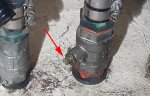
cock1.jpg

... which I am assuming is part 7 on this diagram (not the same seacock)
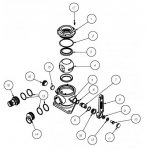
cock2.jpg

It turns freely. When I turn it I can't feel it wanting to fall into the slot in the ball valve, so what are the chances that the end has snapped and is stuck in the ball valve slot? Is this a common occurrence?

If this is not the case, any other suggestions short of removing the seacock altogether?
 
What can happen is that although the body and ball are made of dzr brass, the spindle is ordinary brass and dezincifies. The handle then turns as usual but the ball remains stationary. Solution is to replace the complete valve with a certified bronze or dzr model. Unfortunately, this can't be done afloat.
 
We had this thread a while back , it can be done a float , especially as the op said he just sevices then , it not for the faint hearted but he could bug the through hull fitting and remove the sea cock , or as I have done in the pass remove one and quickly screw in the next one .
Worst that can happen is the thought hull fitting breaks , then plug it from the inside and get hauled out , at the end of the day if you need that sea cock to work you going to have to get haul out any way .
As I said not for the faint hearted , I know people who won't remove their log as there are scared the boat will fill.
 
Having tried both approaches as a youngster and ' got away with it ' I still cringe, I'd go with ghostlymoron's advice - at least find a drying out grid / place with as long a tidal window as possible to allow for inevitable cockups.
 
Last edited:
It's possible to get a sheet of strong plastic, with ropes on the 4 corners, and manoeuvre it around under the hull until it's covering the through-hull, then tying the ropes off tightly. Water pressure will keep the plastic against the through-hull when you remove the seacock, minimising ingress of water.
 
It's possible to get a sheet of strong plastic, with ropes on the 4 corners, and manoeuvre it around under the hull until it's covering the through-hull, then tying the ropes off tightly. Water pressure will keep the plastic against the through-hull when you remove the seacock, minimising ingress of water.

I would have thought that a cork or rubber bung in the outside of the skin fitting would be more successful at keeping the water out than a sheet of plastic. (The OP said it was just below the waterline, so I assume is reasonably accessible.)

The problem with either approach is how do you then stop the skin fitting turning when you are trying to unscrew the existing seacock or tighten the new one? And what do you do if it does turn, breaking the seal between the skin fitting and the hull?

I think anything other than a haul out, or drying out between tides, (as suggested by others) is tempting fate.
 
I would have thought that a cork or rubber bung in the outside of the skin fitting would be more successful at keeping the water out than a sheet of plastic. (The OP said it was just below the waterline, so I assume is reasonably accessible.)

The problem with either approach is how do you then stop the skin fitting turning when you are trying to unscrew the existing seacock or tighten the new one? And what do you do if it does turn, breaking the seal between the skin fitting and the hull?

I think anything other than a haul out, or drying out between tides, (as suggested by others) is tempting fate.

If you happen to brake the seal what you label to get is a small leak if not just a drip plenty of time to sort out an haulout .
All I would suggest is if you are going to do it in the water do it somewhere you can get hauled out if need be .
Over the years I done quite a lot of sea cock some in the water others not , when it comes to hull fitting I always had to grind them out to remove them there been sealed that well . Although it can happen .
 
It is almost certainly a brass valve, as Mac says because it is plated. The stem dezincifies, also as said, and snaps off so that the ball will not turn. An emergency measure might be to remove the stem to check, a thumb will hold the water back when it is removed. If the slot in the ball can be seen you may be able to turn it with a screwdriver. Changing a ball valve afloat is not too difficult with a wooden bung pushed in the skin fitting from outside. Even if it does turn it should be possible to tighten the nut enough to stop it leaking. Hold the threaded part of the skin fitting with water pump pliers or a round jaw Mole.
 
All the DZR valves I have come across are entirely composed of that alloy. Including the ball that is nickel or chromium plated.
Many bronze bodied valves have brass stem and ball, as do brass bodied ones. For this reason DZR is my first choice. It may be that some USA manufactured valves are all bronze but so far I have seen no European ones that are.
 
It's possible to get a sheet of strong plastic, with ropes on the 4 corners, and manoeuvre it around under the hull until it's covering the through-hull, then tying the ropes off tightly. Water pressure will keep the plastic against the through-hull when you remove the seacock, minimising ingress of water.

Historical note: Procedure is know as "Fothering".
 
All the DZR valves I have come across are entirely composed of that alloy. Including the ball that is nickel or chromium plated.
Many bronze bodied valves have brass stem and ball, as do brass bodied ones. For this reason DZR is my first choice. It may be that some USA manufactured valves are all bronze but so far I have seen no European ones that are.

Thanks to all for the replies. This is one of three seacocks that sit in a line so I think it prudent to replace all three since they're similar and of the same age.

My other concern is that since adding the dodger and stainless, we're now sitting in the water a little lower. All three seacocks are submerged, whereas before they were only partially submerged (on the waterline). One is the electric bilge pump, one the sink pump (both 19mm hose) and the third is the manual bilge pump (larger diameter).

Any thoughts on raising these above the waterline whilst I'm at it?
 
I replaced a gate valve type sea cock with a DZR ball valve whilst Lapwing was out of the water. I was slightly concerned that I might have broken the seal on the sea cock but it didn't appear to have moved. However, a slight weep appeared after launching which meant a rapid haul out and rebidding the skin fitting. Unfortunately there's no way to test without dunking the boat.
On the subject of disintegration of the spindle (shaft): theoretically it shouldn't be in contact with the water but must be somehow because I have had this happen to me.
 
Having serviced my seacocks three months ago and checked once again before dropping in the water last week, this morning one of my seacocks appears to have got stuck in the closed position. Frustratingly this is just below the waterline, though rather it stuck in the closed position than open I suppose.

The handle turns. I've taken it off to access the part that turns the ball valve...

View attachment 71862

... which I am assuming is part 7 on this diagram (not the same seacock)

View attachment 71863

It turns freely. When I turn it I can't feel it wanting to fall into the slot in the ball valve, so what are the chances that the end has snapped and is stuck in the ball valve slot? Is this a common occurrence?

If this is not the case, any other suggestions short of removing the seacock altogether?
I see you are a fan of slathering sealant on screwed joints - I just use PTFE tape and haven't had a problem as yet. I also don't use double jubilees as I can see no earthly reason why a hose should become detached if one is used. I do however use a good quality stainless jubilee and make sure it is tight.
 
Any thoughts on raising these above the waterline whilst I'm at it?
I once had a nasty experience with an outlet from a centrifugal bilge pump that was fairly near the W/L. I operated the pump while the boat was heeled. A few minutes later the cabin sole was awash. The outlet was below the W/L and a syphon had been set up over the pipe loop when the pump stopped operating, through the pump and into the bilge.
BTW Could you heel , (historically careen! ) your boat to raise the skin fittings above the water level?
 
Thanks to all for the replies. This is one of three seacocks that sit in a line so I think it prudent to replace all three since they're similar and of the same age.

My other concern is that since adding the dodger and stainless, we're now sitting in the water a little lower. All three seacocks are submerged, whereas before they were only partially submerged (on the waterline). One is the electric bilge pump, one the sink pump (both 19mm hose) and the third is the manual bilge pump (larger diameter).

Any thoughts on raising these above the waterline whilst I'm at it?

Assuming that water has not run the wrong way previously I see no reason why a change of 1-2 inches should make a difference even if they are now submerged.
 
I once had a nasty experience with an outlet from a centrifugal bilge pump that was fairly near the W/L. I operated the pump while the boat was heeled. A few minutes later the cabin sole was awash. The outlet was below the W/L and a syphon had been set up over the pipe loop when the pump stopped operating, through the pump and into the bilge.
BTW Could you heel , (historically careen! ) your boat to raise the skin fittings above the water level?

Those kinds of stories bother me! I was worried the manual bilge pump was doing this yesterday as we had a lot of water in the bilges and figured the same thing was happening but it turns out it is fresh water (another problem). Healing the boat did occur to me. We have a lot of jerry cans of fuel on the deck (we emptied the tanks because of a fuel leak - yet another problem) so I may try this.
 
Top