
What about the joints?

ash2020

Well-Known Member
Joined
7 Jun 2010
Messages
849
Location
Fowey, Cornwall
Visit site
I've had many boats but Zircon is my first wooden boat. She is a Yachting World 5 Tonner, built in 1947, with a white painted carvel hull and looks to be in good overall condition.
At what point do you start redoing the caulking? When it fails?
How can you tell? Strip the paint? How would a surveyor check the condition of the joints.
I'm getting on a bit now so my joints might fail first!
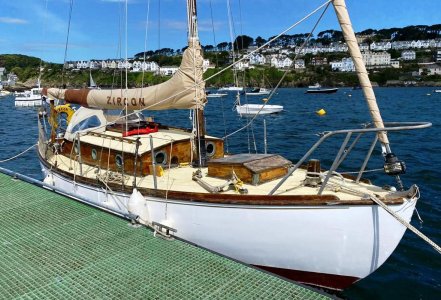

ZIRCON-June-2021.jpg

ZIRCON-FOWEY-CLASSICS.jpg
 
It will tell you. You will begin to see cracks through the paintwork at joints moving - and leaks - particularly where the planks are twisted to fit shape at bow and stern, and along ballast keel - the garboards - not necessarily a big problem, may just need local repair - but best though to get a local wooden boatyard or surveyor to have a look generally, for joints, timbers and any rot inside and out - and condition of fixings - and let you know if they are traditional oakum packed joints or glued timber splines - will be a professional job probably when the time comes, as it is a skill to get it right and can be big problems if you get it wrong. Looks good in the photos though. If there is no discernible movement, and no leaks, probably OK at the moment, but worth having it checked. Does it have a maintenance record of when and how it was last done? - Speak to the boatyard listed as having maintained it in the broker's advert - fairly local to you - or a local wooden boat owner.

Edit - if it has been out of the water for a while it may leak a bit when it is put back until it 'takes up'- hopefully - best to put it in a mud berth for a few days if one locally until leaking stops and have a good pump aboard - local boatyard will be familiar. Find out as much as you can about its construction and maintenance.

It appears the boat has some interesting history - indicates that the original owner was the editor of Yachting World then - when magazine editors had little boats - like Des Sleightholme (YM) and Denny Desoutter (PBO) later - your challenge is to keep it in the condition it is in the photos and win the Concours D'Elegance again for them all and have another feature in the magazines - good luck.
 
Last edited:
It will tell you. You will begin to see cracks through the paintwork at joints moving - and leaks - particularly where the planks are twisted to fit shape at bow and stern, and along ballast keel - the garboards - not necessarily a big problem, may just need local repair - but best though to get a local wooden boatyard or surveyor to have a look generally, for joints, timbers and any rot inside and out - and condition of fixings - and let you know if they are traditional oakum packed joints or glued timber splines - will be a professional job probably when the time comes, as it is a skill to get it right. Looks good in the photos though. If there is no discernible movement and no leaks probably OK at the moment but worth having it checked.
Thank you. That's reassuring. I will know more when she's launched in April, I guess. Very exciting. Sadly there's zero money in the pot for surveyors or professional help so it's fingers crossed for the time being.
 
Not much to add to Egret except to say that boats like that are best kept in the water (or mud) all year round. One of our club members had a sister ship which his family had owned from new and it was in the water all year except for 2 weeks out in the autumn or spring for antifoul. Repaint every 4 or 5 years. It is the drying early season winds that are likely to cause the seams to open up. So if you plan to haul out for the winter months an overall cover with skirts down the topsides will pay off in the long run. Good luck with the boat - it was a great design for its time but requires a different approach to modern boats. If you keep on top of maintenance and use covers the amount of work is really not much more than a modern boat, just a bit different.
 
Last edited:
Congratulations, she’s a lovely little boat. Do keep her wet, afloat or in mud as much as possible. Time ashore will encourage drying out and open up seams, and that might make repairs more urgent. I strongly, very very strongly advise you to invest in some sort of covers. The best you can manage but anything will help. The cost of good covers is repaid very quickly, in all the varnish stripping and refinishing that you will not have to do. And keep her well ventilated. Open hatches, companionway doors, under the covers. Lift cushions, open locker doors. You basically want something like a howling gale blowing through the boat.
 
Top