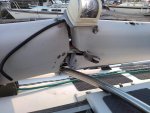
What’s an anti panting plate?

dedwards

Well-Known Member
Joined
12 Sep 2003
Messages
671
Location
Hampshire
Visit site
Hi,
when I got the mast dropped the rigger made a few recommendations for work for him to do to it. I however don’t understand this one. Can somebody explain if I need to worry about it?

“The cap, storm and anti-panting stainless steel backing plates are very old (1st generation) that are prone to cracking and are corroding the internal mast wall. We would advise removing, cleaning away the corrosion, then supply and fit 4th generation caste plates“

thanks
 
Panting as I understand the term is where the middle of the mast moves forward and backwards a small degree when under pressure. Panting I would think is controlled in the same way that the middle of the mast is supported by the rigging.
In a typical mast head rig the middle is supported fore and aft by intermediate stays that come from a chain plate aft of abeam the mast. (so pulling middle back) This pull is offset by an inner forestay pulling the middle forward or by 2 more intermediate side stays pulling mast middle forward.
In a typical fractional rig the intermediate side stays do the same job but are offset by spreaders that are swept backwards to meet the cap shrouds which have chain plate aft of abeam the mast. Thus the tips of the spreaders lean on the cap shrouds (stays) and push the middle of the mast forward. In this rig type the robustness of the spreaders especially in the aft angle is critical and takes a lot of bending load. Now I am guessing that you and the rigger are talking about this mounting of the spreaders.
Now I may be wrong about my guess as to what you and rigger are referring to but if it is this spreader base structure then I can only agree with rigger that it is very critical to mast integrity. (lost a mast on m y little boat through spreader failure to remain angled back) (mast crumpled middle backwards under load) ol'will
 
I think your rigger is talking about the fittings within the mast that take the load from the shroud terminals and spread that load on to the wall of the mast tube.

Should one of those fittings fail and sufficient force be applied, it's highly likely that the shroud terminal will pull through the mast tube, rather like a sardine can lid being opened, probably resulting in catastrophic failure of the mast.

The fittings are backing plates for the shrouds and anti panting stay (baby stay?), rather than anti panting plates.
 

Attachments

  • IMG_20201103_153507246.jpg
    IMG_20201103_153507246.jpg
    298.2 KB · Views: 15
Top