
Weight for anchor rode

coopec

N/A
Joined
23 Nov 2013
Messages
5,211
Visit site
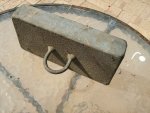
Yesterday I bought just about the last of my lead for ballast. In it was a rectangular lead weight with an attachment hook ( see photo).

I thought of melting it down but I wondered if it would be any use as a weight on an anchor rode? I suppose as it only weigs 10 lb the answer if "no"? (The yacht is 43 ft weighing 12 tonne)

IMG_2004 COMPRESSED.JPG
 
I'll have to read this article carefully but it appears to eloquently back your assertion.

Kellets or Anchor Angels / Sentinels: Uses and Applications
Other studies are available. Remember that if you read other articles on that site, the author is not entirely independent! I haven’t studied the whole site to see if he admits his connections.

I’ve just checked and he admits he’s the designer of the Rocna anchor.
 
Other studies are available. Remember that if you read other articles on that site, the author is not entirely independent! I haven’t studied the whole site to see if he admits his connections.

I’ve just checked and he admits he’s the designer of the Rocna anchor.

Excellent point. (I'll keep that in mind)
 
10lbs seems a little light but it depends on the circumstances.

I have a 25lb lead weight which I have occasionally used as a kellet. (More often I use it as a temporary anchor, or drudge, to hold the yacht's head to wind when extricating myself from a marina catway; a method described by John Goode in one of his excellent books)
 
I’d agree with others that except in light winds yacht anchor chain weight doesn’t help prevent shock loads or increase the horizontal angle of the anchor itself. The perfect rode would be fractionally heavier than water infinitely strong and chafe proof piano wire. So a chain size or two smaller than traditional and made of higher quality material is the best compromise.
 
I'll have to read this article carefully but it appears to eloquently back your assertion.

Kellets or Anchor Angels / Sentinels: Uses and Applications
In my experience, that's <redacted>
It's a strawman simplistic steady-state case, which will only be of relevance to yachts anchored in a lab where the water is perfectly flat and the wind is absolutely constant.

10lb is only going to be of use for sinking a rope in light airs though.
 
I understand that the latest thinking (backed up by research) is that anchor rode angels are of little or no use.
I agree with John.

One only needs to think it through to come to the correct conclusion that such an encumbrance on the chain/rode is only going to be called upon to do anything when the wind really gets up. Then think about the forces exerted by the same "got up" wind and limitations of weight of the kellet/angel are thrown into sharp focus.

A look down through a clear sea at the concrete blocks used for mooring buoys, even ones designed for smaller boats, begins to put things in perspective. However, please note that I'm not suggesting a direct equivalence. ;)

Richard
 
Waste of time, don't even think of it - its equivalent to a few metres of extra chain, say 5m of 8mm - you will not notice the difference except it will be a nuisance to deploy and retrieve.

You would be better off with a decent snubber.

Jonathan
 
Sir Tom gives you the full SP:


I agree with the others 10lb is not going to do much on your boat.

.
Agree! But I was thinking you'd need several to get any benefit and I wouldn't want to be lugging one 50 lb lump of lead around in a storm :D.

What an excellent presentation by Tom Cunliffe! Thanks
 
Last edited:
I was thinking the opposite, I' afraid, as I can't see a snubbing line on that chain. If there is not one, it's not surprising that he is having to resorting to a cumbersome weight.

Surely not having a snubber is poor seamanship?

Richard
I don't recall seeing a snubber used on most ships?

Having you boat behave badly at anchor is poor seamanship.
How you avoid that is up to you.
Maybe the better seaman has more tools in the box and an open mind?
 
Other studies are available. Remember that if you read other articles on that site, the author is not entirely independent! I haven’t studied the whole site to see if he admits his connections.

I’ve just checked and he admits he’s the designer of the Rocna anchor.
The article really put me off »upgrading» to a Rocna. The point of the rode is not to lower the angle of the line at extreme static load (1tonne in his example). It is to reduce the dynamic variation and peak load. A snubber does the same, just less. Clump weights are used on the moorIng lines of Windfloat Atlantic, same function. Still 10lbs not much, have been thinking of a 10-15 kg kettlebell.
 
Waste of time, don't even think of it - its equivalent to a few metres of extra chain, say 5m of 8mm - you will not notice the difference except it will be a nuisance to deploy and retrieve.

You would be better off with a decent snubber.

Jonathan

If you have all-chain rode, this^^. Just deploy a few more meters of chain and use a snubber. Practice and theroy agree that a kellet is basically useless and a lot more trouble.

However, if you have primarily fiber rode, a kellet has several uses:
  • Keeps rode from wrapping around the keel in wind-against -tide.
  • Makes the boat swing more like boats on all chain in light winds, which can make a big difference in a crowded harbor.
  • Reduces yawing in light to moderate winds.
  • Keeps the rode low during the initial set.
Note that with a fiber rode, shock absorption is not a factor.

Once the wind gets up it is not going to keep a fiber rode down like chain (check the maths--too light compared to 100-200 feet of chain). The only solution is long scope. That is one of the limitations of rope.

But, I would NEVER use a weight for that. I've learned that attaching a loop of old chain of the same weight (10 pounds or so is all we are talking about) is much easier to handle. Loop it twice to reduce the length, attch it with a prusik, and the will glide right over the rollers, no fuss at all. I've been doing this on my F-24 for several season for lunch stops, because it is easier even that rigging a bridle. I just leave it on the rope.
 
Last edited:
I don't recall seeing a snubber used on most ships?....

A ship is not a boat. The relative effects of wind and wave are much different, if you do the maths. An apple and a hand grenade are both round, but they are not at all the same, and so this is an argument ruined by the enormous difference in scale.

An open mind is good.
 
A ship is not a boat. The relative effects of wind and wave are much different, if you do the maths. An apple and a hand grenade are both round, but they are not at all the same, and so this is an argument ruined by the enormous difference in scale.

An open mind is good.
Indeed.
A ship will rarely anchor where waves cause it significant motion.
The waves are normally shorter than the ship.
Neither will it respond to little windshifts.
An oil rig OTOH is often a much more dynamic problem.
 
A ship is not a boat. The relative effects of wind and wave are much different, if you do the maths. An apple and a hand grenade are both round, but they are not at all the same, and so this is an argument ruined by the enormous difference in scale.
Indeed.
A ship will rarely anchor where waves cause it significant motion.
The waves are normally shorter than the ship.
Neither will it respond to little windshifts.
An oil rig OTOH is often a much more dynamic problem.

And an oil rig typically lays to 12 or so anchors in a spread pattern, with far less yawing. Obviously, that applications has been studied a LOT.
 
...

But, I would NEVER use a weight for that. I've learned that attaching a loop of old chain of the same weight (10 pounds or so is all we are talking about) is much easier to handle. Loop it twice to reduce the length, attch it with a prusik, and the will glide right over the rollers, no fuss at all. I've been doing this on my F-24 for several season for lunch stops, because it is easier even that rigging a bridle. I just leave it on the rope.
I find 10kg of dive weights tied to the rode simple enough to handle. Whatever is at hand.
 
Top