Weight distribution on a boat, i think ive got it wrong!?

matnoo

Well-Known Member
Joined
6 Jun 2006
Messages
171
Location
Solihull, W.mids
www.faceparty.com
What are the issues with weight distribution, I have several heavy items, outboard (i have a far out and a close in mounting option), two anchors two stonking great batteries, 4x 20litre water tanks and loads of kit. My boat has more than enough space, and most of the kit is entirely portable.

I have always thought that putting all of the weight equally at either end of the boat, forward and aft, would be the best, as would make the boat far more stable, the heavier weighted front and back would give each end more mass, and so would cut into waves better? ... but ive been frowned upon when told this by a salty old sea dog...

Im clearly not saying im right, as after being grimaced at, im now doubting my original layout!

Surely putting all the weight in the middle would just make the boat seesaw violently? Ie, it would just follow the angle of the surface of the water?

So where should the majority of the weight be placed!?

(I have a very ruggedly built 23ft/7m fin keeled GRP yacht)

Most confused, Mat
 
Salty sea dog right, you wrong.

Keep the weight low, and in the centre of the boat.

It's all about polar moments of inertia. Weight wants to keep on going (or maybe it's mass), so when the bow begins to drop, the weight of anchor and chain perched right up the front end wants to keep on dropping, accentuating the pitch. Same, though less marked, with an outboard hanging off the pushpit.

Take a look at a racing boat, and you'll see they make every effort to keep weight out of the ends of the boat (including, for the same reason, the masthead)
 
Hi Mat,
I think the salty old sea dog might be right! It is usually advisable to keep weight out of the ends. You want to keep heavy stuff in the middle and low down. Weight in the ends causes hobby-horsing particularly if the boat is quite pointy and doesn't have much reserve bouyancy at the bow and stern.
 
[ QUOTE ]
Weight wants to keep on going (or maybe it's mass), so when the bow begins to drop, the weight of anchor and chain perched right up the front end wants to keep on dropping, accentuating the pitch

[/ QUOTE ]
On the other hand, with weight at the ends, the inertia of the weight will make the boat less prone to start the pitch - so I never really understood this theory that is widespread among racers. Weight in the ends shouldn't make the boat pitch more - just a different pitch characteristic that might suit some wave patterns better than others.

n'est-ce pas?
 
The problem is called polar moment of inertia.

A boat is more sensitive to all inputs if the centre of mass is at the centre of the boat and the mass within the boat is as close to the centre of mass as may be reasonably acheived.

If you have lots of mass at the front it will dig into waves more making the boat wetter, if you have lots of mass at the stern it makes it more liable to pooping. Don't get me wrong there's lots of shades of grey but a boat will handle better and ride the waves more comfortably if the masses on board are as near to the centre as possible. . That's why racing boats have maximum backwards/forwards movements set for defined items such as anchors and you always see the foredeck crew running back to the middle at the slightest opportunity.

But remember rule one - The skipper is always right!
 
>Weight in the ends shouldn't make the boat pitch more<

Wrong, I'm afraid. A boat will start to pitch on almost any wave worth the name, so it's going to pitch come what may. What you you don't want it to do is pitch any more than necessary. Putting weight at the ends encourages it to keep bob-bob-bobbing along. Trust me, thousands of racers, optimised down to drilled out handles on the kettle, haven't got it wrong.
 
Go upwind in waves with the anchor and chain in its bow locker. turn down wind and shift the anchor and chain to the saloon sole.

Sail upwind again. You'll be surprised at the difference.
 
[ QUOTE ]

What are the issues with weight distribution, I have several heavy items, outboard (i have a far out and a close in mounting option), two anchors two stonking great batteries, 4x 20litre water tanks and loads of kit. My boat has more than enough space, and most of the kit is entirely portable.

I have always thought that putting all of the weight equally at either end of the boat, forward and aft, would be the best, as would make the boat far more stable, the heavier weighted front and back would give each end more mass, and so would cut into waves better? ... but ive been frowned upon when told this by a salty old sea dog...

Im clearly not saying im right, as after being grimaced at, im now doubting my original layout!

Surely putting all the weight in the middle would just make the boat seesaw violently? Ie, it would just follow the angle of the surface of the water?

So where should the majority of the weight be placed!?

(I have a very ruggedly built 23ft/7m fin keeled GRP yacht)

Most confused, Mat

[/ QUOTE ]

Here I will cross all borders !! First I would advise spreading out the weight to even the boat up. Then the weighty items should be as near centre as possible. Of course bow anchor and engine will necessary be at ends .......... but other stuff ... try and get it low and midships as possible.

The spreading out of weight will give an easy motion wherever possible.
Bring weight near to midships will assist as TK says to try prevent the "Rodeo-horse" style movement .... To those who think it doesn't happen ... the sea is far more powerful than your engine or boat ... it will pick up that bow or stern without any trouble at all and slam it down again ... having more weight there will increase that slam ... in fact other end will assist in making the "upward" more violent as well.

A good lesson to me was when I sailed on Ro-Ro ships with the all-forward accommodation ... UGH !! Prancing horse we called it ...
My boat has a heavy engine balanced by a concrete slab up fwd ... those two items make my boat pitch hard ... honest.
 
From your description you have an outboard on the transom. If at all possible this should be inboard as far as possible. For weight distribution reasons and also to minimise the prop out of the water when pitching.
From there it is priority to get the boat balanced fore and aft. You need to have a spirit level or have someone sail next to you in calm water to assess the balance with normal crew in the cockpit.
Move the heavy items forward as necessary to get a balance, but keep it as near the centrre as possible. But floating level is the priority. Hopefully with the transom just in the water but not dragging.
For my experience on a slightly smaller boat if the bow is too high it really slams and stops when hitting small waves (chop). It seems happier to have the bow slice into the wave rather than rise over it and drop onto it. So we do a crew forward when beating into waves. He becomes promoted to "water breaker" whose job it is to stop all the spray /water that comes over the bow before it gets to the skipper. (funny that is often me up front) olewill
 
Ever noticed a clock pendulum? It just keeps going and going ..... similar will happen with all the weight at either end of the boat and none in the middle .... unless you can shock absorb it ... now - how about some horizontal foils on that rudder then?! /forums/images/graemlins/laugh.gif
 
[ QUOTE ]
For my experience on a slightly smaller boat if the bow is too high it really slams and stops when hitting small waves (chop). It seems happier to have the bow slice into the wave rather than rise over it and drop onto it. So we do a crew forward when beating into waves. He becomes promoted to "water breaker" whose job it is to stop all the spray /water that comes over the bow before it gets to the skipper. (funny that is often me up front) olewill

[/ QUOTE ]

olewill,

I remember when sailing a Scorpion dinghy in my youth, it was important to get weight forwards when beating. Not sure why, but it worked, and the bows seemed to slice through the waves quite nicely.

I am wondering if this applies to 14 tonnes of Moody 44.... my father added a load of anchor cable at some point and said that she sailed much better to windward after adding it.
 
Heavy weights at the extremities will tend to accentuate the pitching effect, as inertia carries the bow deeper in, then further out on each wave. Keeping the weight amidships allows the hull to follow the waves - as someone said, it will pitch regardless of where the weight is.

------------------------------------------------------------------------
am wondering if this applies to 14 tonnes of Moody 44.... my father added a load of anchor cable at some point and said that she sailed much better to windward after adding it.

------------------------------------------------------------------------

More likely she was out of trim. The tendency in a cruising boat is to have all the gear down aft - engine, fuel, crew, bosuns locker dinghy outboard on the pushpit rail etc... so the boat is down by the stern from her normal marks.

I soon discovered my first boat - a 17ft Lysander - sailed much better ballasted up forward. No slamming, better to windward etc. Even the Seagull started better! (45 pulls instead of 150).

Trouble was she wanted to come back out into the cockpit......
 
A lighter pendulum swings for less time.

Comparing it to a clock is not quite right, becasue a clock pendulum is powered by, err, clockwork, or weights.

Tie a button to a piece of string and let it swing.
Now replace the button with a winch handle. See how much longer it keeps on swinging.
Now tie the winch handle near the top of the string. See how much less time it keeps on swinging.
 
Mat,

I think most of the posts so far have missed the point (ooops! standby for damnation! PM for any specific issues, since I'm off to Greece for a couple of weeks.)

The issue is comfort versus speed, and this is because the natural frequency of pitching is slower with weight at the ends of the boat, and quicker with weight in the middle of the boat.

As a side issue, whenever the pitching frequency is similar to the wavelength you're butting into, you'll hobby-horse like nobody's business, and life will be uncomfortable and slow (at that stage you'll wish you could shift all the gear to the centre, or vice versa, but it's probably better to tack!)

Excepting the side issue above, stuff in the centre (quick reactions to oncoming waves) is good for speed (you're not frequently burying the bow and adding to drag) but bad for old codgers who like a gentle ride and can accept a dose of salt water every now and again.

And vice versa. I loved the comfort of the old metre class submarines which had so much fore and aft inertia that they just ploughed through everything with little pitching reaction. In spite of their overhangs.

So, racing oriented chaps will tell you to keep it in the middle. And cruise oriented chaps may prefer the comfort of keeping things at the ends (you should see the paraphernalia overhanging the ends of many live-aboard boats!). And they'll all be convinced (if they've thought about it) that they're right.

The real answer is variable geometry of course, a big set of rails down below to shuffle the stuff in and out to seek the optimum pitching frequency for the waves you're encountering . . . now there's a project for you.
 
As a racing orientated chap ....

Weight low down and in the middle - assist the keel as much as possible and keep the boat upright - flatter boat = more comfort and more speed!

Upwind - weight forwards to lift the transom out of the water and reduce drag

Downwind - weight in the middle of the boat (bow out of the water to stop it burying into waves, stern out to prevent 'pooping') If it gets into surfing conditions, weight as far back as possible to stop the bow plowing into the next wave and stopping the boat.

Quote:
"now - how about some horizontal foils on that rudder then?! "

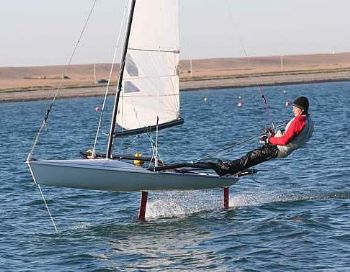
Then we get to the ultimate ... loose all the weight and put foils on the keel too:

2007rs600ff1.jpg


Used to have one of these (without foils though!) - very good fun!!
But seriously, foils on the rudder do stabalise the boat, but need to be trimmed carefully - the International 14's now have these. If they are trimmed too far down then the boat wants to nose dive when going downwind. If they are trimmed too high then the bow lifts when going upwind and the stern drags! On the 14's they have a tiller extension which twists to alter the angle of the foils - very technical but a great increase in both speed (via trim) and stability in big winds.

Jonny
 
i'd agree with that...

Some boats, most famously some of the older Nicholsons, would fill the water tanks in the bows for upwind work to prevent slamming, and aid progress to windward....

IMHO, there is no right answer here for a CRUISING boat, as you have to balance comfort against performance, as well as change it for different points of sail.....

A happy medium seems to me to be, keep the anchor and chain forward (its more hassle lugging it all back and forth than I can be bothered with), but avoid putting too much heavy stuff in aft and forepeak lockers.... keep things like spare anchors, chain etc nice and low down, and towards the centre as possible, but don't get too obsessed by any of it!
 
[ QUOTE ]
A lighter pendulum swings for less time.

Comparing it to a clock is not quite right, becasue a clock pendulum is powered by, err, clockwork, or weights.

Tie a button to a piece of string and let it swing.
Now replace the button with a winch handle. See how much longer it keeps on swinging.
Now tie the winch handle near the top of the string. See how much less time it keeps on swinging.

[/ QUOTE ]

Thanks Ken, that's the point I was hinting at.
 
Took a Mobo across the channel with too much weight up foreward, she was a bugger to stear. Moved some weight to midships and got hold of some bagged swarf that we secured aft and it was a different boat.
 
Top