
VP2030-D not electrical isolated?!

Bagarn86

New Member
Joined
15 Jun 2022
Messages
5
Visit site
Hi,

I have a VP2030D with reverse gear and straight axle. Had the reverse gear removed to change the rear crankshaft seal earlier this year and after that refitted the flywheel housing etc with a new plastic gasket between the housing and engine block to isolate them. However now during the season I noticed the anode on the propeller shaft and propeller seems to wear very quickly so decided to measure between the engine block and flywheel housing with a multimeter/summer and it seems they are connected anyway! I get a clear tone on the summer when the multimeter when measuring with the probes on the reverse gear and engine block.

When I fitted the plastic gasket and ring (no 28 and 29 in the pic) I applied a small amount of grease on the flywheel housing surface to keep the plastic seal in place when fitting the housing back, could it be that somehow connects the engine block and reverse gear? Dont really know if this is the proper way to measure it though, anyone have any insight and/or tips?
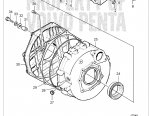
7A522924-0676-433F-AF31-A54575319B08.jpeg
 
Many people would use an ohms range to check the isolation of the gear box but if you get a tone when using the continuity setting it does tell you that the engine and gear box are connected electrically

The insulating washers #32 and insulating bushes #31 are part of the gearbox isolation . Are you sure they are all correctly fitted ?

With a shaft drive isolation of the gearbox is not necessary. It is only relevant when a sail drive is fitted .
 
Many people would use an ohms range to check the isolation of the gear box but if you get a tone when using the continuity setting it does tell you that the engine and gear box are connected electrically

The insulating washers #32 and insulating bushes #31 are part of the gearbox isolation . Are you sure they are all correctly fitted ?

With a shaft drive isolation of the gearbox is not necessary. It is only relevant when a sail drive is fitted .
I think I managed to fit them correctly as well, as far as I know at least. But something apparently seems to be connecting them together.
Oh they don’t need to be isolated on a shaft drive? How come? :)
 
I think I managed to fit them correctly as well, as far as I know at least. But something apparently seems to be connecting them together.
Oh they don’t need to be isolated on a shaft drive? How come? :)
It was a measure introduced to reduce the risk of corrosion of sail drive legs. One former forum member lost the entire sd leg on an engine not isolated (MD22) due to an electrical fault. However not all manufacturers follow VP's practice. (if any ?)
 
It was a measure introduced to reduce the risk of corrosion of sail drive legs. One former forum member lost the entire sd leg on an engine not isolated (MD22) due to an electrical fault. However not all manufacturers follow VP's practice. (if any ?)
I understand that the electrical isolation was also to protect the bearings in the box? Any voltage generated by seawater, SS and yellow metal props OR generated by using the block as common ground from house systems etccould seek seawater path through the bearings?
 
Don't think your anode depletion is anything to do with the engine isolation or otherwise. They are there to protect the yellow metal of the prop from the stainless shaft which is why they are fitted close to the prop.
 
Don't think your anode depletion is anything to do with the engine isolation or otherwise. They are there to protect the yellow metal of the prop from the stainless shaft which is why they are fitted close to the prop.
As an aside, one of the previous owners of my boat put a household yellow and green from the mains incoming earth to the engine block and then another from the gearbox to a pear anode. Basically my boat was the anode for the pontoon. The anode didnt last long and when i twiggedwhat was going on I removed it, putting it back to basic Beneteau and negative isolated MD22
 
What else is it wired to? presumably located so that it is to protect the prop and bonded from the engine via the prop shaft coupling. If it is not depleting and your prop is not dezincifying then it is probably not doing anything.
 
Don't think your anode depletion is anything to do with the engine isolation or otherwise. They are there to protect the yellow metal of the prop from the stainless shaft which is why they are fitted close to the prop.
Ok! In this case it’s kind of hard to know what’s what really, because I changed to an anode in magnesium this year compared to other years when I’ve used zinc. At the same time I did the removal of the reverse gear, so again hard to know what’s what.

Magnesium anodes are supposed to work in fresh water (lakes) but also reasonably well in brackish water (Baltic sea). Usually we have the boat in fresh water but this year we decided to have it in the Baltic after the boat was in the water. I think the go to choice for brackish water is aluminum so could just be the magnesium depletes too quickly in this water.

Boat will not be lifted until end of September and hard to know right now if the anodes will survive until then. Is it necessary to lift the boat earlier just to change the anode?
 
If it is not depleting and your prop is not dezincifying then it is probably not doing anything.
Yes, that was my point. Beneteau didn't seem to realise that the isolation of the gearbox. MaxProp is protected by it's anode, and there is a ring anode which protects the exposed bit of tube and cutter parts.
 
Agree many "experts" have a a very hazy understanding of the subject. However even if the gearbox was not isolated the anode would probably not do anything as the prop anode depletes first and the engine/box is not connected to the stern tube anyway! You might want to remove it, or use it as a ground for your shorepower if you do not have a ground already. That only became compulsory in the (I think) 2011 revisions to the RCD. Many builders use an anode for a ground, just as I am doing in my new installation.
 
Agree many "experts" have a a very hazy understanding of the subject. However even if the gearbox was not isolated the anode would probably not do anything as the prop anode depletes first and the engine/box is not connected to the stern tube anyway! You might want to remove it, or use it as a ground for your shorepower if you do not have a ground already. That only became compulsory in the (I think) 2011 revisions to the RCD. Many builders use an anode for a ground, just as I am doing in my new installation.
?
 
Top