
Volvo Penta MD2030-D Faulty Injection Pump?

Bloomer

New Member
Joined
4 Jan 2019
Messages
3
Visit site
Hi All- We've been having an issue with our Volvo Penta MD2030-D for months now and can't seem to trace down the source of the problem to fix it. We ran the motor at 2K RPM for about 8 hours when suddenly the RPMs dropped and started going up and down, then the engine would die. Bled the lines, problem persisted. The engine seems to run well at a steady idle, if we don't touch the throttle, especially when the engine is cold. As soon as we add power and then reduce power, she drops RPMs and dies. If we run at low idle, she dips her RPMs and runs rough every few minutes then has a sudden surge again and goes back up. Lower the throttle, she dies. There is no white smoke or black smoke and water is coming out the back nicely.

We have:
-checked the pickup tube on the tank, checked the fuel quality (it is very clean), ran the engine with the pickup tube and return line in a bucket of diesel (note that there are some bubbles in the return line). This eliminates the tank itself or the vent being an issue...
-replaced all fuel system hoses and fittings
-replaced stock shut-off valve with a new one
-changed the primary Volvo filter 3 times
-changed the secondary (Racor) filter 3 times, then eventually replaced it with an entirely new unit as we found a small leak)
-replaced the fuel lift pump
-cleaned and serviced all injectors
-replaced one injector that was leaking despite being serviced
-replaced all delivery tubes
-replaced return line (as it got a crack from muddling with it)
-checked mixing elbow for clog, it was not clogged. Cleaned it and re-installed it.
-removed and cleaned heat exchanger (hey why not while it's all apart!?)
-changed coolant (it was very dirty)

If we run the engine with an electric pump in place between the tank and the secondary (Racor) filter, it still has the above described issues, but not as bad. It runs better and does not completely die although it still sounds like it is hunting for fuel as the RPMs surge. We are going to do some more testing but we are suspecting the injector pump to perhaps be the issue. We understand from speaking to several Volvo mechanics that they've never seen one fail and they've never even sold one, but hey- there is a first time for everything, right? Our next step will be to pinch the return line a bit to try to push some fuel pressure backwards and see if she runs better, assuming she is not getting enough fuel consistently. Beating our heads against the wall here and hoping for some other opinions! Cheers in advance.
 
Maybe your fuel shutoff solenoid is playing up I think you can unscrew it from the pump to override the system to stop the engine use the small sprung lever on top of the timing cover or blank off the air intake. The solenoid has to be energised to allow fuel to flow.
I see you have renewed it ( back to the drawingboard) Could still remove it and eliminate any wiring fault.
 
Last edited:
Maybe your fuel shutoff solenoid is playing up I think you can unscrew it from the pump to override the system to stop the engine use the small sprung lever on top of the timing cover or blank off the air intake. The solenoid has to be energised to allow fuel to flow.
I see you have renewed it ( back to the drawingboard) Could still remove it and eliminate any wiring fault.

I don't think the 2030 has a fuel solenoid, you pull a lever to stop it.
 
If we run the engine with an electric pump in place between the tank and the secondary (Racor) filter, it still has the above described issues, but not as bad. It runs better and does not completely die although it still sounds like it is hunting for fuel as the RPMs surge. We are going to do some more testing but we are suspecting the injector pump to perhaps be the issue. We understand from speaking to several Volvo mechanics that they've never seen one fail and they've never even sold one, but hey- there is a first time for everything, right? Our next step will be to pinch the return line a bit to try to push some fuel pressure backwards and see if she runs better, assuming she is not getting enough fuel consistently. Beating our heads against the wall here and hoping for some other opinions! Cheers in advance.

Gosh, that's all very annoying. How old is the engine (year and engine hours)? Replacing the fuel injection pump is very costly, so I'd see it as a last resort.

The symptoms you've described do sound rather like fuel starvation or air in the fuel. You mention air bubbles in the return fuel - is this still happening? It's intriguing that the symptoms are less pronounced with an electric pump in place. Could there be a tiny air leak somewhere?

If all else fails, I'd reckon that getting a skilled VP engineer to look at the governor mechanism might be worthwhile prior to replacing the injection pump. Although I'm happy to tackle DIY repairs on almost any engine bits, I have to confess that governor issues would always make me get a "proper man" in to investigate!

Don't lose heart, it's basically a very simple engine and is eminently fixable, once you know the cause.

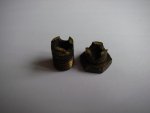
On my last boat, I had a 2003T engine which developed starting/running problems suggesting an air leak. Like you, I investigated everything. Then, the second or third time I checked the fuel tank pickup pipe, the banjo bolt felt funny as I was tightening it, then the head snapped off! Turned out the banjo bolt had cracked sufficiently to allow air to get in past the copper washers. New banjo bolt, problem solved!

IMGP1049.jpg
 
Forget the injector pump for now, it's probably something much simpler and cheaper. I've dealt with a number of poor running issues with diesel engines on yachts, plant and cars. I've had apparently very intractable issues such as: a blob of goo in the fuel tank, air drawn in fuel pipework due to banjo washers, pin-holes in pipework, flakes of paint in a fuel tank, valves that weren't operating properly, filters blocked up with whatever the haze was in the fuel (very tricky that one), water in the fuel tank, non function stop solenoid. etc etc. I would say before the OP does anything, use a vacuum pump on the last low pressure fuel line connection to the injector pump, suck fuel through and see what happens. The nuclear option would be to clean the tank out and renew all the fuel pipework, fittings and filter assemblies.
 
I don't think the 2030 has a fuel solenoid, you pull a lever to stop it.

The OP says he replaced the fuel shut off valve I think this is a solenoid that shuts off at the fuel pump and operates via a relay so if you remove the solenoid it eliminates any wiring / relay fault but once removed the engine wont stop when you switch off the key and it is not advisable to switch off the ignition with the engine running hence using the spring lever on the timing cover this will stop the engine before turning off the ignition.
 
The OP says he replaced the fuel shut off valve I think this is a solenoid that shuts off at the fuel pump and operates via a relay so if you remove the solenoid it eliminates any wiring / relay fault but once removed the engine wont stop when you switch off the key and it is not advisable to switch off the ignition with the engine running hence using the spring lever on the timing cover this will stop the engine before turning off the ignition.

PVB is right. The MD 2010/20/30/40 series engines have a mechanical "pull to stop" control ....... see the owners manual on VP's website https://www.volvopenta.com/marineleisure/en-en/for-owners/your-engine/manuals---handbooks.html
 
PVB is right. The MD 2010/20/30/40 series engines have a mechanical "pull to stop" control ....... see the owners manual on VP's website https://www.volvopenta.com/marineleisure/en-en/for-owners/your-engine/manuals---handbooks.html

Plus one. The valve he is referring to is probably the ball valve from the tank. I had an Ask the Experts question from USA a while back. He had been led down the path of fuel pump/governor. Springs in the governor changed etc etc. The “injector pump” on these engines is not as we usually see. More a series of pistons running off the camshaftinside a housing.
Turned out to be an air leak. Interesting that an electric pump goes some way to alleviating the situation. I am not impressed by the OEM lift pump. I would be checking from the stack pipe all the way along the fuel line. I have been caught out in my youth by blocked stack pipe gauze filters or pipes themselves.
 
Hi All- We've been having an issue with our Volvo Penta MD2030-D for months now and can't seem to trace down the source of the problem to fix it. We ran the motor at 2K RPM for about 8 hours when suddenly the RPMs dropped and started going up and down, then the engine would die. Bled the lines, problem persisted. The engine seems to run well at a steady idle, if we don't touch the throttle, especially when the engine is cold. As soon as we add power and then reduce power, she drops RPMs and dies. If we run at low idle, she dips her RPMs and runs rough every few minutes then has a sudden surge again and goes back up. Lower the throttle, she dies. There is no white smoke or black smoke and water is coming out the back nicely.

We have:
-checked the pickup tube on the tank, checked the fuel quality (it is very clean), ran the engine with the pickup tube and return line in a bucket of diesel (note that there are some bubbles in the return line). This eliminates the tank itself or the vent being an issue...
-replaced all fuel system hoses and fittings
-replaced stock shut-off valve with a new one
-changed the primary Volvo filter 3 times
-changed the secondary (Racor) filter 3 times, then eventually replaced it with an entirely new unit as we found a small leak)
-replaced the fuel lift pump
-cleaned and serviced all injectors
-replaced one injector that was leaking despite being serviced
-replaced all delivery tubes
-replaced return line (as it got a crack from muddling with it)
-checked mixing elbow for clog, it was not clogged. Cleaned it and re-installed it.
-removed and cleaned heat exchanger (hey why not while it's all apart!?)
-changed coolant (it was very dirty)

If we run the engine with an electric pump in place between the tank and the secondary (Racor) filter, it still has the above described issues, but not as bad. It runs better and does not completely die although it still sounds like it is hunting for fuel as the RPMs surge. We are going to do some more testing but we are suspecting the injector pump to perhaps be the issue. We understand from speaking to several Volvo mechanics that they've never seen one fail and they've never even sold one, but hey- there is a first time for everything, right? Our next step will be to pinch the return line a bit to try to push some fuel pressure backwards and see if she runs better, assuming she is not getting enough fuel consistently. Beating our heads against the wall here and hoping for some other opinions! Cheers in advance.
Hi All- We've been having an issue with our Volvo Penta MD2030-D for months now and can't seem to trace down the source of the problem to fix it. We ran the motor at 2K RPM for about 8 hours when suddenly the RPMs dropped and started going up and down, then the engine would die. Bled the lines, problem persisted. The engine seems to run well at a steady idle, if we don't touch the throttle, especially when the engine is cold. As soon as we add power and then reduce power, she drops RPMs and dies. If we run at low idle, she dips her RPMs and runs rough every few minutes then has a sudden surge again and goes back up. Lower the throttle, she dies. There is no white smoke or black smoke and water is coming out the back nicely.

We have:
-checked the pickup tube on the tank, checked the fuel quality (it is very clean), ran the engine with the pickup tube and return line in a bucket of diesel (note that there are some bubbles in the return line). This eliminates the tank itself or the vent being an issue...
-replaced all fuel system hoses and fittings
-replaced stock shut-off valve with a new one
-changed the primary Volvo filter 3 times
-changed the secondary (Racor) filter 3 times, then eventually replaced it with an entirely new unit as we found a small leak)
-replaced the fuel lift pump
-cleaned and serviced all injectors
-replaced one injector that was leaking despite being serviced
-replaced all delivery tubes
-replaced return line (as it got a crack from muddling with it)
-checked mixing elbow for clog, it was not clogged. Cleaned it and re-installed it.
-removed and cleaned heat exchanger (hey why not while it's all apart!?)
-changed coolant (it was very dirty)

If we run the engine with an electric pump in place between the tank and the secondary (Racor) filter, it still has the above described issues, but not as bad. It runs better and does not completely die although it still sounds like it is hunting for fuel as the RPMs surge. We are going to do some more testing but we are suspecting the injector pump to perhaps be the issue. We understand from speaking to several Volvo mechanics that they've never seen one fail and they've never even sold one, but hey- there is a first time for everything, right? Our next step will be to pinch the return line a bit to try to push some fuel pressure backwards and see if she runs better, assuming she is not getting enough fuel consistently. Beating our heads against the wall here and hoping for some other opinions! Cheers in advance.
Hi- Did you solve this issue? Would be great for an update or resolution. Many thanks.
 
Top