
Volvo penta 852741 steering actuator

rich.wheat

New Member
Joined
9 Nov 2022
Messages
2
Visit site
Hello, can anyone give me advice or guidance on my Volvo penta AQ205A steering actuator, when the helm wheel is turned port or starboard the sleeve/tube where the steering cable passes through and secured by the nut on the left side of the actuator moves about 15mm either way, resulting in the rudder not moving in synq with the helm (lagging behind) I'm looking for either an exploded parts diagram of this actuator or if someone can advice me how this sleeve is secured within the actuator so when the helm is turned either way the rudder responds immediately. Thanking you in anticipation.
Rich. WheatIMG_20221109_201647.jpg
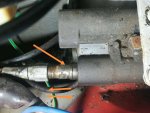
 
Hi,
Is this a new boat to you ?
Generally speaking with cable you will always have like 1-2cm both sides on the steering wheel before the rudder is applied. The longer the cable is the worse it gets. With hydraulic steering this is not an issue.
I have the same set up like you and I changed the cable to a new one some time ago - It helped the issue a little but did not fix it.
 
Hi,
Is this a new boat to you ?
Generally speaking with cable you will always have like 1-2cm both sides on the steering wheel before the rudder is applied. The longer the cable is the worse it gets. With hydraulic steering this is not an issue.
I have the same set up like you and I changed the cable to a new one some time ago - It helped the issue a little but did not fix it.
Thank you for replying, do you know what holds the sleeve in place within the hydrolic unit, Im thinking now if this is normal I'll place a jubilee clip over the left & right ends of the sleeve. Not sure where I'd get a replacement steering cable from. Yes it's a recently purchased river boat - Fairline Sprint and seems I've got lots of problems to sort before the summer. The alternator isn't charging the batteries, the the hydrolic pump squeals and stalls when the helm is turned so I've got my work cut out but one step at a time and it will get resolved.
 
Hi. I had the same engine in a Sealine 218. The squeal is fairy common. Can be sorted by adjusting the set up of the belt and pump position. There is or should be a spacer behind the pump assembly. Check it’s still in place. Bit of perseverance and you’ll get there. Notorious for it.
I’d also say that some slack is taken up at the hydraulics, when it’s running…also very likely it’s your steering bush that’s worn at the actual outdrive itself.
 
Hi Rich. Did you ever find an answer to the quesitojn of the movement? I have exactly the same problem. There's ledd movement when the engine is running but still enough to cause steering lag.
Thanks, Bernie
 
I too would like an answer to this thread I've been scratching my head regarding how the actuator actually works ..
Given that the steering cable passes right through the actuator and appears to bypass it completely I've come to the conclusion that the steering cable pulls and pushes the actuator by tugging on the nut where the cable joins to the actuator ... what you might consider the "steering part" of the cable is simply bracing against the tiller arm and its actually the cable outer sleeve that pulls and pushes the actuator valve ... hence Rich Wheats 15mm of play ... I suspect it's not "play" it's the actuator valve that triggers the ram.

Therefore if Rich Wheat were to halt this "play" with Jubilee clips he'd stop his power steering working

I'd love to know if I'm right about this.

Also it seems dumb that the powered ram pushes and pulls much further down the tiller arm thus wasting a pile of that "power" steering with weak leverage... wouldn't it work better upside down ?
 
That is how these actuators work, there is a floating section that the outer cable connects to. So it reacts against the inber cable pushing on the steering arm, the floating action opens a valve to direct the fluid to one side or the other of the cylinder, so its designed to have this free play. I would make sure the outer cable is screwed fully tight, there are two flats on the tube on the other side of the valve housing so you can hold the tube while tightening the cable nut, these flats must be positioned vertically when the cable nut is tight.
 
Thanks "Spannerman" for confirming my theory
The final phrase "these flats must be positioned vertically when the cable nut is tight" is interesting ... "vertical" that's the spanner approaching from the top then ... and what would happen if this were not the case ?

I'm chasing down a steering stiffness which at first I thought insignificant due to the fact that my turning of the wheel moves two outdrives also turns the flybridge wheel and spins the autohelm worm and screw (in clutch disengaged mode) so a lot to be done ... and I can steer with one finger (but it has to be a strong finger) however the autohelm frequently "stalls" presumably because its working too hard and whilst both outdrives can be easily rocked slightly side to side from outside the boat from the inside the port side tiller arm is almost impossible to move when unhitched from the steering bar.

I'm starting with the cheap suff first checking out all the cables then I'll sort a regime of lubing and working the steering yokes in the hope that a complex and expensive outdrive removal can be avoided.

Or do you think one (strong) finger steering is about right

Thanks
 
Yes considering how much machinery is in motion, there is a grease nipple on top of the steering arm which usually gets forgotten, the movement on the drives is typical Volvo slack. I don’t know the reason for the position of the flats, but it is in the workshop manual that it must be, so its probably to do with the orientation of the shuttle valve, and yes its with the spanner coming from the top.
 
Top