Volvo penta 2030 flexible coupling removal

Ok thanks for your time and information. Ill have to measure my cylinders.

Yesterday i was able to pull out the flexible coupling by using the gearbox to break the sticktion.

I also have questions regarding the removal of the crankshaft. The manual says ill have to be playing around with the injection pump and timing gears which makes me a bit nervous. What are your tips/recommendations with this.

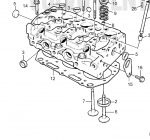
Also i took out the valves from the cylinder head and realized that one of the exhaust valves seats its really damaged. I tried to find a seat online in "parts4engines" but couldn't find any.

Thanks again.
 
Ok thanks for your time and information. Ill have to measure my cylinders.
Yesterday i was able to pull out the flexible coupling by using the gearbox to break the sticktion.
I also have questions regarding the removal of the crankshaft. The manual says ill have to be playing around with the injection pump and timing gears which makes me a bit nervous. What are your tips/recommendations with this.

Also i took out the valves from the cylinder head and realized that one of the exhaust valves seats its really damaged. I tried to find a seat online in "parts4engines" but couldn't find any.

Thanks again.

The parts list only shows separate seats for the inlet valves ........ surprising ? .... and they are NLA!

.
 
Hi VicS. I just realized, thank you. My question is: how do i repair the exhaust valve seat. Is buying a new cylinder head the only solution?.

Cheers.
 

Attachments

  • cylinder head.PNG
    cylinder head.PNG
    109.3 KB · Views: 11
  • valve seat.PNG
    valve seat.PNG
    19.3 KB · Views: 12
Hi VicS. I just realized, thank you. My question is: how do i repair the exhaust valve seat. Is buying a new cylinder head the only solution?.

Cheers.

I would contact a local repair shop that deals with agricultural and or Motor vehicle engine rebuilds and ask if they have the facilities to cut recesses in the valve pocket and fit an insert. They should have no problem finding a suitable insert.

A local Google search should help and the machine shop should be able to find suitable inserts.

If your exhaust seat isn.t too badly damaged it may be possible to recover a good seat by machining and not need an insert. The repair shop can advise on this..
 
I measured the cylinders for wear, out of round etc, and all was within suggested tolerance, so I just honed them to deglaze them.

I have another question regarding dismantling the crankshaft. The manual is a bit confusing and i wonder if you had to lift the injection pump in order to remove the timing gear casing.

Thanks.
 
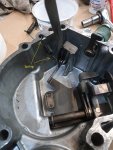
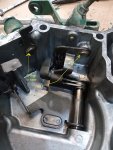
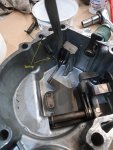
This is perhaps the trickiest part of assembly of the engine. The casing over the regulation levers (I wouldn't call it a timing cover, as it doesn't set the timing) connects to the fuel injection pump by a slide linkage. There's an umbrella shaped plastic cam that alters the setting. And there's 2 tiny little springs inside the casing. I can't remember if the injection pump MUST be removed to get the casing off. There's 2 O rings in the casing well worth changing if you have it off, they seal the two shafts controlling throttle and fuel cutoff.
I removed the fuel pump anyway, and had that refurbed along with the injectors. Was worth doing.
IMG_20220117_131953_750b.jpg IMG_20220117_132004_741b.jpg
 

Attachments

  • IMG_20220117_131953_750b.jpg
    IMG_20220117_131953_750b.jpg
    374.5 KB · Views: 2
Hi all

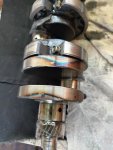
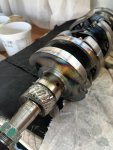
I finally was able to remove the crankshaft. Did check on it and found some blueing marks and some dark spots on one of the counterweights. Suprisingly enough corresponds with the only cylinder which looks glazed and the valve seat and valve are damaged. I think it could be some kind of overheating that happen maybe to due of lack of lubrication or something.
What are your suggestions?. Do you think the crankshaft may have to be machined with this kind of damage?

Also, those o-rings you installed. Did you use normal black o-rings or the fuel/oil resistant ones?

Cheers.
 

Attachments

  • 20221120_145146.jpg
    20221120_145146.jpg
    391.3 KB · Views: 13
  • 20221120_145201.jpg
    20221120_145201.jpg
    406.9 KB · Views: 12
I cannot see how that heating has been caused by operation of the engine. The heating is on the OD of the counterweights with no sign in your photos that the journals have heated. Looks like the two areas have been heated by a flame to over 300 degrees C. No explanation.
 
I cannot see how that heating has been caused by operation of the engine. The heating is on the OD of the counterweights with no sign in your photos that the journals have heated. Looks like the two areas have been heated by a flame to over 300 degrees C. No explanation.


It is very strange to have such heat staining on a large lump of steel, I would suggest that there is something queer about this engine and as I said, replace it rather than spend lots of money effecting any repairs which could well be a waste.
Is there any history with this engine?
 
Top