Volvo Penta 2003T Exhaust Elbow / Manifold Removal

aussi

Well-Known Member
Joined
1 Sep 2005
Messages
176
Location
Shropshire, boat in Conwy
www.eboatcards.com
Hi all,

After seeing the state of the exhaust elbow on a friend's boat this afternoon (OMG!), I thought it sensible to check mine. I have a Volvo Penta 2003T (turbo) and surprisingly neither the workshop manual nor user manual describe how to remove this. I've read a load of posts on the Internet but they all seem to describe removal of the elbow on the non-turbo model - i.e. "Remove 4 bolts and the elbow comes off easily". As far as I can see, the turbo model doesn't have 4 bolts to remove, instead there are two bolts attaching the raw water feed from the heat exchanger and there is a V-clamp attaching the elbow to the turbo. The exploded diagram shows this clearly and the photos below show my engine.
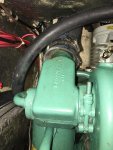
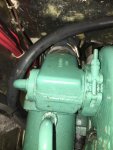
IMG_5382.jpg IMG_3860.jpg IMG_0778.jpg

I have a couple of questions: Firstly, is removal of the elbow a matter of removing the V-clamp and the two bolts? Secondly, is there anything I need to be careful or aware of when doing this? Finally, I realise I will need replacement gaskets before I start, so will I need 1 x 840902, 1 x 859112 and 1 x 949657, or is it worth getting 1 x 418411 too, in case I disturb the connection to the heat exchanger?

Sorry if this has been covered in another post, but I did quite a bit of searching without finding anything. Please point me there if so!
 
Unless there are symptoms which suggest to you that it's getting blocked, I'd suggest you leave it alone. My old 2003T was 24 years old when I sold the boat, had about 2500 hours on the engine, and I'd never had the exhaust elbow off.
 
Unless there are symptoms which suggest to you that it's getting blocked, I'd suggest you leave it alone. My old 2003T was 24 years old when I sold the boat, had about 2500 hours on the engine, and I'd never had the exhaust elbow off.
That was my thinking up to now as you don't hear a lot of stories of problems with Volvo elbows. I just got a bit worried when I saw the state of the one that came off my friends boat (not a Volvo), so thought I would ask the question. Thanks for the confidence boost.
 
Heads up! If you have the Volvo heat exchanger etc make sure you have a supply of their rubber gland, gasket, filler things for when you put it all back together.

Oh! Deja-vu.

Was a bit fed up with the water out of the exhaust being a bit half hearted. Then the engine boiled just as we left Dover for Scotland!

Diversion to Eastbourne, everything else working well. Reluctantly took the elbow off. 4 bolts as the illustration in the Volvo parts book. Wack with an encouraging stick and it came off. Probably the first time in the 30 years life of the engine.

Heaven knows how the water was getting through. Seemingly completely blocked up. Poked about a bit and found a lot of nasty looking solid crap blocking up all sorts of water paths. It was only the fact that it was slightly softer than the metal that really gave the clue to it being there.
Poked a bit more and realised that sitting on the pontoon this was not going to get fixed.

Internet and spare elbow and gaskets ordered for delivery following day.
Poked a bit more and then I could see daylight through the elbow - what was that dreadful black stuff. Must be something pretty unpleasant.

Anyway, new elbow fitted, loads of water coming out the exhaust and the heat exchanger is getting the chance to do what it is there for.

Think it will merit an inspection - put it on the list for the next winterising.
 
Was a bit fed up with the water out of the exhaust being a bit half hearted. Then the engine boiled just as we left Dover for Scotland!

Diversion to Eastbourne, everything else working well. Reluctantly took the elbow off. 4 bolts as the illustration in the Volvo parts book. Wack with an encouraging stick and it came off. Probably the first time in the 30 years life of the engine.

If your elbow was fixed with 4 bolts, then you don't have the same engine as the OP. The elbow on the 2003T is a much better design, incorporating a liner which the exhaust gas goes through, and is less prone to problems.
 
That was my thinking up to now as you don't hear a lot of stories of problems with Volvo elbows. I just got a bit worried when I saw the state of the one that came off my friends boat (not a Volvo), so thought I would ask the question. Thanks for the confidence boost.
Volvos suffer from blocked elbows much as others do. It depends on the useage. Ive had a look at the spare parts diag and it would appear that all you have to do is undo the single bolt on the clamp, undo the two bolts on the water injection pipe and the jubilee clips on the rubber exhaust. If yo do do it take great care, the cast iron bits go like cheese! Its to do with the sea water dissolving the iron in the cast iron and leaving the carbon behind to hold the shape!
Stu
 
Volvos suffer from blocked elbows much as others do. It depends on the useage. Ive had a look at the spare parts diag and it would appear that all you have to do is undo the single bolt on the clamp, undo the two bolts on the water injection pipe and the jubilee clips on the rubber exhaust. If yo do do it take great care, the cast iron bits go like cheese! Its to do with the sea water dissolving the iron in the cast iron and leaving the carbon behind to hold the shape!
Stu

You don't seem to have read pvbs post above.

The turbo engine (as is very clear from the photos) does not have the same design of exhaust as the non turbo engine and is not as prone to corrosion or bunging up.
 
Can't comment on the Turbo type , but I remove mine each year and give it a quick clean , ever since I had problem some years back and ended up having to buy an expenses part .
 
Ive had a look at the spare parts diag and it would appear that all you have to do is undo the single bolt on the clamp, undo the two bolts on the water injection pipe and the jubilee clips on the rubber exhaust.
That's my interpretation too, hopefully someone who has done this successfully can confirm that it really is that simple.

The turbo engine (as is very clear from the photos) does not have the same design of exhaust as the non turbo engine and is not as prone to corrosion or bunging up.
It's totally crazy that a boat would have a turbo in the first place, but I'm stuck with it. It does seem that in the case of Volvo, this means there is actually one advantage of having the turbo version.
 
It's totally crazy that a boat would have a turbo in the first place, but I'm stuck with it. It does seem that in the case of Volvo, this means there is actually one advantage of having the turbo version.

Volvo Penta fitted the turbo to the 2003 in response to requests from boatbuilders for a higher power version. The 2003T was fitted in lots of Scandinavian boats. I had one in my old Hallberg-Rassy, and it was a willing and reliable performer over the 19 years I owned the boat.

Don't know how long you've had your boat, but from my experience with the 2003T, there are two potential reliability issues which are worth checking. Firstly, the alloy oil cooler is prone to corrosion; if it corrodes right through, the engine empties its sump into the bilge, with major consequences. The oil cooler is tucked away under the heat exchanger, but can be inspected with torch, mirror and contortion. The second potential issue is the external steel pipe which takes high pressure oil to the turbo; if this corrodes, pinhole leaks can develop which will empty the sump and, well, you know the rest. Again, worth looking carefully at this pipe.
 
You don't seem to have read pvbs post above.

The turbo engine (as is very clear from the photos) does not have the same design of exhaust as the non turbo engine and is not as prone to corrosion or bunging up.

I did read it, it describes one person useage, my post was quite specific, "it depends on useage". I referred to Volvo engines in general because of another comment by someone who said VP engines havent been reported as blocking up. Well they do. The turbo one in question has a similar design to all others, a water injection pipe in to a waterjacket that keeps the outer "elbow" outlet cool and also spreads the injection equally in to the actual exhaust. It has just as much chance of getting blocked as other elbows with the same design features. Salt water injected in to hot gas, (in the case of a turbo, running hotter than a NA engine) can cause salt crystals to form and if the engine isnt used hard the possibility of carbon building up with the salt crystals to form blockages. As it happens the paint on the turbo looks as if the engine hasnt been used hard, make out what you can from that.
Stu
 
Volvo Penta fitted the turbo to the 2003 in response to requests from boatbuilders for a higher power version. The 2003T was fitted in lots of Scandinavian boats. I had one in my old Hallberg-Rassy, and it was a willing and reliable performer over the 19 years I owned the boat.

Don't know how long you've had your boat
It's a 1989 Malo (also Scandinavian) and I've owned it for 5 years.

but from my experience with the 2003T, there are two potential reliability issues which are worth checking. Firstly, the alloy oil cooler is prone to corrosion; if it corrodes right through, the engine empties its sump into the bilge, with major consequences. The oil cooler is tucked away under the heat exchanger, but can be inspected with torch, mirror and contortion.
I had raw water flow issues early on so had an an engineer look at it (I was less confident working on the engine myself back then too). That resulted in a new oil cooler and a complete clean of the heat exchanger. The state of the oil cooler was worryingly bad, so you are dead right with your caution - anyone else reading this with the same engine, I agree with pvb - check this unit.

Did you ever remove your elbow when you owned your 2003T?

The second potential issue is the external steel pipe which takes high pressure oil to the turbo; if this corrodes, pinhole leaks can develop which will empty the sump and, well, you know the rest. Again, worth looking carefully at this pipe.
Thank you for the heads up on that one too - really useful - I'll check that pipe carefully the next time I'm on board.

Salt water injected in to hot gas, (in the case of a turbo, running hotter than a NA engine) can cause salt crystals to form and if the engine isnt used hard the possibility of carbon building up with the salt crystals to form blockages. As it happens the paint on the turbo looks as if the engine hasnt been used hard, make out what you can from that.
It only has 1100 engine hours on the clock so if that is truthful then it's a little used engine for its age. Which makes me concerned about the salt buildup you describe, and now even keener to get the thing off to take a look!

Thank you all for replying by the way - this kind of assistance and advice is invaluable.
 
Did you ever remove your elbow when you owned your 2003T?

Not once. As I posted earlier, if there are no symptoms, why bother? There's enough to do on a boat with essential maintenance, so no need for non-essential work.
 
Last edited:
Not once. As I posted earlier, if there are no symptoms, why bother? There's enough to do on a boat with essential maintenance, so no need for non-essential work.

Ain't that the truth! :(

I removed both my Yanmar elbows for the first time after 3500 hours because one was leaking a bit at the infamous "dodgy" weld. Whilst they were off I Milliputted round the weld on both of them to give me a few more years. I don't regret taking them off as they were both a nightmare to release from the exhaust hose and that has now been silicone greased so they will be very easy to remove in future and all the studs and the gasket were copper-greased so they will also be easy to remove next time ..... but would I ever remove them again unless there were specific "blocked-elbow" symptoms ..... definitely no as both were absolutely as clean as a whistle internally. :)

Richard
 
Standard Yanmar mixer elbows are notorious for dribbling water into the exhaust from the weld and corroding the head. By the time you find the problem with the elbow it's often too late to save the head. I have regularly found it necessary to clean my (bronze) high level mixer and replaced the Cast Iron elbow/manifold it sits on three times due to corrosion of the threads. Checking isn't hard and worth the expenditure of a gasket, even at Yanmar's inflated prices.
 
Ain't that the truth! :(

I removed both my Yanmar elbows for the first time after 3500 hours because one was leaking a bit at the infamous "dodgy" weld. Whilst they were off I Milliputted round the weld on both of them to give me a few more years. I don't regret taking them off as they were both a nightmare to release from the exhaust hose and that has now been silicone greased so they will be very easy to remove in future and all the studs and the gasket were copper-greased so they will also be easy to remove next time ..... but would I ever remove them again unless there were specific "blocked-elbow" symptoms ..... definitely no as both were absolutely as clean as a whistle internally. :)

Richard

I was an apprentice with the National Coal Board. What ever you think if it as a nationalised industry, their apprenticeship system was secind to nine. We got involved with the latest thinking at the time which was turning our maintenance systems over to PPM, planned preventative maintenance. So instead of waiting for things to break we took them apart and inspected them for wear and built up a knowledge base as to what was going on. Things have moved on since then with maintanance and aircraft especially are subject to PPM in a much more technical way. To say if it aint broke dont fix it is going back to the days when stuff fell out of the skies. We all know on here from the hundreds of posts that exhaust elbows/raw water injection points do get blocked with a mixture of salt and carbon and the more knowledgeable ones of us know that the hot salt water injected does corrode the cast iron and weaken it substantially. There was a report kicking around about how it does it, with the seawater dissolving the iron and leaving a framework of carbon behind that looks as if it is solid but when poked with a screwy, it crumbles. If someone has concerns about their exhaust and it has done quite a few hours, and it is easy to take off, as the OPs is, then I would not hesitate to say take it off for an inspection as part of a reasonable PPM schedule!
Stu
 
Top