Volvo MD7A Rebuild and Cooling System Questions

damonlm

New Member
Joined
30 May 2019
Messages
1
Visit site
In November 2018 I purchased a 1984 Dufour 2800 that was fitted with the original Volvo MD7A. This has been running absolutely fine, albeit with a little white smoke under moderate to hard throttle. A couple of weeks ago on a trip out, I noticed significant more smoke and a lot less water flow than I’m used to seeing. I have very little mechanical experience so turned to the internet and forums for suggestions. The impellor was checked and all looked fine. I read on lots of sites how the water channels through the exhaust manifold get clocked up so I set about removing this to inspect further. To my amazement, 2 of the 3 water channels were completely blocked with the third more than 50% restricted. Having read a very detailed blog about someone flushing one of these engines, I purchased some Rydlyme Marine descaler, various hoses and a submersible pump. A bucket of the Rydlyme solution was then pumped through the tube from the inlet seacock; I bypassed the water pump with some flexi house and plugged the bypass hole within the thermostat housing to make sure the solution went around the engine. I had to modify the existing thermostat to do this and replaced it in the housing to get a watertight seal. The return to the bucket came from the top of the exhaust block. I ran the solution both ways around the engine for 2 hours each way. The results were amazing.

Ironically, once refitting a new thermostat and reconnecting the relevant pipes. Very little water was still coming out of the exhaust. It turned out to be a blocked water inlet seacock. This was an easy fix and considering 2.5 of the 3 channels were blocked in the exhaust block, I consider the flush a good job to have still done.

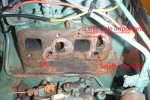
One of my questions is does anyone know what and where the 3 holes in the exhaust block go / do and what the function of the 2 inlet pipes into the block do? One is via a T piece underneath the block and the other through the various routes in the thermostat housing cover.

My second question is what advice would people give if rebuilding one of these engines. I’ve just managed to pick up another MD7A that I’ve seen running. My plan was to strip it completely and rebuild it. Partly for fun and to learn what’s actually in there and secondly to have a ‘good’ engine ready should anything ever happen to the one currently fitted. What tests and tolerances would people recommend I check both before and during the strip / rebuild and how might these results affect my actions. I’ve read things such as compression checks, reseating valves, skimming heads, reboring and cylinders rehoned but don’t know if these are things you should do anyway or only if some tolerance is out etc. Any general advice with this would be greatly appreciated.

Many thanks,

Damon

showthread.php
 
In November 2018 I purchased a 1984 Dufour 2800 that was fitted with the original Volvo MD7A.

]One of my questions is does anyone know what and where the 3 holes in the exhaust block go / do and what the function of the 2 inlet pipes into the block do? One is via a T piece underneath the block and the other through the various routes in the thermostat housing cover.

My second question is what advice would people give if rebuilding one of these engines.

Damon

[http://www.marineengine.com/boat-fo...lvo-MD7A-Rebuild-and-Cooling-System-Questions

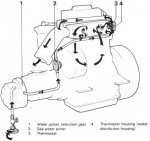
When the engine is cold, and the thermostat is closed, water flows along the pipe under the exhaust manifold to the thermostat housing. It then flows through the bypass passage in the thermostat housing and on to the exhaust outlet elbow, via the anti-siphon device if fitted.

When the engine is hot , and the thermostat is open, water also flows into the manifold water inlet passages from the tee piece and the thermostat housing then via the ports you have ringed in red into the cylinder head. Hot water leaves the head via the roughly triangular port to the back side of the thermostat.
The hot water flow, controlled by the thermostat, then mixes with the bypass flow and flows then to the exhaust elbow.

( in some engines, but not it appears in this case, the open thermostat closes off the bypass)

Dont spend shed loads of money on an old engine like this. Parts generally are expensive and many are no longer available. Keep it going with second had parts etc while you can but put any serious money towards a modern replacement such as a Beta
 
In November 2018 I purchased a 1984 Dufour 2800 that was fitted with the original Volvo MD7A. This has been running absolutely fine, albeit with a little white smoke under moderate to hard throttle. A couple of weeks ago on a trip out, I noticed significant more smoke and a lot less water flow than I’m used to seeing. I have very little mechanical experience so turned to the internet and forums for suggestions. The impellor was checked and all looked fine. I read on lots of sites how the water channels through the exhaust manifold get clocked up so I set about removing this to inspect further. To my amazement, 2 of the 3 water channels were completely blocked with the third more than 50% restricted. Having read a very detailed blog about someone flushing one of these engines, I purchased some Rydlyme Marine descaler, various hoses and a submersible pump. A bucket of the Rydlyme solution was then pumped through the tube from the inlet seacock; I bypassed the water pump with some flexi house and plugged the bypass hole within the thermostat housing to make sure the solution went around the engine. I had to modify the existing thermostat to do this and replaced it in the housing to get a watertight seal. The return to the bucket came from the top of the exhaust block. I ran the solution both ways around the engine for 2 hours each way. The results were amazing.

Ironically, once refitting a new thermostat and reconnecting the relevant pipes. Very little water was still coming out of the exhaust. It turned out to be a blocked water inlet seacock. This was an easy fix and considering 2.5 of the 3 channels were blocked in the exhaust block, I consider the flush a good job to have still done.

One of my questions is does anyone know what and where the 3 holes in the exhaust block go / do and what the function of the 2 inlet pipes into the block do? One is via a T piece underneath the block and the other through the various routes in the thermostat housing cover.

My second question is what advice would people give if rebuilding one of these engines. I’ve just managed to pick up another MD7A that I’ve seen running. My plan was to strip it completely and rebuild it. Partly for fun and to learn what’s actually in there and secondly to have a ‘good’ engine ready should anything ever happen to the one currently fitted. What tests and tolerances would people recommend I check both before and during the strip / rebuild and how might these results affect my actions. I’ve read things such as compression checks, reseating valves, skimming heads, reboring and cylinders rehoned but don’t know if these are things you should do anyway or only if some tolerance is out etc. Any general advice with this would be greatly appreciated.

Many thanks,

Damon

showthread.php
I too have a MD 7a motor and have just cleaned out the exhaust manifold and thermostat housing and exhaust elbow with HCl acid. I am now attempting to clean the motor ports.
I am also interested in how the system works - which way the water flows etc. I found a diagram but this is very unclear as to whether the arrows are entering or leaving the thermostat or the motor?? I think when the engine is cold the central hole into the thermostat housing is open and thus the water can go straight though this and out over the top to the exhaust elbow. When its hot the thermostat spring tightens and the rod pushes against the central hole closing the route over top to the E elbow thus the water is forced around the motor via various routes. My question is how does the water now get out through the exhaust pipe since the pin is shutting the hole off? Can the water get down beside the pin (from the cavity where the spring side of the thermostat fits) into the other side and thus out of the exhaust?
Volvo Penta MD7A Water flow diagram.jpg
 
My problem is how to clean the hole where the water goes into the motor from the thermostat housing once the motor gets hot? This hole is blocked? Can I brush acid on? to try and unblock the hole? The hole from the T inlet port seems to be OK so maybe this would be enough for the water to circulate the motor? Engine (Exhaust manifold removed) showing salt build up.jpg
 
I have a question is the port above the main inlet on the thermostat housing blocked off on the exhaust manifold side ? Thanks for any help
 
I have a question is the port above the main inlet on the thermostat housing blocked off on the exhaust manifold side ? Thanks for any help
Yes.......Do not drill out. It is only drilled out if operating with fresh water cooling when the engine is fresh water cooled via a sea water cooler.

Beware, do not drill the bypass hole under the to thermostat housing as this will reduce the sea water flow through the engine.
 
Thanks for the quick response,the previous owner of the boat opened that hole, I made a plug and sealed it up hopefully test sail next week.
 
I have had 14 years of a partially clogged up cooling channels in a MD7A on my Sigma 33. The best I ever got running was about twenty minutes on low revs. On warm days less!

I have had to learn to pretty much sail to the marina or anchorage and last gasp drop the sails start the engine and berth/pick up mooring before it overheats.

If you can get it cooling/running for longer then great. I would say that your choice is get it running and hope it is better than twenty minutes or get a new engine!

I am looking to get a new engine this year as I have had enough of trying to keep the engine cool! Taking 8 hours to get from Toward to Inverkip in flat calm conditions with an engine that overheats and needs half an hour to cool down is not fun! That sealed it's fate.
 
Top